
Average Bathroom Remodel ROI (DFW vs National Benchmarks)
When people ask whether a bathroom remodel is “worth it,” they’re usually asking a very specific question:
If I spend $X, how much of that do I get back when I sell?
That’s what return on investment (ROI) measures. In remodeling, ROI is calculated as:
- (Added home value ÷ Remodel cost) × 100
But here’s the nuance most homeowners miss: bathroom ROI is not just about dollars returned. It’s also about how quickly your home sells, how competitive it feels, and whether buyers even consider it in the first place.
National Bathroom Remodel ROI Averages
Across the U.S., bathroom remodel ROI has been studied extensively through industry reports like the annual Remodeling Cost vs Value Report, which tracks resale value recovered from common renovations.
Here’s what the data consistently shows:
| Remodel Type | Average Cost (U.S.) | Value Added | ROI % |
|---|---|---|---|
| Minor bathroom remodel | $20,000 – $30,000 | $13,000 – $22,000 | 60% – 75% |
| Mid-range remodel | $30,000 – $50,000 | $18,000 – $32,000 | 55% – 70% |
| Upscale remodel | $60,000 – $100,000+ | $30,000 – $60,000 | 45% – 60% |
Two patterns stand out immediately:
- Smaller, cosmetic upgrades tend to deliver the highest ROI
- Luxury remodels almost always return a lower percentage
That doesn’t mean upscale remodels are a bad decision. It just means they are often lifestyle upgrades first, financial investments second.
How DFW Compares to National Averages
The Dallas-Fort Worth market behaves slightly differently from national averages, and understanding why is key.
DFW is one of the fastest-growing metro areas in the country, with strong population growth and housing demand confirmed by data from the U.S. Census Bureau. That demand supports resale values, which can help homeowners recover more of their remodel cost.
At the same time, there are two forces working against ROI:
- Higher labor costs due to contractor demand
- Higher baseline home prices, which change how buyers perceive value
So what does that mean in practice?
| Remodel Type | National ROI | Estimated DFW ROI |
|---|---|---|
| Minor remodel | 60% – 75% | 65% – 80% |
| Mid-range remodel | 55% – 70% | 60% – 75% |
| Upscale remodel | 45% – 60% | 50% – 65% |
DFW often slightly outperforms national ROI percentages, but only when the remodel aligns with what buyers expect in that price range.
Why Bathroom ROI Is So Consistent
Bathrooms are one of the few remodeling categories that consistently return strong value. That’s not an accident.
According to the National Association of Realtors Remodeling Impact Report, bathroom upgrades rank among the top projects for buyer appeal and resale recovery.
There are three reasons for this:
1. Bathrooms are high-frequency spaces
Buyers don’t “occasionally” use a bathroom. They use it every single day. That makes flaws more noticeable and upgrades more valuable.
2. Bathrooms signal overall home condition
An outdated bathroom makes buyers assume other parts of the home are outdated too. A clean, modern bathroom does the opposite.
3. Bathrooms are expensive to renovate
Buyers know remodeling is costly and disruptive. If it’s already done, they’re willing to pay a premium to avoid it.
A renovated bathroom doesn’t just add value – it removes objections.
The Hidden ROI Most People Ignore
There’s another layer to ROI that doesn’t show up in percentages:
- Faster time on market
- Stronger buyer competition
- Higher perceived home quality
A home with outdated bathrooms may sit longer or require price reductions. A home with updated bathrooms often sells faster and closer to asking price.
That means even if your “paper ROI” is 65%, your real-world financial outcome can be significantly better.
The Core Insight
If you take nothing else from this section, take this:
- Bathroom remodels usually return 55%–75% of their cost
- DFW tends to sit on the higher end of that range
- The highest ROI comes from mid-range, buyer-friendly upgrades – not luxury overhauls
Everything else in this article builds on that foundation.
Because the real question isn’t just how much you’ll get back.
It’s what kind of remodel actually gets you there.
Which Bathroom Upgrades Add the Most Value
Not all bathroom upgrades are created equal.
Some changes instantly increase perceived home value and buyer appeal. Others barely register, even if they cost thousands. The difference comes down to one thing:
Does the upgrade make the bathroom feel newer, cleaner, and more functional at first glance?
The highest ROI upgrades consistently check all three boxes.
The Highest-Value Bathroom Upgrades (Ranked by Impact)
According to the National Association of Realtors Remodeling Impact Report, buyers place the most value on improvements that are immediately visible and widely appealing.
Here’s how the most impactful upgrades typically break down in DFW and similar markets:
| Upgrade | Typical Cost (DFW) | Buyer Impact | ROI Potential |
|---|---|---|---|
| Walk-in shower upgrade | $4,000 – $12,000 | Very High | 70% – 85% |
| Vanity replacement | $800 – $4,000 | High | 65% – 80% |
| New tile (floor or shower) | $2,000 – $10,000 | High | 60% – 75% |
| Countertop upgrade (quartz/granite) | $1,000 – $3,500 | Medium-High | 60% – 70% |
| Lighting upgrades | $200 – $1,500 | Medium | 55% – 70% |
| Fixtures (faucets, hardware) | $150 – $1,000 | Medium | 50% – 65% |
What stands out is that none of the highest-ROI upgrades are purely luxury. They are all practical, visible improvements that buyers immediately understand.
Walk-In Showers: The Single Highest-Impact Upgrade
If there’s one upgrade that consistently drives value in DFW, it’s converting a dated tub or shower combo into a modern walk-in shower.
This shift is backed by broader housing preference data from the U.S. Census Bureau’s American Housing Survey, which shows increasing demand for updated, accessible bathroom layouts.
Why this upgrade performs so well:
- Makes the bathroom feel larger
- Signals a modern, updated home
- Improves usability for a wide range of buyers
- Eliminates one of the most common buyer objections
A dated tub doesn’t just look old – it makes the entire home feel older.
In many DFW homes, especially those built in the early 2000s, replacing the original tub/shower combo is one of the fastest ways to increase perceived value.
Vanity Upgrades: Storage + Visual Impact
Vanities sit at eye level. That alone makes them one of the most important elements in the bathroom.
Upgrading a vanity delivers value because it combines:
- Function (storage, usability)
- Aesthetics (style, materials, finishes)
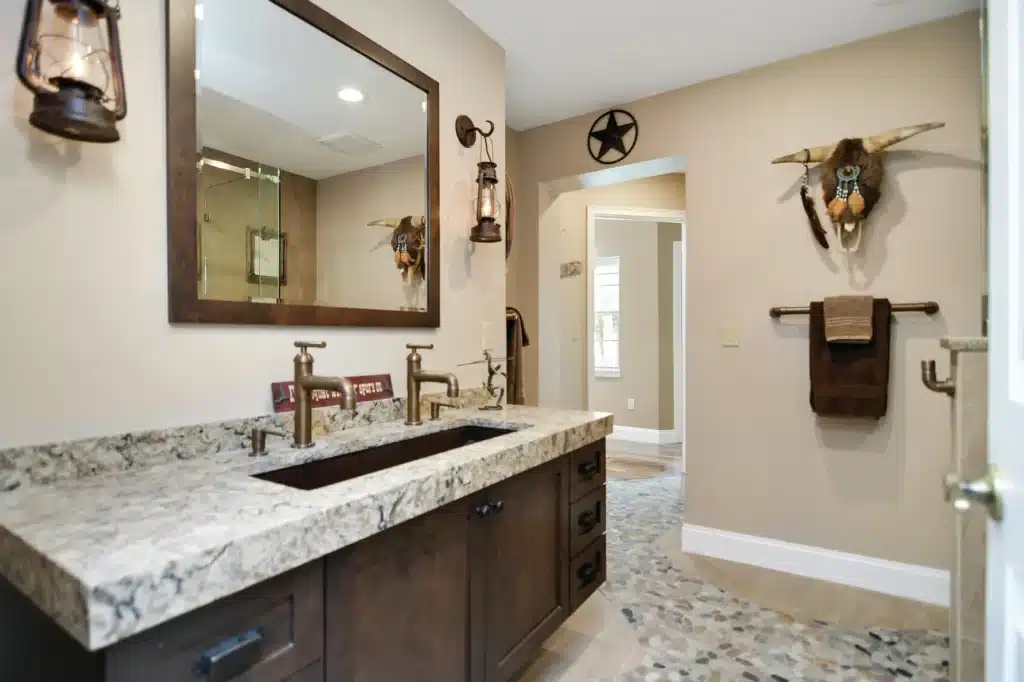
Even a simple swap from a builder-grade vanity to a modern unit with soft-close drawers and a stone countertop can dramatically change how the space feels.
According to design trend data from the National Kitchen & Bath Association, storage and organization are among the top priorities for homeowners and buyers alike.
Tile: Where Most of the Visual Value Lives
Tile is often the single largest visual surface in a bathroom. That makes it one of the most powerful upgrades – but only when done correctly.
High-value tile upgrades typically involve:
- Larger format tiles (cleaner, fewer grout lines)
- Neutral tones (white, beige, light gray)
- Full-height shower tile instead of partial surrounds
These choices align with broader housing market insights from Zillow Research, which consistently shows that neutral, modern finishes help homes sell faster and for higher prices.
The key is restraint. Tile should feel clean and timeless, not bold or experimental.
Countertops: Small Cost, Disproportionate Impact
Bathroom countertops are relatively small compared to kitchens, which creates a unique opportunity:
You can upgrade to higher-end materials without dramatically increasing total cost.
Switching from laminate to quartz or granite:
- Instantly elevates the space
- Signals durability and quality
- Matches buyer expectations in mid-range and higher-end homes
Because the surface area is limited, this upgrade often delivers one of the best “visual impact per dollar” returns.
Lighting: The Most Underrated Upgrade
Lighting rarely gets attention, but it directly affects how everything else looks.
Better lighting:
- Makes the bathroom feel brighter and cleaner
- Improves mirror visibility (important for daily use)
- Enhances listing photos (which drives buyer interest)
The U.S. Department of Energy highlights how modern LED lighting improves both efficiency and brightness in residential spaces through resources like Energy Saver.
Even a $300–$800 lighting upgrade can make a bathroom feel significantly more updated.
Why These Upgrades Work (And Others Don’t)
All high-ROI bathroom upgrades share the same characteristics:
- Immediately visible – buyers notice them instantly
- Universally appealing – no explanation required
- Functionally better – not just aesthetic
They pass what you can think of as the “5-second test”:
If a buyer walks in and understands the upgrade in under 5 seconds, it adds value.
If they don’t notice it, don’t understand it, or don’t care about it, the ROI drops fast.
The Core Insight
If you’re optimizing for ROI, your goal is not to build the “best” bathroom.
It’s to build the most widely appealing version of a modern bathroom.
That means:
- Clean over complex
- Neutral over bold
- Functional over flashy
Because in the end, buyers don’t pay for effort.
They pay for what they instantly recognize as better.

Which Bathroom Upgrades Don’t Pay Off
If high-ROI upgrades are about clarity and broad appeal, low-ROI upgrades fail for the exact opposite reason:
They cost a lot – but buyers either don’t notice, don’t care, or actively dislike them.
This is where many homeowners unintentionally destroy their return.
The Most Common Low-ROI Bathroom Upgrades
Industry data from sources like Zillow Research and valuation insights from the Appraisal Institute consistently show that over-improvement is one of the biggest drivers of poor ROI.
Here are the upgrades that most often underperform:
| Upgrade | Typical Cost | Why It Underperforms | ROI Risk |
|---|---|---|---|
| Luxury materials (marble, imported tile) | $10,000 – $30,000+ | Buyers don’t fully value premium cost | High |
| Highly customized designs | Varies widely | Limits buyer appeal | High |
| Major layout changes (plumbing moves) | $3,000 – $15,000+ | Hidden cost, low visibility | High |
| Overbuilding vs neighborhood | Varies | Price ceiling caps value | Very High |
| Smart/tech-heavy features | $1,000 – $10,000 | Not universally valued | Medium-High |
The pattern is simple:
- The more personal, complex, or invisible the upgrade is, the worse the ROI becomes.
Over-Customization: The Silent ROI Killer
One of the most common mistakes is designing a bathroom for yourself instead of for the market.
That can look like:
- Bold tile patterns
- Unusual color palettes
- Ultra-modern or ultra-traditional styling
- Niche layouts or features
While these choices may feel high-end or unique, they often reduce buyer interest.
Housing market behavior tracked by Freddie Mac research shows that buyers consistently prefer move-in-ready homes with neutral finishes, because they don’t want to take on additional renovation work after purchase.
The more a buyer thinks “I would change this,” the less they’re willing to pay.
In other words, customization creates friction. And friction reduces value.
Luxury Overspend: When Price Outruns Perception
There’s a critical difference between quality and luxury overspend.
Upgrading from laminate to quartz? High ROI.
Upgrading from quartz to imported marble slab with custom fabrication? Often not.
Why?
Because buyers don’t evaluate bathrooms based on cost. They evaluate them based on perception.
A buyer might see:
- Quartz → “Nice, updated bathroom”
- Marble slab → “Nice bathroom”
The perception barely changes, even though the cost may have doubled or tripled.
According to cost-value comparisons from the National Association of Home Builders, diminishing returns are common once materials exceed the standard expected for the home’s price range.
Layout Changes and Plumbing Relocation
Moving plumbing is one of the fastest ways to increase remodeling costs – and one of the worst ways to increase ROI.
Common examples:
- Moving a toilet
- Relocating a shower
- Expanding into adjacent space
These changes often cost thousands due to:
- Opening floors and walls
- Reworking drain lines and supply lines
- Additional labor and inspection requirements
The problem is that buyers rarely notice where plumbing used to be.
All they see is the final layout.
Data from the U.S. Department of Housing and Urban Development highlights that structural and mechanical changes tend to have lower perceived value than visible surface improvements, even when they are more expensive.
If an upgrade is hidden behind the walls, buyers don’t pay for it.
Overbuilding Beyond the Neighborhood
Every home exists within a price ceiling set by its neighborhood.
If you install a $60,000 luxury bathroom in a neighborhood where homes typically sell at mid-range price points, you are unlikely to recover that investment.
This is one of the most consistent findings across appraisal practices and housing studies, including valuation principles outlined by the Appraisal Foundation.
Why this happens:
- Buyers compare your home to nearby alternatives
- They expect a certain level of finish – not significantly above it
- Anything beyond that becomes “extra,” not “value”
In simple terms:
- A mid-range bathroom in a mid-range home = expected
- A luxury bathroom in a mid-range home = partially ignored
Tech and Smart Features: Cool, But Not Valuable
Smart mirrors, integrated speakers, digital shower systems, and app-controlled lighting are becoming more common.
But from an ROI perspective, they’re unreliable.
Why?
- Not all buyers value technology equally
- Some buyers see it as complexity or maintenance risk
- Features can become outdated quickly
While smart home trends are growing, adoption data from the Consumer Technology Association shows that demand is still uneven across demographics.
That makes these upgrades more of a personal convenience than a resale driver.
The Core Pattern Behind Low ROI
All poor-ROI upgrades share at least one of these traits:
- Too expensive relative to perceived value
- Too personalized to appeal broadly
- Too hidden for buyers to notice
If an upgrade fails even one of those tests, ROI starts to drop.
If it fails all three, ROI collapses.
The Core Insight
You don’t lose money on bathroom remodels because you spent too little.
You lose money because you spent in the wrong places.
- Overspending on materials buyers don’t value
- Customizing beyond what the market wants
- Investing in complexity instead of clarity
Because in real estate, value isn’t determined by what something costs.
It’s determined by what the next buyer is willing to pay for it.

Buyer Psychology in the DFW Market
Bathroom ROI is not just about construction. It’s about perception.
You’re not selling tile, vanities, or fixtures. You’re selling a feeling.
And in DFW, that feeling is surprisingly consistent across price ranges.
What Buyers Actually Notice (And What They Ignore)
Most buyers make a decision about a bathroom within seconds. Not minutes. Seconds.
This behavior aligns with broader housing research from the National Association of Realtors, which shows that buyers form strong impressions almost immediately during home tours and rely heavily on visual cues.
Here’s how buyer attention typically breaks down:
| Bathroom Feature | Buyer Attention Level | Impact on Decision |
|---|---|---|
| Cleanliness / condition | Extremely High | Critical |
| Shower/tub appearance | Very High | Major |
| Vanity + countertop | High | Significant |
| Lighting brightness | Medium-High | Noticeable |
| Tile detail (pattern/type) | Medium | Secondary |
| Plumbing layout | Very Low | Minimal |
This explains why visible upgrades outperform structural ones.
Buyers don’t evaluate bathrooms like contractors. They evaluate them like snapshots.
If something looks new, clean, and functional, it passes.
If it looks dated, worn, or confusing, it fails.
The “Move-In Ready” Standard in DFW
DFW buyers have a strong bias toward homes that feel finished.
That’s not unique to Texas, but it’s amplified here due to market conditions. Rapid population growth and steady housing demand, tracked by the U.S. Census Bureau, mean buyers often have multiple options.
When comparing similar homes, buyers consistently choose:
- The one that feels updated
- The one that requires the least work
- The one that looks easiest to live in immediately
This creates a powerful dynamic:
- A slightly more expensive home with a modern bathroom often beats a cheaper home with an outdated one
Because buyers mentally factor in the cost, time, and stress of remodeling.
The “Buyer Test” That Determines Value
In practical terms, every bathroom upgrade gets filtered through a simple mental test:
- Does this feel new?
- Does this feel clean?
- Would I need to change anything?
If the answer to the third question is “yes,” value drops.
Research from Zillow housing trends consistently shows that homes described as “updated” or “renovated” sell faster and often at higher prices than comparable homes that require work.
The goal is not to impress buyers. It’s to remove reasons for hesitation.
What DFW Buyers Specifically Expect in Bathrooms
While buyer psychology is broadly consistent nationwide, certain expectations show up repeatedly in the DFW market:
| Feature | Buyer Expectation Level |
|---|---|
| Walk-in shower (primary bath) | Expected in mid-high homes |
| Double vanity | Expected in primary bathrooms |
| Neutral color palette | Strong preference |
| Bright lighting | Expected |
| Updated fixtures | Expected |
| Tub + shower combo (secondary baths) | Acceptable |
These expectations are shaped by both regional home styles and broader housing trends. Data from the American Housing Survey shows increasing preference for modern layouts and functional bathroom design across U.S. households.
What’s important is not just having these features – it’s having them in a way that feels current.
Why Neutral Always Wins
One of the most misunderstood aspects of bathroom ROI is color and style.
Homeowners often assume that bold design adds personality and value. In reality, it often does the opposite.
Neutral design works because:
- It appeals to the widest range of buyers
- It photographs better in listings
- It makes spaces feel larger and cleaner
- It avoids triggering “I need to redo this” reactions
According to market behavior insights from the Federal Housing Finance Agency, buyer decisions are heavily influenced by perceived condition and ease of transition into the home.
Bold design increases uncertainty. Neutral design reduces it.
The Emotional Layer of Bathroom Value
Bathrooms are not purely functional spaces.
They are tied to:
- Daily routines
- Comfort
- Privacy
- Cleanliness
That makes them emotionally loaded for buyers.
A dated or poorly designed bathroom creates discomfort. A clean, modern one creates relief.
Buyers don’t just think, “This looks nice.”
They think, “I wouldn’t have to deal with this.”
That emotional response directly impacts willingness to pay.
The Core Insight
Bathroom ROI is not driven by cost. It’s driven by perception.
In the DFW market, the winning formula is simple:
- Make it feel new
- Make it feel clean
- Make it feel easy
Everything else is secondary.
Because buyers don’t pay for what you built.
They pay for how it makes them feel the moment they walk in.

Cheap vs Expensive Bathroom Remodel ROI Comparison
One of the biggest misconceptions in remodeling is this:
Spending more does not mean you make more.
In fact, the opposite is usually true.
Bathroom remodel ROI follows a predictable curve where returns peak in the mid-range and decline at the high end. Understanding this is the difference between a smart investment and an expensive mistake.
The Three Remodel Tiers (And How They Perform)
Bathroom remodels typically fall into three clear pricing tiers:
| Remodel Tier | Typical Cost (DFW) | Scope | ROI Range |
|---|---|---|---|
| Budget / Cosmetic | $5,000 – $12,000 | Surface updates, fixtures, paint | 70% – 90% |
| Mid-Range Remodel | $15,000 – $35,000 | New vanity, tile, shower upgrades | 60% – 75% |
| High-End / Luxury | $50,000 – $90,000+ | Custom everything, layout changes | 45% – 60% |
These ranges align closely with national remodeling data from the Remodeling Cost vs Value Report, which consistently shows diminishing returns as project costs increase.
Why Cheap Remodels Often Have the Highest ROI
Budget remodels tend to outperform because they fix the most obvious problems at the lowest cost.
Think:
- Replacing outdated fixtures
- Updating lighting
- Installing a new vanity
- Fresh paint and flooring
These changes directly address what buyers notice first.
According to the National Association of Realtors Remodeling Impact Report, relatively low-cost improvements often produce outsized returns because they dramatically improve perceived condition without major investment.
Fixing what looks bad is more valuable than upgrading what already looks acceptable.
That’s why a $8,000 refresh can sometimes add $6,000–$7,000 in value, while a $70,000 remodel might only add $35,000–$45,000.
Why Mid-Range Remodels Hit the Sweet Spot
Mid-range remodels are where ROI and livability meet.
They typically include:
- Walk-in shower upgrades
- New tile and flooring
- Updated vanity and countertops
- Modern lighting and fixtures
These projects align almost perfectly with buyer expectations in DFW.
Research from the Harvard Joint Center for Housing Studies highlights that homeowners tend to recover the most value when renovations bring a property up to market standards – not beyond them.
Mid-range remodels do exactly that.
They transform the bathroom into something buyers expect, without introducing unnecessary cost.
Why Expensive Remodels Lose ROI
Luxury remodels feel like they should add the most value.
They don’t.
Here’s why:
| Factor | What Happens in High-End Remodels |
|---|---|
| Cost escalation | Expenses rise rapidly (custom work, premium materials) |
| Buyer perception | Improvements are seen as “nice,” not essential |
| Market ceiling | Home value capped by neighborhood comps |
| Diminishing returns | Each additional dollar adds less value |
The economic principle behind this is well-documented: diminishing marginal returns, where each additional unit of investment produces a smaller gain.
Housing research from the Federal Reserve and broader economic studies reinforce that over-investment rarely translates into proportional value increases in residential real estate.
The first $15,000 fixes problems.
The next $15,000 improves quality.
The last $30,000 is mostly preference.
Real-World ROI Comparison
To make this concrete, here’s how different remodel levels often play out:
| Remodel Type | Cost | Estimated Value Added | Net Gain/Loss |
|---|---|---|---|
| Cosmetic refresh | $8,000 | $6,000 – $7,500 | -$500 to -$2,000 |
| Mid-range remodel | $25,000 | $15,000 – $20,000 | -$5,000 to -$10,000 |
| Luxury remodel | $70,000 | $30,000 – $45,000 | -$25,000 to -$40,000 |
At first glance, every option looks like a “loss.”
But that’s only if you view ROI purely in isolation.
In reality:
- The cosmetic remodel improves saleability
- The mid-range remodel maximizes buyer appeal
- The luxury remodel maximizes personal enjoyment
Each serves a different purpose.
The Hidden Tradeoff: ROI vs Lifestyle
This is where most homeowners need clarity.
There are two separate goals:
- Maximize resale return
- Maximize personal enjoyment
Budget and mid-range remodels lean toward ROI.
Luxury remodels lean toward lifestyle.
Neither is wrong – but confusing the two leads to bad decisions.
The Consumer Financial Protection Bureau emphasizes that homeowners should evaluate renovations not just as financial investments, but as use-value decisions based on how long they plan to stay.
If you’re selling soon, ROI matters most.
If you’re staying long-term, lifestyle matters more.
The Core Insight
Bathroom remodel ROI is not linear.
It follows a curve:
- Low cost → high percentage return
- Mid cost → best balance of value and appeal
- High cost → lowest financial return
If your goal is purely financial, the answer is clear:
Stay in the middle.
Because the best remodel is not the one that costs the most.
It’s the one that matches what buyers already expect – and nothing more.

Remodel vs Move: Financial Decision Breakdown
At some point, every homeowner considering a bathroom remodel runs into the same question:
Should I upgrade this house… or just move to a better one?
This is where ROI becomes part of a much bigger financial equation.
Because the real comparison isn’t just remodel cost vs value added.
It’s remodel cost vs the total cost of moving.
The True Cost of Moving in DFW
Most homeowners underestimate how expensive moving actually is.
It’s not just the price difference between homes. It’s a stack of transaction costs that add up quickly.
According to housing cost breakdowns from the Consumer Financial Protection Bureau, buyers and sellers typically face multiple fees during a transaction.
Here’s what that looks like in practice:
| Cost Category | Typical Range |
|---|---|
| Real estate agent commissions | 5% – 6% of sale price |
| Closing costs (buyer + seller) | 2% – 5% |
| Moving expenses | $1,000 – $10,000+ |
| Repairs / staging before sale | $2,000 – $15,000+ |
For a $400,000 home in DFW, that often translates to:
- $28,000 – $44,000 in total transaction costs
And that’s before considering the cost of the new home itself.
The Mortgage Rate Problem
One of the biggest hidden factors today is interest rates.
Many homeowners locked in historically low mortgage rates in previous years. Moving means giving that up.
Data from the Federal Housing Finance Agency shows that even small increases in mortgage rates can significantly impact monthly payments.
Example:
| Scenario | Loan Amount | Interest Rate | Monthly Payment |
|---|---|---|---|
| Existing home | $350,000 | 3.0% | ~$1,475 |
| New home | $350,000 | 6.5% | ~$2,200 |
That’s a $700+ monthly increase for the same loan amount.
Over time, that dwarfs the cost of most bathroom remodels.
Moving doesn’t just cost money upfront. It can permanently increase your monthly expenses.
When Remodeling Is Financially Smarter
In many DFW scenarios, remodeling wins on pure economics.
You’re typically looking at:
- $15,000 – $30,000 for a solid mid-range bathroom remodel
- vs
- $30,000 – $50,000+ in moving-related costs alone
And that doesn’t include:
- Higher mortgage payments
- New property taxes
- Unknown repair costs in the next home
Research from the Harvard Joint Center for Housing Studies highlights a growing trend: homeowners are choosing to renovate instead of move, largely due to rising housing costs and affordability constraints.
This trend is especially strong in fast-growing metro areas like DFW.
When Moving Makes More Sense
That said, remodeling is not always the better choice.
There are situations where moving is clearly the smarter decision.
| Situation | Better Choice |
|---|---|
| Home is too small overall | Move |
| Layout is fundamentally flawed | Move |
| Multiple major systems need replacement | Move |
| Neighborhood no longer fits lifestyle | Move |
| Only the bathroom feels outdated | Remodel |
The key distinction is scope.
- If the bathroom is the problem → remodel
- If the house is the problem → move
The “Stacked Cost” Advantage of Remodeling
One of the biggest advantages of remodeling is that it’s targeted.
You’re fixing a specific issue without taking on unnecessary costs.
Compare that to moving:
| Decision | What You Pay For |
|---|---|
| Remodel | Only the bathroom |
| Move | Entire home + transaction costs + financing changes |
This is why even a “low ROI” remodel can still be the better financial move overall.
Because the alternative is often far more expensive.
The Emotional and Lifestyle Factor
There’s also a non-financial layer to this decision.
Moving involves:
- Leaving a familiar location
- Changing commute patterns
- Adjusting to a new neighborhood
- Disrupting routines
Remodeling, on the other hand, improves your current environment without those tradeoffs.
The U.S. Census Bureau has noted declining mobility rates in recent years, meaning fewer Americans are moving compared to previous decades.
That reinforces a broader trend:
- People are increasingly choosing to improve what they have instead of replacing it.
A Simple Decision Framework
If you want a clear way to evaluate the decision, it comes down to this:
| Question | If YES | If NO |
|---|---|---|
| Do you like your home overall? | Remodel | Move |
| Is the bathroom the main issue? | Remodel | Move |
| Would moving increase your monthly costs significantly? | Remodel | Move |
| Are there multiple major problems beyond the bathroom? | Move | Remodel |
The Core Insight
From a purely financial standpoint, remodeling often wins.
Not because it produces massive ROI on paper, but because it avoids a much larger expense.
- Moving = high upfront cost + long-term financial impact
- Remodeling = targeted cost + controlled outcome
The question isn’t “Will I get all my money back?”
It’s “What is the cheaper path to the result I want?”
In many DFW cases, that answer is clear:
Fix the bathroom. Keep the house.

When a Bathroom Remodel Is Not Worth It
By this point, it’s clear that bathroom remodels can deliver strong value.
But there are also very real scenarios where remodeling is the wrong move entirely.
Not low ROI.
Not reduced ROI.
Wrong decision.
Understanding these situations is just as important as knowing when to remodel.
Selling Too Soon After Remodeling
One of the most common mistakes is remodeling right before selling, expecting a full return.
In reality, ROI takes time to materialize.
According to housing market behavior tracked by the National Association of Realtors, many remodeling projects recover value through both resale price and improved marketability over time.
If you remodel and sell within a few months:
- You don’t benefit from living in the upgrade
- You don’t fully capture buyer perception gains
- You absorb the full upfront cost with limited recovery
| Timeline After Remodel | ROI Outcome |
|---|---|
| 0–6 months | Lowest return |
| 6–24 months | Moderate return |
| 2+ years | Strongest overall value |
Remodeling right before selling is often paying retail to sell wholesale.
If your bathroom is severely outdated or hurting the sale, a light refresh may still make sense. But full remodels rarely justify themselves on short timelines.
Bigger Problems Exist Elsewhere in the Home
A bathroom remodel cannot compensate for major issues in other parts of the house.
Examples:
- Foundation problems
- Roof damage
- Outdated electrical or plumbing systems
- HVAC failures
These issues directly affect home value and buyer confidence.
Guidance from the U.S. Department of Housing and Urban Development emphasizes that structural integrity and essential systems are primary factors in home valuation and buyer decision-making.
If those areas are neglected, upgrading a bathroom is like polishing one room in a compromised structure.
Buyers will notice.
No buyer pays a premium for a nice bathroom in a problematic house.
Over-Improving Relative to the Neighborhood
Every property is anchored by its surrounding market.
Spending far beyond what nearby homes support creates a ceiling on value.
This principle is foundational in real estate appraisal and is reinforced by valuation standards from the Appraisal Foundation, which emphasize that comparable properties heavily influence home value.
| Scenario | Outcome |
|---|---|
| Remodel matches neighborhood standard | Value supported |
| Remodel slightly exceeds standard | Partial value recovery |
| Remodel far exceeds standard | Value capped |
If most homes in your area have:
- Basic builder-grade bathrooms
And you install:
- High-end custom tile
- Imported stone
- Designer fixtures
You are unlikely to recover that difference.
Budget Constraints Leading to Incomplete Work
Another situation where remodeling backfires is when the budget is too tight to complete the project properly.
This often leads to:
- Mixing old and new finishes
- Skipping critical upgrades (like waterproofing)
- Choosing low-quality materials that wear quickly
Research from the Consumer Financial Protection Bureau highlights that partial or poorly executed home improvements can reduce perceived value and create buyer skepticism.
Buyers notice inconsistency immediately.
A half-updated bathroom often performs worse than an outdated but cohesive one.
In remodeling, incomplete work doesn’t save money. It destroys value.
Functional Layout Problems That Remodeling Can’t Fix
Some bathrooms have deeper design issues that surface-level remodeling cannot solve.
Examples:
- Poor layout or cramped spacing
- Awkward door placement
- Insufficient storage
- Structural constraints limiting changes
Fixing these issues often requires:
- Moving walls
- Relocating plumbing
- Structural modifications
At that point, costs rise significantly, and ROI becomes harder to justify.
Data from the Harvard Joint Center for Housing Studies shows that major structural renovations carry higher costs and more variable returns compared to surface-level improvements.
If the layout is fundamentally flawed, a remodel may not deliver the outcome you expect.
Financial Strain and Opportunity Cost
Even if a remodel technically “adds value,” it may not be worth it financially for your situation.
Consider:
- Cash flow constraints
- High-interest financing
- Opportunity cost of using that money elsewhere
The Federal Reserve emphasizes that large expenditures should be evaluated against broader financial stability, not just potential returns.
A $25,000 remodel that creates financial stress is not a good investment, even if it adds $15,000 in home value.
A Simple “Do Not Remodel” Checklist
If several of these apply, remodeling is likely not the right move:
| Situation | Recommendation |
|---|---|
| Planning to sell within 6 months | Avoid full remodel |
| Major home issues exist | Fix those first |
| Budget is insufficient for quality work | Delay project |
| Remodel exceeds neighborhood value | Scale down |
| Layout problems require major changes | Reevaluate |
The Core Insight
Bathroom remodels are powerful – but only in the right context.
They work best when:
- The rest of the home is in good condition
- The budget supports a complete, cohesive upgrade
- The design aligns with market expectations
They fail when:
- Timing is wrong
- Scope is mismatched
- Budget is misallocated
The worst remodeling decision isn’t choosing the wrong tile.
It’s choosing to remodel when you shouldn’t be remodeling at all.

See the Full Bathroom Remodel Cost Guide (DFW 2026)
At this point, you understand the core principle behind bathroom remodeling:
ROI comes from precision in spending, not scale of spending.
Turning that principle into a real-world plan requires one thing above all else:
Why Cost Context Shapes Every Decision
Every remodeling outcome depends on three variables:
- Total budget
- Allocation across categories
- Alignment with market expectations
Without clear cost benchmarks, it becomes easy to:
- Allocate too much budget to low-visibility upgrades
- Underfund high-impact areas
- Misalign the project with what buyers expect in your price range
Construction data from the U.S. Census Bureau shows wide cost variation across projects with similar scope, driven by labor complexity, material choices, and project planning.
Two bathrooms can appear nearly identical at completion while differing significantly in total cost due to behind-the-scenes decisions.
What a Complete Cost Guide Should Clarify
A well-structured cost guide answers the questions that directly impact ROI:
| Question | Why It Matters |
|---|---|
| What does a typical bathroom remodel cost in DFW? | Establishes a realistic baseline |
| How does cost scale with bathroom size? | Prevents underestimating scope |
| What portion of the budget goes to labor vs materials? | Reveals where money is actually spent |
| How do material choices affect total cost? | Guides smarter upgrade decisions |
| What does each price tier actually include? | Aligns expectations with budget |
Each of these answers influences how efficiently your budget translates into value.
Cost Structure Drives Outcome
Design choices shape appearance, but cost structure determines performance.
Research from the Joint Center for Housing Studies of Harvard University highlights how project scope and spending distribution consistently influence remodeling outcomes across markets.
This leads to a simple pattern:
- Balanced budgets tend to produce stronger returns
- Misallocated budgets tend to reduce overall efficiency
A project that prioritizes visible, high-impact elements often delivers stronger buyer response than one that concentrates spending on hidden or highly specialized upgrades.
Strong ROI comes from aligning spending with what buyers immediately see and value.
How to Apply Cost Data Strategically
With clear pricing benchmarks, decision-making becomes more controlled and predictable.
You can:
- Prioritize upgrades that directly influence perception
- Maintain consistency across all finishes
- Keep the project aligned with neighborhood standards
Here’s a simplified framework for applying cost data:
| Budget Level | Recommended Approach |
|---|---|
| Under $15k | Focus on cosmetic updates and visual improvements |
| $15k–$35k | Execute a full mid-range remodel with balanced upgrades |
| $35k+ | Expand scope only when supported by home value and long-term plans |
Guidance from the National Association of Home Builders reinforces the importance of matching renovation scope to the surrounding market to maintain value alignment.
Bringing It All Together
This article answered the strategic question:
Is a bathroom remodel worth it in DFW?
The next step is execution:
- Define your budget range
- Understand what that budget realistically delivers
- Allocate funds toward the highest-impact areas
Every successful remodel begins with clarity before construction starts.
The most effective projects are planned with intention, executed with discipline, and aligned with real market expectations.
With the right cost understanding, you can move forward with confidence and build a remodel that delivers both functional improvement and strong financial performance.