How Materials Impact Total Bathroom Remodel Cost
Walk into two bathrooms of the same size in Dallas-Fort Worth, and you might assume they cost roughly the same to remodel.
They rarely do.
One comes in at $18,000. The other quietly crosses $45,000.
The difference is not square footage. It is not even labor.
It is materials.
Materials are the invisible force that determines how far a remodel can go, how long it will last, and how expensive it becomes once installation begins. In most DFW bathroom remodels, materials account for 35% to 50% of the total budget, while labor makes up the rest. But that number is misleading. Because once you choose higher-end materials, labor costs often rise alongside them due to increased installation complexity.
According to national construction cost breakdowns from the National Association of Home Builders, finish materials consistently rank among the largest cost drivers in interior renovations, especially in high-detail spaces like bathrooms.
The Core Principle: Materials Set the Ceiling
Think of your remodel budget like a container.
Labor fills it. Design shapes it.
But materials determine how big that container needs to be in the first place.
A bathroom built with:
- ceramic tile
- a stock vanity
- basic fixtures
can stay within a controlled budget.
That same bathroom, upgraded to:
- large-format porcelain or natural stone
- a custom-built vanity
- premium fixtures and frameless glass
can double in cost without changing the layout at all.
Quote Insight:
“Bathrooms are small spaces, but they are some of the most material-dense rooms in a home.”
Every surface matters. Floors, walls, countertops, cabinetry, fixtures, glass. Unlike a living room, there is almost no “empty” space. That density amplifies every material decision.
Why Bathrooms Are Uniquely Material-Driven
Bathrooms are not just aesthetic spaces. They are technical environments.
They require:
- waterproofing systems
- precise tile installation
- plumbing integration
- ventilation considerations
Even federal guidelines like indoor moisture and ventilation standards from the Environmental Protection Agency emphasize how critical proper material selection is for long-term durability and mold prevention.
This means materials are not just visual upgrades. They directly affect performance.
A cheaper tile might save $2 per square foot upfront. But if it cracks, absorbs moisture, or requires more labor to install correctly, the total cost can increase over time.
Installed Cost vs Material Cost
One of the biggest mistakes homeowners make is focusing only on material price per square foot, instead of installed cost.
Here is what that looks like in practice:
| Material Type | Raw Cost (per sq ft) | Installed Cost (DFW) |
|---|---|---|
| Ceramic Tile | $2 – $6 | $8 – $18 |
| Porcelain Tile | $4 – $10 | $12 – $25 |
| Natural Stone | $8 – $25+ | $20 – $50+ |
The gap comes from labor.
More complex materials require:
- additional prep work
- specialized tools
- longer installation time
- higher-skilled trades
So while a material might appear affordable at first glance, the installed cost tells the real story.
The Hidden Multipliers That Increase Material Costs
Material costs do not scale linearly. They compound.
Here are the biggest multipliers that push budgets higher:
1. Coverage Area
Bathrooms may be small, but they are fully covered. Floor, shower walls, backsplash, niches, sometimes even ceilings. More surface area means more material.
2. Waste Factor
Most tile installations require 10% to 20% extra material for cuts and breakage. Complex patterns can push that even higher.
3. Layout Complexity
Straight lay tile is fast. Herringbone or custom patterns dramatically increase labor time and material waste.
4. Size and Format
Large-format tiles reduce grout lines but are harder to install. Small mosaics require more labor per square foot.
5. Supporting Materials
What you do not see matters:
- backer board
- waterproof membranes
- adhesives and thinset
- sealants
These can add thousands to a project without changing the visible design.
Example: Where the Money Actually Goes
Here is a realistic breakdown of a $25,000 mid-range bathroom remodel in DFW:
| Category | Estimated Cost | % of Budget |
|---|---|---|
| Labor | $12,000 | 48% |
| Tile & Flooring | $4,500 | 18% |
| Vanity & Cabinetry | $3,500 | 14% |
| Countertops | $1,800 | 7% |
| Fixtures | $1,700 | 7% |
| Shower Glass | $1,200 | 5% |
| Misc Materials | $300 | 1% |
Even in a balanced remodel, materials collectively rival labor in total cost.
And as material quality increases, this balance shifts.
A high-end remodel might flip the equation:
- Labor stays similar
- Materials escalate significantly
The Strategic Takeaway
Most homeowners approach remodeling like this:
“What finishes do I like?”
But the better question is:
“What materials give me the best outcome per dollar?”
Because in DFW, where labor rates are already elevated due to demand, materials are where you gain or lose control of your budget.
Key Insight:
The smartest remodels are not the ones with the most expensive materials.
They are the ones where material choices are intentional, consistent, and aligned with the overall budget.
Before choosing tile, vanities, or fixtures, you are not just picking a style.
You are setting the financial trajectory of the entire project.

Tile Cost in DFW (Porcelain vs Ceramic vs Natural Stone)
Tile is where most bathroom budgets quietly expand.
It looks simple on the surface. Just pick a color, a size, and install it.
But tile is not one decision. It is a chain reaction.
Material → layout → labor → waterproofing → waste → installation time.
And in DFW remodels, tile is often the single largest material cost category, especially once showers, floors, and accent walls are included.
Why Tile Dominates Bathroom Costs
Unlike other materials, tile is everywhere:
- shower walls
- shower floors
- main flooring
- backsplashes
- niches and accents
That coverage makes even small price differences compound quickly.
According to installation standards from the Tile Council of North America, proper tile systems require multiple layers – substrate, waterproofing, mortar, grout – meaning the visible tile is only part of the total cost.
Quote Insight:
“Tile is not a product. It is a system. And systems cost more than they look.”
Tile Types and Their Cost Differences
There are three primary categories homeowners choose from in DFW.
Each one changes both material cost and installation cost.
Ceramic Tile (Budget-Friendly)
Ceramic is the most affordable and easiest to install.
- Softer material, easier to cut
- Works well for walls and light-use floors
- Lower durability compared to porcelain
Best for: budget remodels, secondary bathrooms
Porcelain Tile (Most Common in DFW)
Porcelain dominates mid-range remodels.
- Denser and more water-resistant
- Better durability for floors and showers
- Slightly harder to cut, increasing labor
Best for: most DFW bathrooms balancing cost and performance
Natural Stone (Luxury Tier)
Includes marble, travertine, and slate.
- Unique appearance, no two pieces identical
- Requires sealing and ongoing maintenance
- Heavier and more complex installation
Best for: high-end master bathrooms
Guidance from the Natural Stone Institute emphasizes that stone requires sealing and periodic maintenance, which adds long-term cost beyond installation.
Installed Tile Cost in DFW (Real Numbers)
Most homeowners underestimate tile because they only look at material price.
Installed cost is what matters.
| Tile Type | Material Cost (per sq ft) | Installed Cost (DFW) | Typical Use |
|---|---|---|---|
| Ceramic | $2 – $6 | $8 – $18 | Walls, light-use floors |
| Porcelain | $4 – $10 | $12 – $25 | Floors, showers |
| Natural Stone | $8 – $25+ | $20 – $50+ | Luxury showers, feature walls |
The gap between material and installed cost comes from labor, prep, and system requirements.
Shower Tile vs Floor Tile Cost Differences
Not all tile installations cost the same.
Showers are significantly more expensive than floors.
| Area | Typical Installed Cost per sq ft | Why It Costs More |
|---|---|---|
| Bathroom Floor | $10 – $20 | Flat surface, faster install |
| Shower Walls | $20 – $40 | Waterproofing, vertical work |
| Shower Floor (mosaic) | $25 – $50 | Slope, drainage precision |
Shower systems require:
- waterproof membranes
- slope toward drain
- precise sealing
Even small mistakes can lead to water damage, which is why installation standards matter. The Environmental Protection Agency highlights moisture control as critical for preventing mold and structural damage in wet areas.
The Real Cost of Tile Layout Choices
Tile layout is where budgets quietly double.
Two bathrooms using the same tile can have completely different costs based on pattern.
| Layout Type | Labor Impact | Waste Factor |
|---|---|---|
| Straight lay | Lowest | 10% |
| Offset / brick | Moderate | 12% |
| Herringbone | High | 15% – 20% |
| Custom patterns | Very high | 20%+ |
Complex layouts require:
- more cuts
- more time
- more material waste
This is one of the most common hidden cost drivers homeowners overlook.
Real Example: 5×8 Bathroom Tile Cost Breakdown
Let’s break down a typical 5×8 bathroom (40 sq ft floor + shower walls) in DFW.
Mid-Range Porcelain Tile Scenario
| Component | Area | Cost per sq ft | Total Cost |
|---|---|---|---|
| Floor tile | 40 sq ft | $15 | $600 |
| Shower walls | 90 sq ft | $28 | $2,520 |
| Shower floor mosaic | 15 sq ft | $35 | $525 |
| Waterproofing system | — | — | $800 |
| Labor & prep | — | — | $2,000 |
Total Tile Cost: ~$6,400
That is for a mid-range setup.
Switch to natural stone, and that number can exceed $10,000+ for the same space.
Hidden Tile Costs Most Homeowners Miss
Tile is not just tile. The supporting system matters.
Here are the most overlooked costs:
1. Waterproofing Systems
- Schluter or similar systems
- Essential for longevity
- $500 – $1,500+
2. Substrate Preparation
- Backer board or cement board
- Leveling uneven floors or walls
3. Grout and Sealers
- Epoxy grout costs more but lasts longer
- Natural stone requires sealing
4. Demo and Removal
- Removing old tile adds labor cost
5. Transition Pieces and Edges
- Metal trims, bullnose edges, thresholds
These items are rarely visible in showrooms, but they show up in the final invoice.
DFW Trend Insight: Bigger Tile, Higher Cost
Recent remodeling trends across Texas show a clear shift toward larger-format tiles and slab-style finishes, especially in showers .
Why homeowners prefer them:
- fewer grout lines
- cleaner, modern look
- easier maintenance
But the tradeoff is installation complexity.
Large tiles require:
- perfectly flat surfaces
- precise alignment
- experienced installers
Which increases labor costs significantly.
Strategic Takeaway
Tile decisions are not about picking what looks best in a showroom.
They are about understanding the full system:
- material
- installation
- layout
- maintenance
Key Insight:
The cheapest tile rarely creates the cheapest bathroom.
And the most expensive tile rarely creates the best value.
The goal is not to minimize tile cost.
It is to choose tile that:
- fits your budget
- matches your labor constraints
- performs long-term in a high-moisture environment
Because once tile is installed, it is one of the hardest and most expensive elements to change.
Vanity Cost (Stock vs Semi-Custom vs Custom)
The vanity is where cost becomes visible.
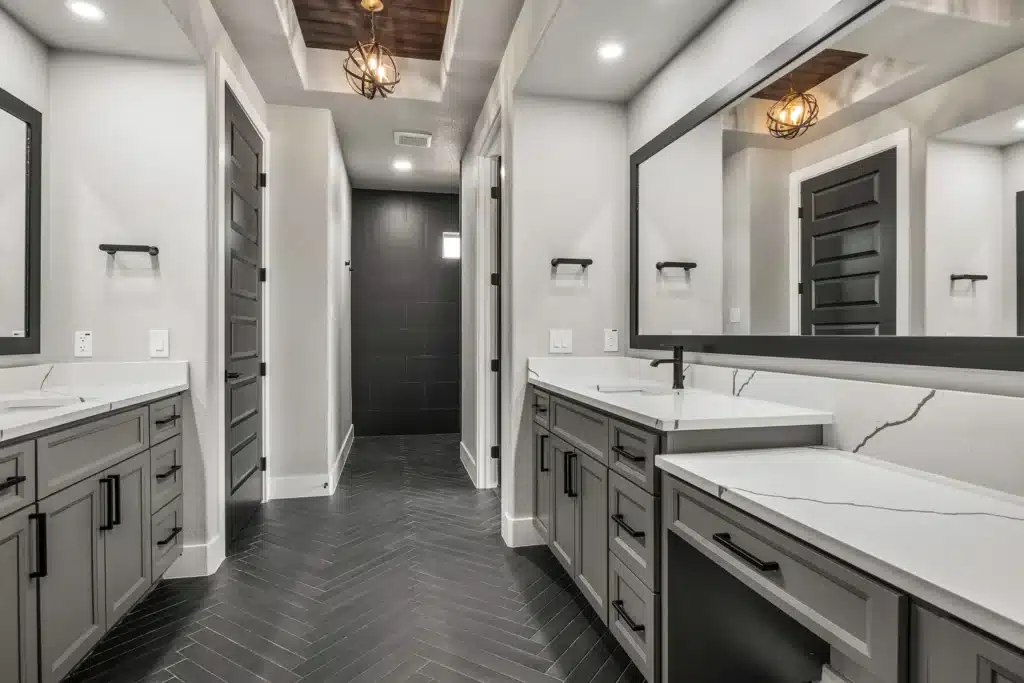
Tile covers the room, but the vanity defines it. It controls storage, daily usability, and the overall feel of the space. And in DFW remodels, it is one of the most misunderstood cost categories because homeowners price the cabinet, not the system.
A vanity is not just a box on the wall. It includes:
- cabinetry
- countertop
- sink
- faucet
- hardware
- plumbing connections
When all components are included, vanities typically account for 10% to 25% of a total bathroom remodel budget in DFW, depending on quality and size.
Why Vanity Choices Scale Nonlinearly
Vanity pricing does not increase gradually. It jumps in tiers.
A $900 cabinet does not become a $1,800 system when upgraded. It becomes a $4,000 to $6,000 installed setup once fabrication, plumbing, and labor are included.
Design standards from the National Kitchen & Bath Association emphasize that vanity width, spacing, and clearance directly affect usability and long-term satisfaction, not just appearance. That means poor sizing decisions can create functional issues even in expensive bathrooms.
Quote Insight:
“The vanity is not just what you see. It’s how the bathroom works every day.”
The Three Vanity Tiers in DFW
Stock Vanities (Entry-Level)
Stock vanities are pre-built units sold at major retailers.
They are:
- available in fixed sizes (24″, 30″, 36″, etc.)
- limited in finish and storage options
- typically made from MDF or particle board
Typical DFW Cost:
- Cabinet only: $300 to $1,200
- Fully installed: $1,000 to $3,000
Best use cases:
- powder rooms
- quick remodels
- strict budgets
Tradeoffs:
- wasted space due to fixed sizing
- lower resistance to moisture over time
- minimal customization
Semi-Custom Vanities (Mid-Range Standard)
Semi-custom vanities are modular systems with adjustable configurations.
They offer:
- multiple size combinations
- upgraded finishes and drawer systems
- stronger materials like plywood construction
Typical DFW Cost:
- Cabinet: $1,200 to $3,500
- Fully installed: $3,000 to $7,000
Best use cases:
- guest bathrooms
- most mid-range remodels
- homeowners balancing cost and quality
Tradeoffs:
- moderate lead times (2 to 6 weeks)
- still limited compared to full custom builds
Custom Vanities (High-End)
Custom vanities are built specifically for the space.
They allow:
- exact wall-to-wall fit
- fully customized storage layouts
- premium materials and finishes
Typical DFW Cost:
- Cabinet: $4,000 to $10,000+
- Fully installed: $7,000 to $15,000+
Best use cases:
- master bathrooms
- luxury remodels
- non-standard layouts
Tradeoffs:
- highest cost tier
- long lead times (6 to 12+ weeks)
Vanity Cost Comparison Table
| Vanity Type | Cabinet Cost | Installed Cost (DFW) | Lead Time | Durability |
|---|---|---|---|---|
| Stock | $300 to $1,200 | $1,000 to $3,000 | Immediate | Low to Mid |
| Semi-Custom | $1,200 to $3,500 | $3,000 to $7,000 | 2 to 6 weeks | Mid to High |
| Custom | $4,000 to $10,000+ | $7,000 to $15,000+ | 6 to 12+ weeks | High |
What “Installed Cost” Actually Includes
Most estimates fail because they exclude integration costs.
A realistic vanity system includes the following:
| Component | Typical Cost Range |
|---|---|
| Cabinet | $1,200 to $5,000+ |
| Countertop (quartz or granite) | $1,000 to $3,000 |
| Sink | $150 to $600 |
| Faucet | $150 to $800 |
| Plumbing labor | $300 to $1,500 |
| Installation labor | $500 to $1,500 |
Total Installed Range: $3,000 to $10,000+
According to remodeling cost benchmarks from HomeAdvisor, installation and associated work can increase vanity costs by 30% to 70% beyond the cabinet price alone.
Single vs Double Vanity Cost Impact
Upgrading to a double vanity significantly increases both material and labor cost.
| Vanity Type | Installed Cost | Increase vs Single |
|---|---|---|
| Single Vanity | $2,000 to $5,000 | — |
| Double Vanity | $4,000 to $9,000+ | +50% to 100% |
The increase comes from:
- additional plumbing lines
- larger cabinetry
- larger countertop slabs
- longer installation time
Despite the cost, double vanities are often expected in mid-range and high-end primary bathrooms, which can influence resale value.
Real Example: Mid-Range Vanity Setup in DFW
Here is a realistic breakdown for a semi-custom vanity installation:
| Component | Cost |
|---|---|
| Semi-custom cabinet | $2,400 |
| Quartz countertop | $1,500 |
| Undermount sink | $300 |
| Faucet | $350 |
| Plumbing labor | $700 |
| Installation labor | $900 |
Total Vanity Cost: ~$6,150
This aligns with mid-range bathroom remodel pricing across DFW .
Hidden Cost Drivers Most Homeowners Miss
Vanity costs increase based on conditions, not just selections.
Key drivers include:
Fit and spacing
If the vanity does not perfectly fit the wall, filler panels and trim work are required.
Wall and floor conditions
Uneven surfaces require leveling before installation.
Plumbing location
Moving drain or supply lines increases labor complexity.
Countertop fabrication
Custom cuts, sink openings, and edge profiles raise costs.
Moisture durability
Higher humidity environments require better materials to prevent long-term damage.
DFW Trend: Cohesion Over Individual Upgrades
Recent Texas remodeling trends show a shift toward coordinated material choices rather than isolated upgrades .
This means:
- vanity color aligns with flooring undertones
- hardware matches fixtures
- countertop complements tile
Not for aesthetics alone, but because cohesive design improves perceived value.
Quote Insight:
“A bathroom feels expensive when everything matches. Not when one thing stands out.”
Strategic Takeaway
The vanity is one of the few elements that impacts both function and perception.
It determines:
- storage capacity
- daily usability
- visual focal point
But it is also one of the easiest places to overspend.
Key Insight:
The right vanity is not the most expensive option.
It is the one that fits the space, matches the material level, and keeps the entire remodel balanced.
Choose the vanity tier early.
Because once that decision is made, the rest of the bathroom tends to follow it.

Countertops (Quartz vs Granite vs Marble Comparisons)
Countertops are one of the smallest surfaces in a bathroom, but they carry outsized impact.
They sit at eye level. They get daily contact with water, soap, heat, and chemicals. And in most DFW remodels, they are one of the first things people notice when they walk into the room.
That combination makes countertop selection less about looks alone and more about performance over time.
A material that looks identical on day one can behave very differently after a year of real use.
Why Countertops Drive Perceived Quality
Countertops connect multiple elements in the bathroom:
- vanity cabinetry
- sinks
- backsplashes
- fixtures
Because of that, they act as a visual anchor.
If the countertop looks premium, the entire bathroom feels higher-end. If it looks cheap or worn, it pulls everything else down with it.
Material guidance from the Natural Stone Institute emphasizes evaluating porosity, durability, and maintenance requirements alongside appearance when selecting stone surfaces.
Quote Insight:
“Countertops are judged instantly, but they are lived with daily.”
The Three Dominant Materials in DFW Remodels
Most bathroom remodels in DFW use one of three materials: quartz, granite, or marble.
Each occupies a different position in the cost, durability, and maintenance spectrum.
Quartz
Quartz is an engineered material made from crushed stone and resin.
It is the most commonly chosen option in modern remodels because it is:
- non-porous
- highly durable
- consistent in appearance
Typical Installed Cost (DFW): $70 to $120 per square foot
Advantages:
- does not require sealing
- resists staining and moisture
- uniform patterns for clean design
Limitations:
- less natural variation than stone
- can be damaged by extreme heat if not protected
Best suited for:
- mid-range and high-end bathrooms
- homeowners prioritizing low maintenance
Granite
Granite is a natural stone with unique patterns and color variation.
It has been a long-standing standard in residential construction.
Typical Installed Cost (DFW): $60 to $100 per square foot
Advantages:
- strong and heat resistant
- natural aesthetic
- slightly lower cost than premium quartz
Limitations:
- requires periodic sealing
- more variation between slabs
Best suited for:
- traditional or transitional designs
- homeowners who want natural materials without luxury pricing
Marble
Marble is a high-end natural stone known for its veining and softness.
It is widely associated with luxury but comes with tradeoffs.
Typical Installed Cost (DFW): $80 to $150+ per square foot
Advantages:
- premium visual appeal
- unique, high-end patterns
Limitations:
- porous and prone to staining
- scratches and etches easily
- requires ongoing maintenance
Testing from Consumer Reports consistently shows marble to be significantly more vulnerable to staining and surface damage compared to engineered quartz.
Best suited for:
- master bathrooms
- design-focused spaces with lighter daily use
Installed Cost Breakdown by Material
Countertop pricing is driven by both material and fabrication.
Material cost alone does not reflect the total price.
| Material | Material Cost per Sq Ft | Installed Cost per Sq Ft (DFW) | Maintenance Level |
|---|---|---|---|
| Quartz | $50 to $90 | $70 to $120 | Low |
| Granite | $40 to $80 | $60 to $100 | Medium |
| Marble | $60 to $120+ | $80 to $150+ | High |
Installed cost includes:
- cutting and fabrication
- edge finishing
- sink cutouts
- installation labor
What Actually Increases Countertop Cost
Most price variation comes from fabrication complexity, not just material selection.
Key cost drivers include:
Thickness
Standard slabs are 2 cm or 3 cm. Thicker slabs increase both material and support requirements.
Edge Profiles
Basic edges are included. Decorative edges increase labor and fabrication time.
Sink Integration
Undermount sinks require precision cuts. Integrated sinks increase complexity further.
Backsplashes
Adding vertical surfaces increases both material usage and labor.
Slab Selection
Premium slabs with unique veining or color patterns are priced higher, even within the same material category.
Real Example: Quartz Countertop in a DFW Remodel
A typical mid-range bathroom vanity using quartz:
| Component | Cost |
|---|---|
| Quartz slab (30 sq ft) | $2,100 |
| Fabrication and edging | $650 |
| Sink cutout and install | $300 |
| Installation labor | $450 |
Total Countertop Cost: ~$3,500
This aligns with typical mid-range remodel budgets across DFW .
Performance Comparison Across Materials
| Feature | Quartz | Granite | Marble |
|---|---|---|---|
| Durability | High | High | Medium |
| Maintenance | Very low | Moderate | High |
| Stain Resistance | Excellent | Good with sealing | Low |
| Consistency | Uniform | Natural variation | High variation |
| Longevity | High | High | Medium |
DFW Design Trend: Clean and Cohesive Surfaces
Recent remodeling trends across Texas show homeowners moving toward:
- lighter colors
- subtle veining
- cohesive material palettes
Quartz dominates this trend because it allows for:
- predictable patterns
- consistent finishes
- easier coordination with cabinetry and flooring
This is not just aesthetic. It also improves resale perception because the space feels intentional rather than pieced together.
Quote Insight:
“Consistency makes a bathroom feel expensive faster than any single upgrade.”
The Hidden Cost of Choosing the Wrong Material
Countertop mistakes rarely show up immediately.
They appear months later.
Common issues include:
- marble staining from daily products
- granite losing its seal over time
- cheaper materials chipping at edges
Because countertops are fabricated and installed as single pieces, replacement requires:
- demolition
- re-measurement
- full reinstallation
That makes corrections expensive.
Long-term material performance research consistently shows that durability and maintenance requirements outweigh upfront savings in high-use environments.
Strategic Takeaway
Countertops are not the largest cost in a bathroom remodel, but they are one of the most influential.
They affect:
- daily usability
- maintenance effort
- long-term durability
- perceived quality
Key Insight:
The right countertop is not the one that looks best in a showroom.
It is the one that performs best under daily use.
For most DFW remodels:
- quartz offers the best balance of durability and simplicity
- granite provides natural appeal with moderate maintenance
- marble delivers visual impact but requires commitment
Once installed, countertops are difficult to change.
Choosing correctly the first time is what keeps the remodel from becoming a long-term problem.
Fixtures (Budget vs Mid vs Luxury Tiers)
Fixtures are where daily interaction meets cost control.
They are touched every day. Turned on, turned off, adjusted, cleaned. And yet, they are one of the most commonly mis-budgeted parts of a bathroom remodel because homeowners often price them individually instead of as a system.
A faucet might cost $150. A shower system might cost $400.
But once you factor in valves, trim kits, installation, and compatibility, fixture costs expand quickly.
In most DFW bathroom remodels, fixtures account for 5% to 15% of the total budget, depending on quality and complexity.
What Counts as “Fixtures”
Fixtures include all functional water and hardware components:
- sink faucets
- showerheads and valves
- tub fillers
- handles and trim kits
They are separate from plumbing rough-ins but directly connect to them.
Guidelines from the Environmental Protection Agency highlight that fixture selection also impacts water efficiency and long-term utility costs, especially through programs like WaterSense.
Quote Insight:
“Fixtures are small purchases that get used more than anything else in the bathroom.”
The Three Fixture Tiers in DFW Remodels
Budget Fixtures (Entry-Level)
Budget fixtures prioritize affordability and basic function.
They are typically:
- mass-produced
- made with lighter internal components
- limited in finish options
Typical DFW Cost:
- Faucet: $75 to $200
- Shower system: $150 to $400
- Full bathroom fixture set: $300 to $800
Installed Cost Range: $800 to $1,500
Best for:
- rental properties
- low-budget remodels
- secondary bathrooms
Tradeoffs:
- shorter lifespan
- less precise control
- fewer design options
Mid-Range Fixtures (Most Common)
Mid-range fixtures balance durability, design, and cost.
They often feature:
- solid brass or higher-quality internal parts
- smoother valve operation
- broader finish selections
Typical DFW Cost:
- Faucet: $200 to $500
- Shower system: $400 to $1,000
- Full bathroom fixture set: $800 to $2,500
Installed Cost Range: $1,500 to $3,500
Best for:
- most homeowner remodels
- primary and guest bathrooms
Tradeoffs:
- higher upfront cost than budget options
- still limited customization compared to luxury
Luxury Fixtures (High-End)
Luxury fixtures prioritize performance, customization, and aesthetics.
They often include:
- thermostatic controls
- multi-function shower systems
- premium finishes and design
Typical DFW Cost:
- Faucet: $500 to $1,500+
- Shower system: $1,000 to $4,000+
- Full bathroom fixture set: $2,500 to $7,000+
Installed Cost Range: $3,500 to $10,000+
Best for:
- master bathrooms
- high-end remodels
- design-driven spaces
Tradeoffs:
- significantly higher cost
- more complex installation
Fixture Cost Comparison Table
| Tier | Faucet Cost | Shower System Cost | Installed Total (DFW) | Lifespan |
|---|---|---|---|---|
| Budget | $75 to $200 | $150 to $400 | $800 to $1,500 | Low |
| Mid-Range | $200 to $500 | $400 to $1,000 | $1,500 to $3,500 | Medium to High |
| Luxury | $500 to $1,500+ | $1,000 to $4,000+ | $3,500 to $10,000+ | High |
What Drives Fixture Costs Higher
Fixture pricing increases based on complexity, not just brand.
Key cost drivers include:
Valve Systems
Higher-end systems use pressure-balancing or thermostatic valves, which improve temperature control but increase cost.
Finish Quality
Matte black, brushed gold, and specialty finishes often cost more than standard chrome.
Multi-Function Systems
Rain heads, handheld sprayers, and body jets require additional plumbing and increase both material and labor costs.
Brand and Certification
Fixtures tested and certified for performance and water efficiency often cost more upfront but perform better long-term. Standards from organizations like the American Society of Mechanical Engineers help ensure fixture reliability and safety.
Real Example: Mid-Range Fixture Setup in DFW
Typical mid-range bathroom fixture package:
| Component | Cost |
|---|---|
| Faucet | $300 |
| Shower system with valve | $850 |
| Tub filler (if applicable) | $400 |
| Installation labor | $900 |
Total Fixture Cost: ~$2,450
This aligns with mid-range remodel budgets across DFW .
Water Efficiency and Long-Term Cost
Fixtures are one of the few categories that directly impact monthly utility costs.
WaterSense-certified fixtures from the EPA are designed to reduce water usage without sacrificing performance.
Typical savings:
- up to 20% reduction in water use
- lower long-term operating costs
This makes mid-range fixtures often the best balance between upfront cost and long-term value.
DFW Trend: Matte Finishes and Consistency
Recent remodeling trends across Texas show strong demand for:
- matte black
- brushed brass
- consistent fixture finishes across the entire bathroom
Consistency matters more than individual upgrades.
A cohesive set of mid-range fixtures often looks more expensive than mixing high-end and low-end pieces.
Quote Insight:
“Fixtures should match each other before they try to stand out.”
The Hidden Cost of Cheap Fixtures
Budget fixtures often create hidden costs over time:
- leaks due to lower-quality components
- inconsistent water pressure
- premature replacement
Because fixtures are tied into plumbing systems, replacing them later involves:
- labor
- potential wall or tile disruption
That makes cheap fixtures more expensive in the long run.
Strategic Takeaway
Fixtures are not the largest cost category, but they are one of the most frequently used.
They affect:
- daily comfort
- water efficiency
- long-term reliability
Key Insight:
The best fixtures are not the cheapest or the most expensive.
They are the ones that balance durability, performance, and consistency across the entire bathroom.
For most DFW remodels, that means:
- avoiding the lowest tier
- selecting cohesive mid-range systems
- upgrading to luxury only where it meaningfully improves experience
Because unlike décor, fixtures are functional. And function is what you feel every day.
Flooring Materials (Tile vs LVP vs Natural Stone)
Flooring is one of the most deceptive cost categories in a bathroom remodel.
At first glance, it looks simple. A small area. A limited number of square feet. A quick install.
In reality, bathroom flooring is one of the most technically demanding parts of the entire project because it must handle:
- constant moisture
- temperature changes
- foot traffic
- slip resistance requirements
And unlike other areas of the home, failure here leads to structural issues, not just cosmetic ones.
Why Bathroom Flooring Is Different
Bathroom floors are not just surfaces. They are part of a waterproofing system.
They interact with:
- subfloor preparation
- waterproof membranes
- slope and drainage (especially in showers)
Guidelines from the Tile Council of North America emphasize that proper installation methods and substrate preparation are critical for long-term performance in wet environments.
Quote Insight:
“Bathroom flooring is not about what looks best. It’s about what survives daily use.”
The Three Main Flooring Options in DFW Remodels
Most bathroom floors in DFW fall into three categories:
- tile (ceramic or porcelain)
- luxury vinyl plank (LVP)
- natural stone
Each has different cost, durability, and installation requirements.
Tile Flooring (Most Common)
Tile is the standard choice for bathrooms.
It is:
- water-resistant
- durable
- available in a wide range of styles
Typical Installed Cost (DFW): $10 to $25 per square foot
Advantages:
- excellent moisture resistance
- long lifespan
- wide design flexibility
Limitations:
- cold underfoot without heating
- grout requires maintenance
Best for:
- all bathroom types
- most remodel budgets
Luxury Vinyl Plank (LVP)
LVP is a synthetic flooring material designed to mimic wood or stone.
It has grown in popularity due to cost and ease of installation.
Typical Installed Cost (DFW): $6 to $15 per square foot
Advantages:
- lower cost
- softer underfoot
- faster installation
Limitations:
- less durable than tile in wet environments
- potential water damage at seams
Best for:
- budget remodels
- secondary bathrooms
Natural Stone Flooring
Natural stone includes materials like marble, travertine, and slate.
It is considered a premium option.
Typical Installed Cost (DFW): $20 to $50+ per square foot
Advantages:
- high-end appearance
- unique natural patterns
Limitations:
- porous and requires sealing
- higher maintenance
- more expensive installation
Best for:
- luxury remodels
- master bathrooms
The Natural Stone Institute notes that stone flooring requires regular sealing and maintenance to prevent moisture intrusion and staining.
Flooring Cost Comparison Table
| Material | Installed Cost (DFW) | Durability | Water Resistance | Maintenance |
|---|---|---|---|---|
| Tile | $10 to $25 | High | Excellent | Medium |
| LVP | $6 to $15 | Medium | Good | Low |
| Natural Stone | $20 to $50+ | High | Moderate | High |
What Actually Increases Flooring Cost
Flooring costs are driven more by installation complexity than material price.
Key factors include:
Subfloor Condition
Uneven or damaged subfloors require leveling or replacement.
Waterproofing Systems
Membranes and underlayment add cost but are essential for longevity.
Tile Size and Pattern
Large tiles require precision leveling. Complex patterns increase labor time.
Grout and Sealing
Specialty grout and sealing systems increase both material and labor costs.
Real Example: Tile Flooring Installation in DFW
Typical mid-range tile flooring project:
| Component | Cost |
|---|---|
| Porcelain tile (80 sq ft) | $800 |
| Thinset and materials | $250 |
| Waterproofing membrane | $400 |
| Labor | $1,200 |
Total Flooring Cost: ~$2,650
This aligns with typical DFW remodel pricing .
Slip Resistance and Safety
Bathroom flooring must also meet safety standards.
Slip resistance is measured using coefficients of friction, and recommended values are outlined in building safety guidelines from organizations like the Occupational Safety and Health Administration.
Higher slip resistance:
- reduces fall risk
- improves safety in wet conditions
Textured tile and smaller grout patterns often perform better than smooth surfaces.
DFW Trend: Wood-Look Tile Over LVP
One of the biggest trends in Texas remodels is the shift toward wood-look porcelain tile instead of LVP .
Why:
- maintains the warmth of wood aesthetics
- avoids moisture risks of vinyl seams
- increases long-term durability
This trend reflects a broader shift toward materials that combine appearance with performance.
Quote Insight:
“The best flooring today looks like wood but performs like tile.”
The Hidden Cost of Choosing the Wrong Flooring
Flooring failures are expensive because they affect the structure beneath them.
Common issues include:
- water penetration damaging subfloors
- tile cracking due to poor installation
- LVP warping in high-moisture environments
Fixing these problems often requires:
- full removal
- subfloor repair
- complete reinstallation
That makes initial material choice critical.
Strategic Takeaway
Flooring is not just a design decision. It is a performance decision.
It affects:
- durability
- safety
- long-term maintenance
Key Insight:
The best bathroom flooring is not the cheapest or the most visually appealing.
It is the one that handles moisture, wear, and daily use without failure.
For most DFW remodels:
- tile remains the safest and most reliable choice
- LVP works for budget-conscious projects
- natural stone is reserved for high-end, design-focused spaces
Because once flooring fails, the cost is not just replacement. It is reconstruction.

Labor vs Materials Percentage Breakdown
At a glance, most homeowners assume materials are the main cost in a bathroom remodel.
They are not.
In DFW, labor is typically the largest single expense, often exceeding any individual material category. But the relationship between labor and materials is not fixed. It shifts depending on the level of finishes, complexity, and installation requirements.
Understanding this split is what prevents budgets from drifting out of control.
The Typical Cost Split in DFW
For most mid-range bathroom remodels in DFW, the breakdown looks like this:
| Category | Percentage of Total Cost |
|---|---|
| Labor | 45% to 60% |
| Materials | 40% to 55% |
This aligns with national remodeling cost data, where labor consistently represents a major portion of interior renovation expenses according to the National Association of Home Builders.
Quote Insight:
“You don’t pay for materials alone. You pay for the skill required to install them correctly.”
Why Labor Often Costs More Than Materials
Bathrooms require multiple specialized trades working in sequence:
- demolition
- plumbing
- electrical
- tile installation
- cabinetry
- finishing
Each step depends on the previous one being done correctly.
Unlike other parts of the home, bathrooms are highly condensed spaces where everything must fit and function precisely. That increases labor time and reduces efficiency.
Guidelines from the Bureau of Labor Statistics show that skilled trades such as plumbers, electricians, and tile setters command higher wages due to specialization and licensing requirements.
How Material Choices Affect Labor Costs
Labor and materials are not independent.
When material quality increases, labor costs often rise with it.
Examples:
Large-format tile
Requires more precise leveling and installation.
Natural stone
Needs sealing, careful handling, and specialized cutting.
Custom vanities
Require detailed fitting and alignment.
Luxury fixtures
Often involve more complex plumbing setups.
This creates a compounding effect where upgrading materials increases both sides of the budget.
Real Example: Same Bathroom, Different Material Levels
Here is how the labor vs materials split changes based on finish level for a similar-sized bathroom:
| Remodel Type | Labor Cost | Material Cost | Total Cost | Labor % |
|---|---|---|---|---|
| Budget | $9,000 | $6,000 | $15,000 | 60% |
| Mid-Range | $12,000 | $13,000 | $25,000 | 48% |
| High-End | $15,000 | $25,000 | $40,000 | 38% |
As materials become more expensive, they begin to overtake labor as the dominant cost.
Where Labor Costs Actually Come From
Labor is not a single line item. It is a collection of specialized work.
Typical labor breakdown:
| Trade | Role | Cost Range |
|---|---|---|
| Demolition | Removal of old materials | $1,000 to $3,000 |
| Plumbing | Pipe adjustments, fixture install | $1,500 to $5,000 |
| Electrical | Lighting, outlets, wiring | $800 to $2,500 |
| Tile Installation | Floors and walls | $4,000 to $12,000 |
| Carpentry | Vanity, framing adjustments | $1,000 to $4,000 |
| Finishing | Paint, trim, final touches | $500 to $2,000 |
These costs vary depending on scope, but tile and plumbing typically dominate labor expenses.
Why Tile Labor Is So Expensive
Tile is one of the most labor-intensive parts of a bathroom remodel.
It requires:
- surface preparation
- waterproofing
- precise layout
- cutting and fitting
- grouting and sealing
Standards from the Tile Council of North America emphasize strict installation methods to prevent long-term failure in wet environments.
Even small mistakes can lead to:
- water intrusion
- cracked tiles
- mold growth
That risk is why skilled tile labor commands higher pricing.
The Hidden Costs That Blur the Split
The line between labor and materials is not always clean.
Some costs sit in between:
- waterproofing systems
- adhesives and thinset
- fasteners and hardware
- delivery and handling
These are technically materials, but they are driven by installation requirements.
They can add thousands to a project without being obvious in initial estimates.
DFW Trend: Labor Stability, Material Volatility
In recent years, DFW has seen:
- relatively stable labor pricing
- more volatile material costs due to supply and demand shifts
This means:
- labor is predictable
- materials are where budgets fluctuate
That makes material selection the primary lever for controlling total cost.
Quote Insight:
“Labor sets the floor. Materials set the ceiling.”
When the Ratio Becomes a Problem
The labor vs materials ratio can signal issues in a remodel plan.
Warning signs:
Labor above 65%
Indicates inefficient design or excessive structural changes.
Materials above 65%
Suggests overinvestment in finishes relative to the space.
Balanced remodels typically stay within a 45 to 60 percent range for both categories.
Strategic Takeaway
The most important insight is this:
Labor and materials are not competing costs. They are linked.
Every material decision affects labor.
Every labor requirement influences material choices.
Key Insight:
The goal is not to minimize labor or materials.
It is to keep them in balance so neither side overwhelms the budget.
For most DFW bathroom remodels:
- labor will be the largest single category
- materials will determine how high the total cost goes
And understanding that relationship is what turns a rough estimate into a controlled project.

Full Cost Table (Material-by-Material Summary)
At this point, each material category has been broken down individually.
But real remodel decisions are not made in isolation.
They are made by combining everything into a single budget and understanding how each category contributes to the total. This is where most homeowners lose clarity, because costs feel scattered across dozens of small decisions.
This section consolidates everything into one clear, material-by-material view.
Complete Bathroom Material Cost Breakdown (DFW)
Below is a realistic cost summary for a mid-range bathroom remodel in DFW, broken down by major material categories.
| Category | Budget Tier | Mid-Range Tier | High-End Tier |
|---|---|---|---|
| Tile (walls + shower) | $1,500 to $3,000 | $3,000 to $7,000 | $7,000 to $15,000+ |
| Vanity & Cabinetry | $1,000 to $3,000 | $3,000 to $7,000 | $7,000 to $15,000+ |
| Countertops | $800 to $2,000 | $2,000 to $4,000 | $4,000 to $8,000+ |
| Fixtures | $300 to $800 | $800 to $2,500 | $2,500 to $7,000+ |
| Flooring | $800 to $2,000 | $2,000 to $4,000 | $4,000 to $8,000+ |
| Shower Glass | $800 to $1,500 | $1,500 to $3,000 | $3,000 to $7,000+ |
| Misc Materials | $300 to $800 | $800 to $2,000 | $2,000 to $5,000+ |
Total Material Cost by Tier
When combined, material costs scale significantly depending on finish level:
| Remodel Tier | Total Material Cost |
|---|---|
| Budget | $5,500 to $13,000 |
| Mid-Range | $13,000 to $29,500 |
| High-End | $29,500 to $65,000+ |
These numbers align closely with broader remodeling cost ranges and material distributions reported in national cost studies such as those from the National Association of Home Builders, where finish materials represent a major portion of total project cost.
Quote Insight:
“The total cost is not one decision. It is the sum of dozens of small ones.”
How Each Category Contributes to Total Cost
Not all materials carry equal weight.
Here is how the average mid-range remodel typically breaks down by category:
| Category | % of Material Budget |
|---|---|
| Tile (walls + shower) | 25% to 35% |
| Vanity & Cabinetry | 15% to 25% |
| Countertops | 8% to 12% |
| Fixtures | 8% to 12% |
| Flooring | 8% to 12% |
| Shower Glass | 5% to 10% |
| Misc Materials | 3% to 8% |
Tile and cabinetry dominate because they cover the most surface area and require the most material volume.
Real Example: Mid-Range Bathroom Material Budget
A realistic mid-range DFW remodel might look like this:
| Category | Cost |
|---|---|
| Tile (shower + walls) | $5,200 |
| Vanity & cabinetry | $4,800 |
| Countertops | $3,200 |
| Fixtures | $2,400 |
| Flooring | $2,600 |
| Shower glass | $2,200 |
| Misc materials | $1,100 |
Total Materials: ~$21,500
This aligns with typical DFW remodel pricing from local cost guides .
Why Costs Escalate Faster Than Expected
Material costs rarely increase linearly.
Instead, they compound.
For example:
- upgrading tile increases both tile cost and labor
- upgrading fixtures often requires upgraded plumbing components
- upgrading cabinetry may require upgraded countertops
This stacking effect is why a remodel can move from $25,000 to $40,000 without a major layout change.
Research from the U.S. Census Bureau’s construction spending data shows that finish-level upgrades are one of the primary drivers of cost variation in residential construction.
The “Mismatch Problem” That Wastes Budget
One of the most common issues in remodel planning is mismatched material levels.
Examples:
- luxury countertops paired with budget cabinetry
- high-end tile paired with basic fixtures
- premium vanity with low-quality flooring
This creates two problems:
- The bathroom feels inconsistent
- Money is wasted on upgrades that do not elevate the entire space
Quote Insight:
“A bathroom feels expensive when everything is aligned, not when one thing is upgraded.”
DFW Trend: Balanced Material Packages
Recent remodeling trends across Texas show a clear shift toward balanced material selection rather than isolated upgrades .
Homeowners are increasingly choosing:
- consistent mid-range materials across all categories
- fewer extreme high-end upgrades
- cohesive color and finish palettes
This approach:
- controls budget
- improves visual consistency
- increases perceived value
Strategic Takeaway
This table is not just a reference. It is a planning tool.
It shows:
- where money actually goes
- which categories dominate cost
- how upgrades compound
Key Insight:
The total cost of a bathroom remodel is not determined by one expensive item.
It is determined by how all material categories work together.
If you control:
- tile scope
- vanity level
- fixture tier
you control the majority of the budget.
Everything else follows from those decisions.
How to Choose Materials Based on Budget
Most bathroom remodels do not go over budget because of one bad decision.
They go over because of dozens of small upgrades that feel harmless in isolation.
A slightly better tile. A nicer faucet. A thicker countertop. A custom vanity instead of semi-custom.
Individually, each upgrade seems reasonable. Combined, they push the project far beyond the original plan.
Choosing materials based on budget is not about finding the cheapest options. It is about controlling where upgrades happen and where they do not.
The Core Principle: Allocate, Don’t React
The mistake most homeowners make is choosing materials reactively.
They walk into a showroom, see something they like, and adjust the budget to fit it.
The better approach is to allocate the budget first, then choose materials within those constraints.
Guidance from the Consumer Financial Protection Bureau emphasizes that setting clear spending limits before making purchasing decisions leads to significantly better financial outcomes.
Quote Insight:
“If you don’t assign your budget upfront, your materials will assign it for you.”
Step 1: Define Your Total Remodel Budget
Start with a clear total number.
In DFW, typical bathroom remodel ranges:
- Budget: $15,000 to $25,000
- Mid-range: $25,000 to $45,000
- High-end: $45,000 to $80,000+
From there, materials typically represent 40% to 55% of the total cost.
Step 2: Allocate Material Budget by Category
Instead of guessing, use a structured allocation:
| Category | Recommended % of Material Budget |
|---|---|
| Tile (walls + shower) | 25% to 35% |
| Vanity & cabinetry | 15% to 25% |
| Countertops | 8% to 12% |
| Fixtures | 8% to 12% |
| Flooring | 8% to 12% |
| Shower glass | 5% to 10% |
| Misc materials | 3% to 8% |
This keeps spending balanced across the entire bathroom.
Step 3: Decide Where to Upgrade
Not every category deserves equal investment.
High-impact areas:
- tile (large surface area)
- vanity (visual focal point)
Lower-impact areas:
- fixtures (beyond mid-range)
- minor accessories
This aligns with broader remodeling ROI studies showing that balanced upgrades across key surfaces deliver better value than isolated luxury features, as reported in cost vs value analyses from sources like Remodeling Magazine.
Quote Insight:
“Upgrade what people see first. Control what they don’t.”
Budget-Based Material Strategy
Budget Remodel Strategy ($15K to $25K)
Focus on:
- stock or basic semi-custom vanity
- ceramic or entry-level porcelain tile
- standard fixtures
- minimal layout changes
| Category | Target Spend |
|---|---|
| Tile | $2,000 |
| Vanity | $1,500 |
| Countertops | $1,200 |
| Fixtures | $600 |
| Flooring | $1,200 |
Goal: functional, clean, durable without overbuilding.
Mid-Range Strategy ($25K to $45K)
Focus on:
- semi-custom vanity
- upgraded porcelain tile
- quartz countertops
- mid-range fixtures
| Category | Target Spend |
|---|---|
| Tile | $4,500 |
| Vanity | $4,000 |
| Countertops | $3,000 |
| Fixtures | $2,000 |
| Flooring | $2,500 |
Goal: balance durability, aesthetics, and resale value.
High-End Strategy ($45K+)
Focus on:
- custom vanity
- large-format or natural stone tile
- premium fixtures
- design cohesion across all materials
| Category | Target Spend |
|---|---|
| Tile | $10,000+ |
| Vanity | $8,000+ |
| Countertops | $5,000+ |
| Fixtures | $4,000+ |
| Flooring | $5,000+ |
Goal: elevate the entire space, not just individual components.
The 80/20 Rule of Bathroom Materials
Not all upgrades deliver equal impact.
In most bathrooms:
- 80% of perceived quality comes from 20% of the materials
Those 20% are typically:
- tile
- vanity
- countertop
Everything else supports those choices.
Research into consumer perception of home improvements shows that visual consistency and major surface finishes drive the majority of perceived value in interior spaces [nahb.org].
Common Budget Mistakes to Avoid
Upgrading everything slightly
Leads to a bloated budget without a clear visual payoff.
Over-investing in hidden elements
Spending heavily on items that do not impact perception.
Ignoring material compatibility
Mixing tiers creates a disjointed look.
Underestimating installation impact
Higher-end materials increase labor costs.
Quote Insight:
“A bathroom doesn’t get expensive all at once. It gets expensive one upgrade at a time.”
A Simple Decision Framework
When choosing any material, ask:
- Does this upgrade improve durability or just appearance?
- Does it match the level of the rest of the bathroom?
- Would I notice this difference daily?
If the answer is no to all three, it is likely not worth the cost.
DFW Trend: Strategic Restraint
Recent remodeling trends across Texas show a shift toward controlled, intentional upgrades rather than maximizing every category .
Homeowners are:
- choosing fewer premium elements
- keeping supporting materials consistent
- prioritizing long-term durability
This leads to:
- better budget control
- more cohesive design
- higher perceived value
Strategic Takeaway
Choosing materials is not about maximizing quality everywhere.
It is about placing quality where it matters most.
Key Insight:
The best remodel is not the one with the most upgrades.
It is the one where every upgrade is intentional.
If you control:
- where money is allocated
- which categories are upgraded
- how materials align with each other
you control the entire outcome of the remodel.
And that is what keeps a project on budget without sacrificing quality.

See the Full Bathroom Remodel Cost Guide (DFW 2026)
If you have made it this far, you already understand something most homeowners miss.
Bathroom remodel costs are not driven by one big decision.
They are driven by material choices stacking on top of each other.
Tile affects labor.
Vanity affects countertops.
Fixtures affect plumbing complexity.
Everything connects.
This guide focused specifically on materials. But materials are only one piece of the full cost equation.
What This Guide Covered vs What It Didn’t
Here is the distinction most people need to make:
| Category | Covered in This Guide | Covered in Full Guide |
|---|---|---|
| Material costs | Yes | Yes |
| Labor breakdown | Partial | Full |
| Timeline | No | Yes |
| Permits & inspections | No | Yes |
| Cost by bathroom size | No | Yes |
| Cost by city (Plano, Frisco, Dallas) | No | Yes |
This article answers:
“What do materials cost?”
The full guide answers:
“What will my entire remodel cost from start to finish?”
Why the Full Picture Matters
A bathroom remodel is not a material purchase.
It is a construction project.
That means costs are influenced by:
- labor sequencing
- structural conditions
- permitting requirements
- contractor pricing
According to construction cost frameworks used by organizations like the U.S. Census Bureau, total project cost is always a combination of materials, labor, and project conditions, not just finishes.
Quote Insight:
“Materials set the direction. Labor and conditions determine the outcome.”
When You Actually Need the Full Guide
You should move to the full cost guide if you are:
- planning a remodel within the next 6 to 12 months
- comparing contractor quotes
- trying to set a realistic total budget
- deciding between remodeling vs not
Because once you start getting real numbers, material pricing alone is no longer enough.
How to Use Both Guides Together
The most effective approach is to use both strategically:
- Use this guide to understand material pricing and make finish decisions
- Use the full guide to understand total project cost and budgeting
This mirrors how professional contractors estimate projects.
They do not start with labor.
They start with material scope, then layer labor and conditions on top.
Industry cost modeling practices outlined in resources like RSMeans construction cost data follow this exact structure.
The Biggest Mistake to Avoid
Most homeowners jump straight to total cost without understanding materials.
That leads to:
- unrealistic expectations
- poor upgrade decisions
- budget overruns
Quote Insight:
“If you don’t understand material costs, every quote will feel random.”
This guide prevents that.
The full guide completes the picture.
Strategic Takeaway
You now understand:
- how each material category is priced
- where money actually goes
- how costs scale across tiers
The next step is simple.
Zoom out.
Key Insight:
Materials determine what your bathroom can become.
The full cost guide determines what it will actually cost to get there.
To see the complete breakdown of labor, timelines, and total remodel pricing across DFW, continue to the full guide.