Countertops are the surface you interact with more than any other element in your kitchen. They take the heat from pots, the impact of dropped utensils, the stain risk from wine and oil, and the daily visual weight of the room. So the question “how much do countertops cost?” is really two questions: how much to buy the material, and how much will you pay in maintenance, repairs, or regret over the next decade?
This guide answers both. The focus is on the three materials that dominate the premium segment of the countertop market: quartz, granite, and marble. Each has a distinct cost profile, a distinct maintenance demand, and a distinct aesthetic. The prices below are 2026 installed costs, meaning slab plus labor plus basic edge profile, for a typical kitchen layout. Where regional variation is material, it’s noted.
If you’re planning a full kitchen overhaul and want a broader budget framework, start with our complete kitchen remodel cost guide before drilling into countertop specifics.

Kitchen Countertop Cost at a Glance (2026)
The table below covers the most common countertop materials, from the budget end through the luxury tier. Prices are fully installed and assume a standard 30-square-foot kitchen counter layout. Actual square footage for most kitchens runs 25 to 45 sq ft, not counting an island, so adjust the total range accordingly.
| Material | Cost per Sq Ft (Installed) | Typical Kitchen Total | Durability | Maintenance |
|---|---|---|---|---|
| Laminate | $15–$40 | $450–$1,200 | Moderate | Low |
| Butcher Block | $40–$100 | $1,200–$3,000 | Moderate | Medium |
| Quartz (engineered) | $70–$150 | $2,100–$4,500 | High | Low |
| Granite | $60–$140 | $1,800–$4,200 | High | Medium |
| Marble | $90–$200+ | $2,700–$6,000+ | Moderate | High |
| Quartzite | $80–$175 | $2,400–$5,250 | Very High | Medium |
| Soapstone | $70–$120 | $2,100–$3,600 | High | Medium |
| Concrete | $65–$135 | $1,950–$4,050 | High | High |
The numbers in that table are ranges, and they’re wide on purpose. A 30-square-foot quartz installation in a market with competitive fabricators can come in near $2,100. The same scope in a high-cost metro, with a designer brand slab and a waterfall edge, can push past $5,000. Neither figure is wrong. They reflect different spec choices.
What drives the spread in each price range
Three variables account for most of the spread within any material category. First, slab grade: quarries and manufacturers produce slabs in commercial, builder, and premium tiers. Entry-level slabs in any material are thinner, with more visible inconsistencies, and are priced accordingly. Second, fabrication complexity: a straight run with an eased edge is the cheapest installation scenario. Cut-outs for sinks and cooktops, unusual angles, backsplash pieces, and specialty edges add labor time and waste. Third, regional labor rates: fabrication and installation labor varies considerably by metro. Markets with high construction demand or limited fabricator competition run noticeably more expensive.
Countertop cost relative to the overall kitchen budget
For most full kitchen remodels, countertops represent 10%–15% of total project cost. On a $40,000 kitchen remodel, that’s $4,000–$6,000 allocated to countertops, which aligns with mid-range granite or quartz. The National Kitchen and Bath Association recommends budgeting countertops as a separate line item rather than rolling them into a general labor estimate, because the material costs alone vary so dramatically by choice.
Research consistently shows that countertop material is the single kitchen feature homeowners most often upgrade mid-project. Setting a firm budget ceiling before selecting material prevents scope creep that’s hard to reverse once slabs are ordered.
How to use this guide
The sections below move from material-specific pricing through side-by-side comparison, long-term cost, installation variables, and finally a step-by-step quoting process. If you already know the material and want installation specifics, skip to Section 8. If you’re deciding between quartz and granite, Section 5’s comparison table gives the clearest head-to-head.
Quartz Countertop Cost: Per Square Foot, Installed
Quartz is the dominant premium countertop material in new kitchen construction and remodels as of 2026. It’s an engineered stone: crushed natural quartz (roughly 90%–95% by weight) bound with polymer resins and pigments. The result is a non-porous, very consistent surface that doesn’t require sealing and resists staining better than any natural stone.
Installed cost range: $70–$150 per square foot. A typical kitchen (30 sq ft) runs $2,100–$4,500 fully installed. High-end designer brands (Cambria, Silestone, Caesarstone’s luxury lines) push the ceiling closer to $180/sq ft in some markets.
Quartz pricing by tier
| Tier | Cost/Sq Ft Installed | What you get |
|---|---|---|
| Builder/entry | $70–$90 | Consistent solid colors, limited patterns, 3/4″ thickness |
| Mid-range | $90–$120 | Wider color/pattern range, 3/4″–1.25″ thickness |
| Premium | $120–$150 | Designer patterns, thick slabs, veining that mimics marble |
| Luxury brand | $150–$180+ | Cambria, Silestone premium, large-format slabs, exclusive colorways |
What makes quartz more expensive than granite in some cases
Quartz costs more than granite at the entry level because manufacturing adds cost. A basic granite slab is quarried and cut; a basic quartz slab requires a manufacturing process with quality control. At the mid-range, they’re roughly equivalent. At the top, designer quartz with complex veining can exceed premium granite because the fabrication and brand premium compound.
Why contractors favor quartz for most kitchens
Quartz is predictably flat, which simplifies installation and reduces waste from working around natural fissures or inconsistent thickness. For kitchens with L-shaped layouts, peninsulas, or islands, that consistency translates directly into lower labor hours. This Old House kitchen guides consistently recommend quartz for households that want low-maintenance surfaces without sacrificing the look of natural stone.
Quartz durability notes that affect long-term cost
Quartz’s resin content makes it heat-sensitive. Placing a hot pan directly from the stove onto quartz can discolor or crack the surface. That’s not a flaw in the material; it’s a use condition that matters for total cost of ownership. Households that cook heavily should either use trivets habitually or consider a natural stone that handles heat differently. The resin also makes quartz susceptible to UV fading if installed in a sunlit space, which is worth noting for kitchen renovations with large south-facing windows.

Granite Countertop Cost: Per Square Foot, Installed
Granite is natural igneous stone quarried from deposits worldwide. India, Brazil, China, and Norway are the dominant sources for slabs reaching the US market. Because it’s a natural material, no two slabs are identical, which is the primary reason many homeowners choose it over engineered alternatives.
Installed cost range: $60–$140 per square foot. A 30-square-foot kitchen runs $1,800–$4,200 fully installed. The lower floor is accessible because commodity granite from high-volume quarries is genuinely inexpensive to produce. Exotic or rare slabs push the ceiling past $140/sq ft.
Granite pricing by origin and rarity
| Category | Cost/Sq Ft Installed | Examples |
|---|---|---|
| Commodity / high-volume | $60–$80 | Santa Cecilia, Uba Tuba, Colonial White |
| Mid-range domestic/import | $80–$110 | Venetian Gold, Blue Pearl, Kashmir White |
| Exotic/rare | $110–$140+ | Blue Bahia, Van Gogh, Marinace |
| Bookmatched/custom | $140–$200+ | Matching slab pairs, rare quarry sources |
How granite fabrication affects total price
Fabrication for granite is more labor-intensive than quartz because natural stone has more variability. A fabricator working with granite must inspect each slab for fissures, map the grain direction, and plan cuts to avoid structural weak points near sink cutouts. Sink cutouts in granite cost $200–$400, compared to $100–$250 for quartz, because of the higher risk of cracking. Cooktop cutouts carry similar premiums.
Sealing cost over time
Granite is porous and requires sealing. A newly installed granite countertop should be sealed before first use and resealed every 1–3 years depending on the stone’s density and usage. Professional sealing runs $100–$300 per application, or you can seal it yourself with a $20–$40 product. Over a 10-year ownership period, budget $200–$600 in sealing costs on top of installation. Family Handyman kitchen guidance has detailed instructions for DIY granite sealing that can bring that recurring cost close to zero.
Granite and kitchen resale value
Granite retains strong buyer recognition as a premium material. In real estate contexts, “granite countertops” is still a shorthand for kitchen upgrades, even as quartz has overtaken it in new construction. That recognition value is worth something in resale contexts, particularly in markets where buyers are accustomed to granite as the kitchen upgrade baseline.

Marble Countertop Cost: Per Square Foot, Installed
Marble is metamorphic limestone, and the most visually distinctive countertop material in the premium category. Carrara marble (white with gray veining, from Italy’s Apuan Alps) is the reference point most homeowners have in mind. Calacatta and Statuario marbles are rarer, more dramatically veined, and significantly more expensive.
Installed cost range: $90–$200+ per square foot. A 30-square-foot kitchen runs $2,700–$6,000+ installed. That wide upper range reflects the significant price difference between Carrara (accessible, $90–$130/sq ft) and Calacatta Gold ($180–$250/sq ft installed in high-demand markets).
Marble pricing by variety
| Marble Type | Origin | Cost/Sq Ft Installed | Character |
|---|---|---|---|
| Carrara | Italy | $90–$130 | White/off-white, fine gray veining |
| Calacatta | Italy | $130–$200+ | Bright white, bold gold/gray veining |
| Statuario | Italy | $150–$220+ | White, dramatic dark gray veining |
| Nero Marquina | Spain | $110–$160 | Black, white veining |
| Emperador Dark | Spain | $100–$150 | Brown/black, white veining |
The maintenance reality that changes the true cost calculation
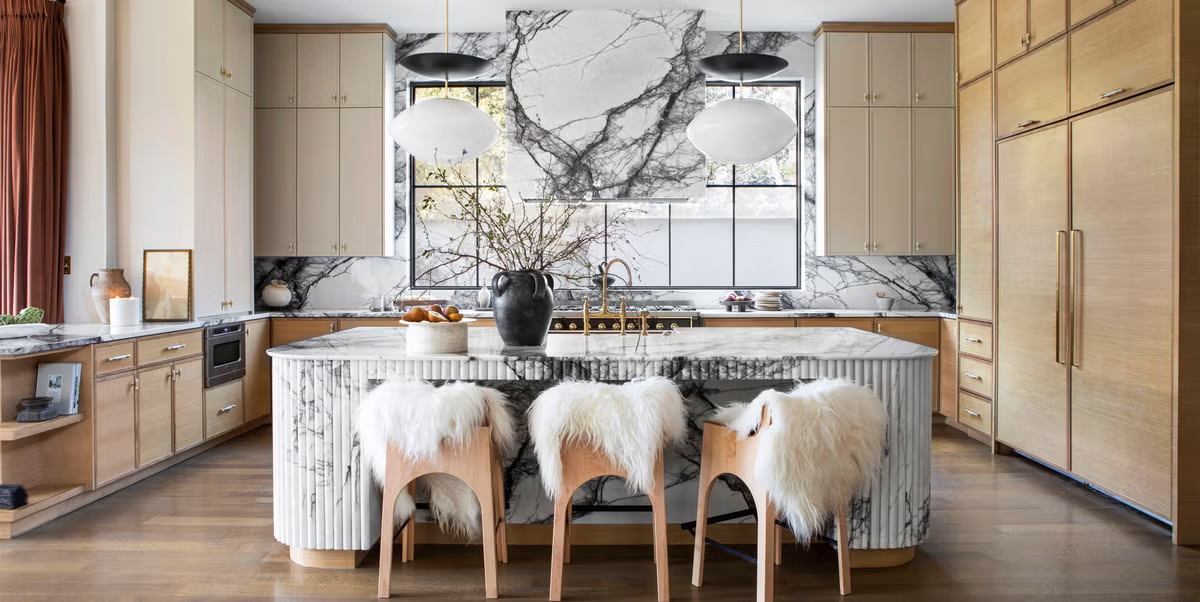
Marble is porous and soft relative to quartz and granite. It etches (surface dulling from acid contact) from lemon juice, vinegar, wine, tomato sauce, and even water with mineral content. Etching is not the same as staining; it’s a chemical reaction that removes the polish from the surface. A professional honing and repolishing service runs $300–$800 for a standard kitchen, and households that use marble countertops without consistent care typically need this service every 2–5 years.
The maintenance cost profile is why marble is disproportionately popular in design-forward kitchens where the owners value aesthetics highly and are realistic about care demands. Architectural Digest kitchen coverage frequently features marble in high-end kitchen photography precisely because it photographs exceptionally well and signals luxury to buyers.
When marble makes financial sense
Marble makes financial sense under three conditions. First, in kitchens that are used lightly (vacation properties, secondary kitchens, or low-cooking households). Second, where the owner explicitly values the patina that develops over time; many marble owners treat the etch marks and wear as part of the material’s character. Third, in high-end remodels where the countertop is a designed feature rather than a functional specification, and the resale market for the property rewards luxury material choices.
Marble alternatives that approximate the look at lower cost
Porcelain slabs with marble-look printing are a credible alternative at $60–$100/sq ft installed. They’re non-porous, etch-resistant, and increasingly indistinguishable from marble at normal viewing distance. Some fabricators are now also producing large-format porcelain islands specifically to capture the marble aesthetic without the maintenance overhead. Houzz kitchen design inspiration shows extensive examples of both material choices in finished kitchens, which is a useful visual reference before committing to either.
Side-by-Side Comparison: Quartz vs Granite vs Marble
The table below consolidates the key decision variables for all three materials.
| Attribute | Quartz | Granite | Marble |
|---|---|---|---|
| Cost/sq ft installed | $70–$150 | $60–$140 | $90–$200+ |
| Typical 30 sq ft kitchen | $2,100–$4,500 | $1,800–$4,200 | $2,700–$6,000+ |
| Porosity | Non-porous | Porous (requires sealing) | Porous (requires sealing) |
| Heat resistance | Moderate (resin can crack) | High | Moderate |
| Scratch resistance | High | High | Low–Moderate |
| Acid/etch resistance | High | Moderate | Low (etches easily) |
| Maintenance level | Low | Medium | High |
| Pattern consistency | Consistent (engineered) | Variable (natural) | Variable (natural) |
| Repair difficulty | Difficult (chip/crack) | Moderate | Difficult (etching, cracks) |
| Resale perception | Strong | Strong | Strong (luxury segment) |
| Best use case | Daily-use family kitchen | Any kitchen, natural look | Design-first, low-traffic |
The core trade-off in plain terms
Quartz wins on maintenance and consistency. Granite wins on natural character and heat tolerance. Marble wins on visual drama and design prestige. The honest framing is that quartz is the lowest total-cost-of-ownership choice for most households when you account for maintenance over 10 years. Granite is the middle ground that most homeowners don’t regret. Marble is a lifestyle choice with real trade-offs that need to go into the decision with open eyes.
According to NKBA kitchen design data, quartz now accounts for more than 40% of countertop selections in professional kitchen remodels, up from less than 20% a decade ago. Granite has declined from its peak but remains the second most-selected material in the premium category.
How the choice interacts with cabinet and flooring selections
The countertop material choice rarely exists in isolation. White or light quartz pairs with almost any cabinet color without risk. Dark granite can visually compete with dark cabinetry in ways that compress the space. Marble with dramatic veining needs cabinet and flooring restraint to avoid visual overload. For a full picture of how countertop selection interacts with your cabinet budget, see our guide to kitchen cabinet costs in 2026.
Regional price variation worth knowing
Labor and fabricator density vary regionally in ways that affect installed cost more than slab cost. The slab itself is priced nationally off commodity markets; it’s the fabrication and installation that swings.
- Northeast (NYC, Boston): add 20%–35% to national installed averages
- West Coast (LA, SF, Seattle): add 15%–30%
- Midwest (Chicago, Minneapolis): near national average
- South (Houston, Atlanta, Dallas): 5%–15% below national average
- Rural markets: mixed; fewer fabricators can mean higher prices despite lower labor rates

Durability and Maintenance Cost Over 10 Years
The installed price is only part of the cost equation. A 10-year ownership window reveals the real differences between materials more clearly than the purchase price alone.
Quartz: 10-year cost picture
Quartz requires no sealing, tolerates cleaning with standard household cleaners, and resists the stains and bacterial growth that porous surfaces can harbor. The primary risk events are chips at corners (a $150–$400 professional repair) and heat damage from pans placed directly on the surface (which is often non-repairable and requires section replacement at $500–$1,500+).
10-year total cost estimate (30 sq ft kitchen, moderate use):
- Installation: $2,100–$4,500
- Sealing: $0
- Routine cleaning supplies: $50–$100 (10 years)
- Chip repair (if applicable): $0–$400
- Heat damage (if applicable): $0–$1,500
- Total range: $2,150–$6,500
Granite: 10-year cost picture
Granite requires periodic sealing and is susceptible to chips at edges (similar to quartz) and rare cracks near cutouts if structural stress is applied. The porosity means that oil-based stains can penetrate if left unsealed, requiring poultice treatments ($50–$200 per event). Properly maintained granite holds its appearance well and doesn’t require refinishing.
10-year total cost estimate (30 sq ft kitchen, moderate use):
- Installation: $1,800–$4,200
- Sealing (DIY, 5 applications): $100–$200
- Routine cleaning: $50–$100
- Chip/crack repair (if applicable): $0–$600
- Total range: $1,950–$5,100
Marble: 10-year cost picture
Marble has the highest ongoing maintenance cost of the three materials. Sealing slows but does not prevent etching. Households that cook with acidic ingredients regularly will see visible etching within the first year. The periodic honing service ($300–$800) is the primary recurring expense, and realistic households should budget for it every 3–5 years.
10-year total cost estimate (30 sq ft kitchen, moderate use):
- Installation: $2,700–$6,000
- Sealing (professional, 5 applications): $500–$1,500
- Honing/repolishing (2 times): $600–$1,600
- Stain treatment: $0–$400
- Chip/crack repair: $0–$600
- Total range: $3,800–$10,100
Durability under real kitchen conditions
The Bureau of Labor Statistics carpenter page tracks labor rates for the trades involved in countertop fabrication and installation. Those rates have increased 15%–22% since 2022, which is why repair costs for all countertop materials have risen significantly. This makes the “avoid repairs through material choice” argument more financially compelling than it was five years ago.

Edge Profiles, Thickness, and Other Pricing Variables
Edge profile and slab thickness are the two specification decisions that have the most direct impact on countertop cost beyond material choice. They’re also the two decisions most often made as afterthoughts, which is how projects end up over budget.
Edge profiles and what they cost
Every countertop installation requires specifying an edge profile. The profile affects both fabrication time and material waste, so it’s priced accordingly.
| Edge Profile | Description | Upcharge (per linear foot) |
|---|---|---|
| Eased/straight | Flat top, slightly rounded corner | $0 (standard) |
| Beveled | Angled cut on top edge | $5–$10 |
| Bullnose | Fully rounded top and front | $10–$20 |
| Half bullnose | Rounded top edge, flat bottom | $8–$15 |
| Ogee | S-curve profile | $20–$40 |
| Waterfall | Edge wraps down to floor on island | $300–$800 per side |
| Mitered | Thick-look edge with mitered join | $200–$600 per run |
For a 20-linear-foot countertop run, upgrading from an eased edge to an ogee adds $400–$800. A waterfall edge on an island adds significant cost that many island budgets don’t initially account for. Our kitchen island cost guide covers island-specific edge and material decisions in detail.
Thickness: 2 cm vs 3 cm slabs
Standard residential countertop thickness is 3 cm (roughly 1.25 inches) in most markets. Some fabricators and tile stores offer 2 cm material, which is thinner, lighter, and less expensive. The trade-offs:
- 2 cm material requires a plywood or laminate substrate at the front edge to appear thick, which adds fabrication cost and can look different up close.
- 3 cm material is structurally self-supporting and has a more substantial visual presence.
- Price difference: 2 cm material runs $5–$15/sq ft less in material cost but requires substrate work that reduces the savings.
For kitchen applications, most fabricators recommend 3 cm for countertops and 2 cm for backsplash applications. Using thinner material on a kitchen counter primarily to save cost usually doesn’t deliver the savings it appears to on a line-item basis.
Backsplash considerations
Many homeowners select matching slab material for a 4-inch backsplash strip or a full-height backsplash. Pricing for this:
- 4-inch slab backsplash (typical): $15–$25/linear foot installed
- Full-height slab backsplash (to upper cabinets): $40–$80/sq ft installed
Full-height slab backsplashes are visually dramatic but require precise measurement and are unforgiving of wall irregularities. They’re a design choice that adds meaningful cost and should be treated as a separate line item.
For island projects specifically, the edge profile and thickness decisions often add 20%–40% to the countertop cost estimate. Getting a fabricator quote with every specification locked in before committing prevents budget surprises that are difficult to reverse after slabs are cut.
Installation Cost and Why It Varies by Slab
Installation is a variable fee that tracks material, layout complexity, and regional labor rates. Understanding what drives that variation lets you evaluate quotes more accurately.
What installation covers
A standard countertop installation includes:
- Templating (measuring the exact cut dimensions, typically done after cabinets are installed)
- Slab cutting and edge profiling at the fabricator’s shop
- Delivery to the job site
- Setting the slab, leveling, shimming as needed
- Sink and cooktop cutouts
- Seaming (where counter runs require multiple slabs)
- Cleanup
Most fabricators price templating, fabrication, and installation as a single service. The “installed cost per square foot” figures throughout this guide follow that convention.
Seaming costs and when they’re unavoidable
Slabs have a maximum size, typically around 55 inches x 120 inches for most granite and quartz products. Any counter run longer than the slab requires a seam. Seams are priced at $150–$400 depending on location and complexity. A seam in a corner, a seam near a sink, or a seam that must match a dramatic pattern are all more expensive than a seam on a straight run.
In L-shaped or U-shaped kitchens, seams are almost always necessary. A competent fabricator plans seam placement to be minimally visible (behind the sink, in a corner, behind the range). A poorly placed seam in the middle of a visible run is both an aesthetic issue and a structural concern.
Labor rates by installer type
| Installer Type | Typical Rate | Notes |
|---|---|---|
| Big-box store (HD, Lowes) | $10–$25/sq ft install only | Material purchased separately or through store |
| Local fabricator/installer | $15–$35/sq ft install only | Variable quality; check reviews |
| Specialty stone fabricator | $20–$45/sq ft install only | Higher skill, better seam work |
| Kitchen remodel contractor | Bundled in project cost | Less transparency on line-item cost |
Big-box installation programs are appealing on price but have variable execution quality and limited accountability for problems. Local specialty fabricators tend to produce better seam work and more careful handling of expensive slabs. For marble and bookmatched granite, using a specialty fabricator rather than a volume installer is worth the premium.
How countertop replacement timing affects cost
Countertop replacement is almost always easier and cheaper during a broader kitchen remodel, when cabinets are already in place but accessible, than as a standalone swap. Standalone countertop replacement adds 15%–25% to cost compared to countertops installed as part of a full remodel, primarily because of protection logistics, plumbing disconnection (for sink removal), and mobilization costs for a single-trade visit.
If you’re coordinating a countertop replacement with other kitchen work, the kitchen remodel timeline guide explains how countertop installation fits into the sequencing of a full kitchen project.

Where to Save and Where to Splurge on Countertops
Thoughtful countertop spending means allocating more where it’s visible and functional, and pulling back where no one will notice. Here’s how that plays out in practice.
Where saving money makes sense
Slab grade on concealed surfaces. The countertop run behind the range, in a butler’s pantry, or in a laundry-room prep area doesn’t need to match the premium material in your main kitchen. Using entry-level quartz or a remnant slab on secondary surfaces saves money without compromising the visual impact of the kitchen.
Edge profile on non-visible runs. The edge profile on the back wall run, hidden behind the range or under upper cabinets, doesn’t need to match the statement edge on your island or perimeter counter. Specifying an eased edge on concealed runs and saving the ogee or bullnose for visible edges is a common cost management technique.
Backsplash material. A full-height slab backsplash is impressive but expensive. Ceramic or porcelain tile at $3–$8/sq ft for material achieves a clean look at a fraction of the cost. Tile also gives you grout lines, which some homeowners dislike for cleaning reasons, but that’s a separate consideration from cost.
Additional ways to reduce countertop cost without reducing quality:
- Remnant slabs: fabricators often sell remnants (leftover pieces from other jobs) at 30%–60% discount for smaller applications
- Second-run or B-grade slabs: often have minor cosmetic flaws invisible once installed
- Off-peak installation timing: some fabricators offer discounts in winter months when demand slows
- Combining your installation with a neighbor’s order: some local fabricators offer small discounts for batching deliveries
Where spending more delivers real return
Quality fabrication for natural stone. With granite and marble, the fabricator’s skill is as important as the material. A poorly cut seam, a chip at a corner cutout, or an uneven installation that creates stress points are expensive to fix and sometimes aren’t fixable at all. Spending $200–$400 more on a qualified fabricator with documented experience in your chosen material is consistently worth it.
Thickness for island countertops. Islands absorb more daily impact than perimeter countertops. Specifying 3 cm material (or even 4 cm for a design statement) on an island while using 2 cm on perimeter runs is a reasonable way to allocate thickness budget where it matters.
Sealing quality on granite and marble. A professional-grade sealer ($50–$100 for a product, or $150–$300 professional application) applied at installation outperforms a builder-grade sealer and extends the time between reapplications. The upfront cost is low relative to the installation, and the protection difference over three to five years is meaningful.
Bob Vila project guidance points out that the countertop is the surface that most affects the perceived quality of the kitchen on first viewing. Allocating budget here rather than on hidden or structural elements typically returns more in buyer perception and daily satisfaction.
Other Countertop Materials Worth Considering
Quartz, granite, and marble are not the only options in the premium and mid-range tiers. Several alternatives deserve mention because they solve specific problems that the main three don’t address as well.
Quartzite (natural stone, not to be confused with quartz)
Quartzite is a natural metamorphic rock, harder than granite, with veining patterns that resemble marble. The confusion with engineered quartz causes pricing and expectation mismatches. Quartzite is a natural stone that requires sealing, unlike engineered quartz.
- Installed cost: $80–$175/sq ft
- Hardness: higher than granite, resistant to scratching and heat
- Maintenance: requires sealing, but does not etch as readily as marble
- Best use case: homeowners who want the marble look with better durability
Quartzite’s main limitation is fabrication difficulty. It’s harder to cut than granite, which means fabrication labor is higher and some local shops don’t work with it. Pricing reflects both material rarity and fabrication complexity.
Soapstone
Soapstone is a natural stone with a distinctive dark gray, matte appearance. It’s non-porous, heat-resistant, and develops a natural patina over time. It doesn’t require sealing, and minor scratches can be sanded out.
- Installed cost: $70–$120/sq ft
- Porosity: none (non-porous without sealing)
- Maintenance: periodic oiling to even out patina (optional, cosmetic)
- Best use case: high-heat cooking environments, farmhouse or industrial kitchen aesthetics
The limitation is aesthetic: soapstone comes in a narrow color range (grays and blacks) and has a distinctly different look from stone materials with varied patterning. It’s a strong choice for the right design context and a poor fit for others.
Concrete
Poured or precast concrete countertops offer complete customization of shape, color, and edge profile. Every installation is unique.
- Installed cost: $65–$135/sq ft
- Porosity: porous without sealing; requires periodic resealing
- Maintenance: higher than quartz, similar to granite
- Best use case: custom kitchens where a completely one-of-a-kind surface is part of the design intent
Concrete countertops require a skilled concrete artisan. Finding qualified installers is the primary constraint. Quality ranges widely, and poorly executed concrete (improper mix, inadequate sealing) develops cracks and staining that are difficult to reverse.
Porcelain slabs
Large-format porcelain slabs have emerged as a serious alternative to natural stone, particularly for marble-look applications. They’re harder than granite, non-porous, UV-stable, and heat-resistant.
- Installed cost: $60–$100/sq ft
- Porosity: none
- Maintenance: low (similar to quartz)
- Hardness: very high (difficult to chip but very hard to repair if chipped)
The primary limitation of porcelain slabs is brittleness during installation. They’re difficult to cut without specialized equipment, which means fewer fabricators handle them and installation cost is higher relative to material cost. Once installed correctly, they’re among the most durable surfaces available. For households that want marble aesthetics without marble maintenance, porcelain slabs are the strongest technical alternative. Consumer Reports has covered kitchen surface durability in its home testing work, and porcelain scores well on abrasion and stain resistance relative to natural stone.
Butcher block and wood
Butcher block countertops (typically maple, walnut, or teak end-grain) are warm, repairable, and well-suited to kitchen islands where cutting directly on the surface is desired.
- Installed cost: $40–$100/sq ft
- Maintenance: oiling every 3–6 months, periodic sanding for deeper scratches
- Best use case: prep-heavy cooking, farmhouse or transitional kitchens, island surfaces
Wood countertops are the only material where damage (scratches, burns) is routinely repairable by the homeowner. A sanded and re-oiled butcher block island can look new after 10 years of heavy use. The trade-off is the maintenance commitment and moisture sensitivity, which rules it out for surfaces near the sink.
Mixing materials (stone on perimeter counters, butcher block on the island) is a popular approach that captures the warmth of wood where it’s useful and the durability of stone where moisture and heat are concerns. Budget planning for this approach, including how material selection affects both maintenance and resale value, is discussed in our bathroom vanity cost guide as well, since the material decision logic applies across surface types.
How to Get an Accurate Countertop Quote
Most countertop quotes are inaccurate because they’re generated before the critical decisions are made. A quote that says “$80/sq ft installed for quartz” tells you almost nothing without knowing the slab grade, the edge profile, the number of cutouts, whether seams are required, and the delivery logistics for your specific address. Here’s how to get quotes that are actually comparable.
Step 1: Measure accurately before calling anyone
Countertop pricing is by square footage. To get a usable quote, you need your actual square footage measured, accurately. Measure each counter run (length x depth, typically 25 inches for standard cabinets) and add the island if applicable. Note the number of corners, the number of sink cutouts, and whether you have a cooktop cutout separate from the sink.
Most fabricators will do a formal template before fabrication anyway, but you need an accurate self-measurement to get a meaningful early quote. An “I have about 35 square feet” conversation will give you a 30%–40% range; a “I have 34.5 sq ft with one undermount sink cutout, two corners, and one seam required” conversation will give you a quote you can actually use.
Step 2: Get three quotes with the same specification
For any countertop project over $3,000 in total cost, get three quotes from three different fabricators with the same spec sheet:
- Material: specific brand or quarry, specific color/pattern
- Thickness: 2 cm or 3 cm
- Edge profile: specific profile name
- Number of cutouts and type (undermount sink vs. drop-in)
- Seam count and locations (if known)
- Backsplash: included or excluded
Quotes built to the same specification are comparable. Quotes from different conversations about roughly what it might cost are not.
Step 3: Understand what’s not included in most quotes
Common countertop quote exclusions that create surprise charges:
- Plumbing disconnection and reconnection (required for sink removal): $150–$350
- Haul-away of existing countertops: $50–$200
- Cabinet leveling (if cabinets aren’t level, countertop can’t be installed properly): $100–$400
- Backsplash removal (if existing tile must come off): $150–$500
- Permit fees (rarely required for countertop-only work, but sometimes for combined projects): $50–$300
Asking each fabricator explicitly “what’s not included in this quote” and getting the exclusions in writing prevents the most common sources of final cost surprises.
Step 4: Verify fabricator credentials
Countertop fabrication is unregulated in most states. Anyone can call themselves a stone fabricator. Before committing to a fabricator, verify:
- Past project photos for your specific material (especially for marble and exotic granite)
- References from customers with similar scope
- Proof of liability insurance (critical because dropped slabs can damage cabinets, floors, and appliances)
- Warranty terms on installation (what happens if a seam opens in six months)
The National Kitchen and Bath Association maintains a directory of certified kitchen designers who can recommend vetted fabricators in your area, which is a useful starting point in markets where you don’t have personal referrals.
What a complete countertop project budget looks like
For a 35-square-foot kitchen with mid-range quartz, one undermount sink cutout, bullnose edge, one seam, and no backsplash:
| Line Item | Cost Range |
|---|---|
| Quartz slab (mid-range, 35 sq ft) | $1,050–$1,750 |
| Fabrication and edge profiling | $500–$900 |
| Installation (delivery, set, level) | $300–$600 |
| Sink cutout | $150–$300 |
| Seam (1) | $150–$300 |
| Plumbing disconnect/reconnect | $150–$250 |
| Total installed estimate | $2,300–$4,100 |
That range is still wide because it reflects real market variation in fabricator rates, regional labor costs, and slab grade. The narrower your specification decisions, the narrower your actual quote range will be.
For a full picture of where countertop cost fits within your overall kitchen remodel budget, our complete 2026 kitchen remodel cost guide breaks down every line item from demo through final punch list. Getting countertop quotes early in the planning process, before you’re committed to a remodel timeline, gives you the most accurate budget foundation and the most leverage in vendor conversations.
The EPA WaterSense program is worth consulting as you plan your kitchen, particularly if the countertop project coincides with faucet replacement. WaterSense-certified faucets can reduce kitchen water use by 30% or more compared to standard models, which adds a utility-savings dimension to the project budget beyond the countertop cost itself.