The vanity is the single most visible component in any bathroom remodel, and it is often the biggest swing in the project budget. A basic stock unit from a home improvement store runs $300–$800 installed. A semi-custom vanity with solid wood construction and a stone top lands somewhere in the $1,500–$4,500 range. A fully custom built-in, designed to fit an unusual space or match a specific design vision, can easily reach $6,000–$12,000 or more before installation costs are added.
That spread exists because “vanity” covers a wide range of products: prefabricated flat-pack furniture, frameless European-style cabinets, furniture-converted antiques, and fully site-built carpentry. Each category carries different material costs, labor hours, and lead times. Understanding where each price tier comes from is the most reliable way to avoid overpaying for one tier and underestimating the real cost of another.
This guide walks through every factor that moves bathroom vanity cost in 2026: stock vs. custom tiers, size, material, countertop type, hardware, installation complexity, and the type of bathroom you are outfitting. You will find pricing tables throughout and specific guidance on where the money is well spent versus where it quietly drains the budget.

Bathroom Vanity Cost at a Glance (2026)
National Price Ranges by Tier
The simplest way to orient yourself on bathroom vanity cost is by tier. The table below reflects installed prices (vanity cabinet plus countertop plus sink plus basic faucet plus standard installation labor) for the most common configurations in 2026. These are national midpoint estimates; regional labor markets and material sourcing will shift the actual number in either direction.
| Tier | Cabinet Type | Installed Cost Range | Best For |
|---|---|---|---|
| Budget | Stock, RTA flat-pack | $300–$900 | Rental properties, small guest baths |
| Mid-range | Stock/semi-custom, pre-assembled | $900–$2,500 | Primary guest bath, standard master bath |
| Upper-mid | Semi-custom, solid wood options | $2,500–$5,000 | Master bath remodel, design-forward finishes |
| Premium | Custom or high-end semi-custom | $5,000–$10,000 | Luxury master bath, high-end renovation |
| Custom/bespoke | Site-built or fully custom | $10,000–$20,000+ | Full custom home, high-spec renovation |
These ranges assume a standard single-sink 36″–48″ vanity. Double sinks, unusual widths, floating wall-mount configurations, and premium stone countertops will each push the number upward. See the full bathroom remodel cost breakdown for context on how the vanity fits into the total project budget.
What Drives Cost Within Each Tier
Within any tier, four variables move the number most reliably:
- Cabinet construction method (particleboard vs. plywood box vs. solid wood face frame vs. full inset)
- Countertop material (cultured marble vs. quartz vs. natural stone)
- Sink type (undermount vs. drop-in vs. vessel)
- Installation complexity (replacing like-for-like vs. moving plumbing vs. floating wall-mount)
A homeowner who buys a $1,200 semi-custom cabinet and pairs it with a $900 quartz top ends up with a better-looking vanity at $2,100 in materials than someone who buys a $1,600 “complete” stock vanity set with a cultured marble top. The tier labels can mislead if you evaluate cabinet cost in isolation.
Regional Variation
Labor accounts for 30%–50% of installed vanity cost in most markets. High-cost metros (New York, San Francisco, Seattle, Boston) push installed totals 25%–40% above the national midpoints shown above. Lower-cost markets in the South and Midwest tend to track 10%–20% below. Material costs for stock and semi-custom vanities are largely national because the products ship from the same distribution centers, but custom carpentry labor is entirely local.
According to the National Kitchen and Bath Association, the vanity and countertop together typically represent 15%–25% of total bathroom remodel spend, with higher-end projects pushing that share toward 30% when custom cabinetry is involved.
Stock vs Semi-Custom vs Custom Vanity Pricing
Understanding how bathroom vanity cost is structured by category is the foundation for any budget decision. The three tiers differ in ways that go beyond price: lead time, fit precision, finish options, and long-term durability all vary significantly.
Stock Vanities: $200–$1,200 for the Cabinet
Stock vanities are manufactured in standard widths (typically 24″, 30″, 36″, 48″, and 60″) and sold ready to install. You will find them at big-box retailers and online. Most ship in 1–5 business days. The cabinet box is almost always MDF or particleboard with a thermofoil or painted veneer finish. Drawer boxes are typically stapled particleboard.
The value proposition is clear: fast availability, predictable cost, and a wide enough selection to suit most standard bathrooms. The limitation is equally clear: you get what is on the shelf. If your bathroom opening is 46″ wide, you are fitting a 42″ or 48″ vanity and either living with the gap or filling it with a filler panel.
Stock vanity cabinet prices by width:
| Width | Cabinet-Only Price (Stock) | Typical Installed Total |
|---|---|---|
| 24″ single | $200–$450 | $500–$1,000 |
| 30″ single | $280–$600 | $600–$1,200 |
| 36″ single | $350–$800 | $750–$1,500 |
| 48″ single | $450–$1,000 | $900–$1,800 |
| 60″ double | $600–$1,200 | $1,200–$2,500 |
| 72″ double | $800–$1,500 | $1,500–$3,000 |
Semi-Custom Vanities: $700–$4,000 for the Cabinet
Semi-custom vanities are built to a broader range of standard dimensions (often in 3″ increments from 18″ to 84″) and offer meaningful choices in door style, finish, and interior configuration. The box construction is typically plywood, and better lines use dovetail drawer boxes. Lead times run 2–6 weeks from cabinet dealers and kitchen and bath showrooms.
The key upgrade over stock: the cabinet is sized more precisely to your space, the finish options are more durable, and the structural quality is noticeably better. Semi-custom cabinets from quality manufacturers hold up significantly better than flat-pack stock in humid bathroom environments.
This Old House bathroom guides consistently demonstrate that semi-custom cabinetry paired with a quality countertop is the sweet spot for bathroom remodels targeting long-term value rather than the lowest upfront cost.
Custom Vanities: $2,500–$15,000+
Custom vanities are built to your exact dimensions and specifications, either by a local cabinet shop or a specialty manufacturer. This is the right choice when your space is non-standard (an angled wall, a column intrusion, a need to wrap around a window), when you want inset doors and drawers with tight tolerances, or when the design vision demands something specific in terms of species, finish, or configuration.
The price range for custom is genuinely wide. A local cabinet shop building a straightforward 48″ vanity in painted maple with full-extension drawers might quote $1,800–$3,500 for the cabinet alone. A high-end custom shop producing a figured walnut floating vanity with integrated lighting and soft-close hardware could run $6,000–$12,000 for the cabinet before any countertop or plumbing work.
According to Architectural Digest bathroom coverage, custom-built vanities have become increasingly common in full primary bathroom renovations as homeowners seek furniture-level quality rather than standard cabinet-grade finishes.

Single Sink vs Double Sink Vanity Cost
Single Sink Vanity Cost
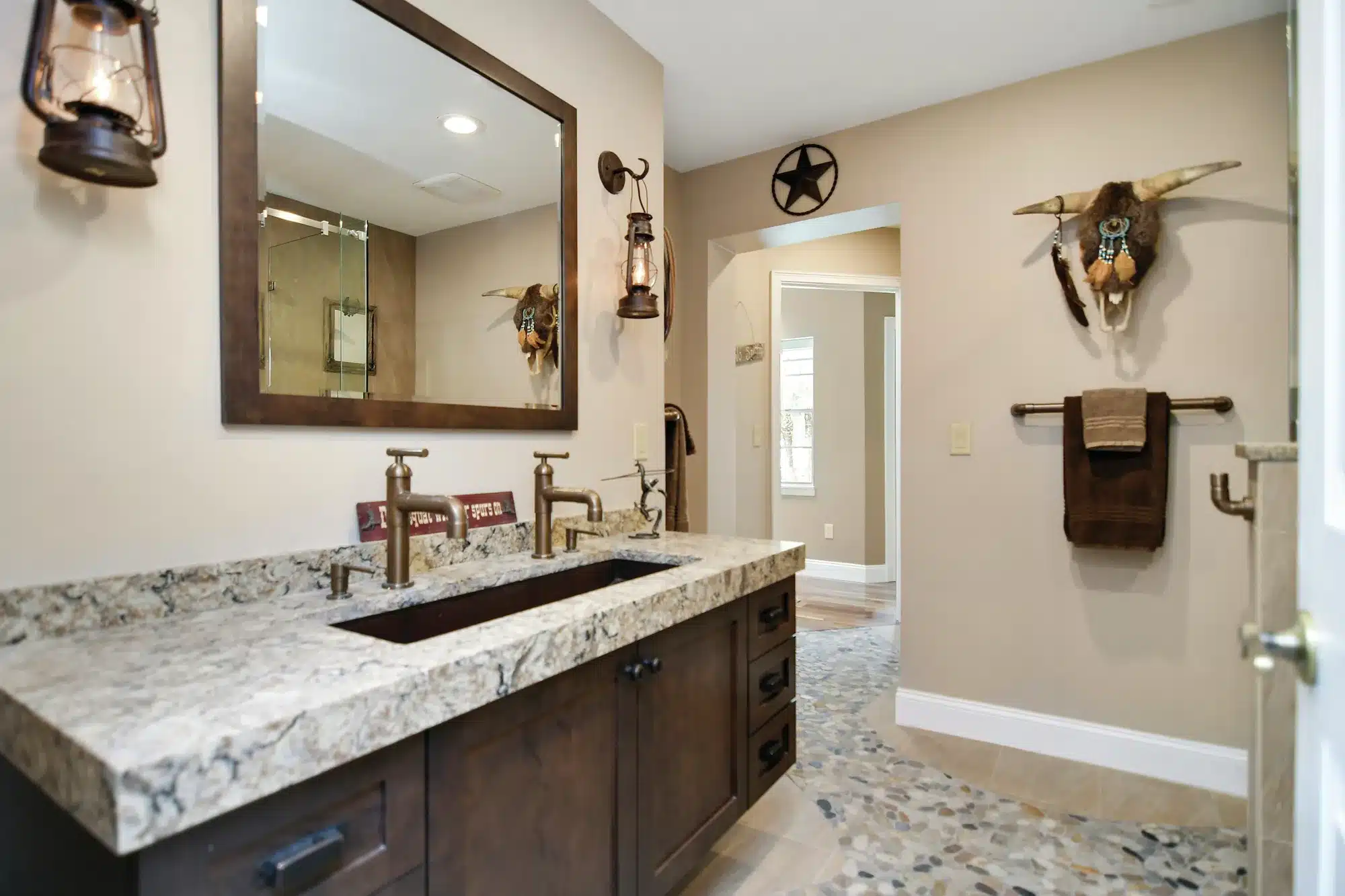
Single sink vanities are the standard choice for guest bathrooms, powder rooms, and smaller primary baths. The standard width range is 24″–48″. A well-configured 36″ single sink vanity with semi-custom cabinetry, an undermount rectangular sink, and quartz countertop installs for $1,800–$3,500 in most markets.
The single-sink format gives you more countertop surface relative to basin space, which many homeowners prefer for storage and counter use. It is also easier to install, with a single set of drain and supply connections rather than two.
Double Sink Vanity Cost: $400–$1,500 More Than Single
Double sink vanities require a minimum 60″ width to function comfortably, with 72″ being a more generous standard. The additional sink, faucet, and drain assembly adds $200–$600 in fixtures alone. The wider cabinet costs more, and if the plumbing rough-in is not already set up for two sinks, adding a second drain and supply line adds $300–$800 in plumbing labor.
Most remodeling projects targeting a double sink vanity in a space that previously had a single sink should budget an extra $600–$1,500 above the cost of the vanity and top to cover the plumbing upgrade.
Family Handyman bathroom guidance notes that double sink vanities are most valuable in households with two regular users who have genuinely different morning routines. In practice, many homeowners who upgrade to a double sink report using only one side most of the time.
Which Sink Count Adds More Value
For resale purposes, a double sink primary bath vanity is a recognized selling point in most markets above the $400,000 home price point. Below that threshold, the presence of a double sink is less reliably valued by buyers. If the renovation is primarily for personal use rather than resale, the choice should be driven by how you actually use the bathroom morning-to-morning.

Vanity Materials and How They Affect Cost
Cabinet Box Construction
The cabinet box (the structural carcass) is the most important determinant of how long a vanity holds up, particularly in bathroom environments with humidity cycling from showers and baths.
- Particleboard/MDF: Standard in stock and lower-tier semi-custom. Susceptible to swelling and delamination if water infiltrates at joints or at the base. Adequate for guest baths and powder rooms that see limited moisture exposure.
- Plywood: Standard in mid-to-upper semi-custom lines. More dimensionally stable under humidity changes, holds fasteners better, and handles minor water exposure without swelling. Worth the upgrade in any bathroom that gets regular use.
- Solid wood: Used in high-end semi-custom and custom vanities for face frames and door construction. Solid wood moves with seasonal humidity changes, so plywood or MDF is actually preferred for flat panel applications.
The jump from particleboard to plywood box construction typically adds $150–$400 to cabinet cost at the semi-custom tier. In a humid climate or a primary bathroom that sees daily shower use, that cost difference is worth it.
Door and Drawer Construction
Frameless (full-access European) cabinets have no face frame, giving full access to the cabinet interior and a more contemporary look. Face-frame cabinets have a wood frame on the cabinet front, which adds rigidity and a more traditional look but reduces interior access slightly.
Inset doors, where the door sits flush inside the face frame rather than overlaying it, add $300–$800 to cabinet cost due to the precision required in fitting. Overlay doors (standard on most stock and semi-custom) are less expensive and easier to adjust.
Drawer construction quality follows a similar gradient: stapled particleboard drawer boxes (stock) to dowelled MDF (mid-range semi-custom) to dovetail solid wood (premium semi-custom and custom). Dovetail construction adds roughly $50–$150 per drawer box in manufacturing cost.
Finish and Coating
Painted finishes are the most popular and the most demanding in terms of quality control. A well-applied conversion varnish or catalyzed lacquer will hold up well in bathrooms. A poorly sprayed painted finish will show wear at the corners and edges within a few years.
Wood stain and clear coat finishes are less popular in bathrooms than in kitchens due to moisture sensitivity but remain common in traditional and transitional designs. Thermofoil (vinyl-wrapped MDF) is common in stock units and is moisture-resistant but can peel at high temperatures over time.
Consumer Reports product testing has documented significant variation in finish durability between cabinet brands at similar price points, suggesting that finish quality is not reliably correlated with retail price in the stock and lower semi-custom tiers.

Countertop Choices for Vanities and Their Costs
The countertop is the second-biggest variable in bathroom vanity cost and the one most homeowners underestimate when budgeting. A $900 cabinet with a $600 quartz top looks and performs better than a $1,200 “complete” vanity set with a $150 cultured marble top. Choosing countertop material independently of the cabinet is almost always a better approach than buying a packaged set.
Cultured Marble: $150–$450 for a Standard Vanity Top
Cultured marble is a polymer composite with a marble-dust filler, molded in standard shapes. It is the default countertop material in budget and lower mid-range complete vanity sets. It is nonporous, easy to clean, and holds up reasonably well over time.
The limitation is appearance: cultured marble looks like what it is, and yellowing and staining around the bowl are common after several years of use. It is entirely appropriate for guest baths, rental properties, and any application where long-term aesthetics are less important than low cost.
Quartz: $350–$900 for a Standard Vanity Top
Engineered quartz is the most popular countertop upgrade in bathroom remodels. It is nonporous, consistent in color and pattern, resistant to staining, and available in a wide range of appearances including convincing marble looks. A 36″–48″ single sink quartz vanity top fabricated with an undermount cutout and standard edge profile runs $350–$600 for the slab work in most markets, plus $80–$150 for installation.
For projects where you want to understand how countertop cost scales across different rooms, see the kitchen countertop cost guide comparing quartz vs granite vs marble for a side-by-side comparison of the same materials in a larger format.
Granite and Natural Stone: $400–$1,200 for a Standard Vanity Top
Natural granite, marble, and quartzite are less common in bathrooms than in kitchens because the smaller countertop format makes the cost difference less dramatic and the maintenance trade-offs more noticeable. Marble is porous and susceptible to etching from toothpaste, face wash, and other mildly acidic products. It is a beautiful choice but requires more care than quartz.
Granite is more practical than marble and less expensive. A standard 36″ granite vanity top with an undermount cutout typically runs $350–$700 for the stone and fabrication, similar to quartz. The primary driver of natural stone cost is slab selection: commodity granite runs $40–$60 per square foot installed, while premium or exotic slabs can reach $120–$200 per square foot.
Tile and Other Options
Tile countertops are uncommon in new vanity installations but are occasionally chosen for their design flexibility and ability to match floor or wall tile. Cost is modest ($200–$500 for a standard 36″–48″ top) but grout maintenance is a real ongoing consideration. For homeowners evaluating tile options more broadly, the bathroom tile cost guide covers porcelain, ceramic, and stone in detail.
| Countertop Material | Cost for 36″–48″ Top (Fabricated + Installed) | Notes |
|---|---|---|
| Cultured marble | $150–$450 | Molded with integral sink; budget option |
| Tile | $200–$500 | Grout maintenance required |
| Butcher block/wood | $250–$600 | Seal carefully; not ideal for primary baths |
| Quartz | $350–$750 | Best value for quality and appearance |
| Granite | $350–$800 | Durable; wide price range by slab selection |
| Marble | $500–$1,200 | Beautiful; requires sealing and more care |
| Quartzite | $600–$1,400 | Premium natural stone; harder than marble |

Hardware, Sinks, and Faucets: The Fitting Cost Add-On
Hardware, sinks, and faucets are the line items that homeowners most commonly underestimate when budgeting a vanity. They are sold separately from most cabinets and semi-custom vanity tops, and the cost range is wide. Budgeting $400–$800 for this category on a mid-range single-sink vanity is realistic before installation is factored in.
Sink Types and Costs
The sink type affects both cost and the countertop fabrication requirements:
- Drop-in (self-rimming): $80–$350. The simplest installation; sits in a cutout and rests on the counter surface. Common in budget configurations.
- Undermount: $120–$500. Mounts below the countertop for a cleaner look and easier cleaning. Requires a solid countertop material (stone, quartz) that can be finished at the edge.
- Vessel: $100–$800. Sits on top of the countertop surface. The taller profile requires a counter height adjustment for comfortable use.
- Integrated (molded): Included in cultured marble top sets; custom integrated sinks in stone or solid surface run $300–$1,200.
Faucets and fixtures with EPA WaterSense certification use 1.2 gallons per minute or less at the lavatory, compared to a standard 2.2 gpm. WaterSense faucets cost no more than standard models at most price points and can meaningfully reduce water use over time.
Faucet Cost by Tier
Faucets for bathroom vanities span an enormous price range. The functional sweet spot for most remodels is $150–$400 for a quality single-hole or 3-hole deck-mount faucet from brands like Moen, Delta, Kohler (mid-tier), or American Standard.
Common faucet configurations and typical costs:
- Single-hole, single-handle: $80–$350
- Widespread (3-hole, 8″ spread): $150–$600
- Wall-mount: $200–$900 (plus $150–$300 additional plumbing labor)
- Vessel faucet (tall single-hole): $100–$400
Hardware: Pulls, Knobs, and Hinges
Cabinet hardware is a small line item with outsized visual impact. A standard 36″ vanity with 4 drawers and 2 doors requires 6–10 hardware pieces. Stock pulls from big-box retailers run $2–$8 each; quality hardware from specialty suppliers runs $8–$35 each. For a full vanity, plan on $50–$300 for hardware depending on the finish and brand.
Matte black and brushed nickel remain the dominant finishes in 2026. Unlacquered brass has seen significant growth in higher-end remodels. Mixing metal finishes (brass hardware with chrome faucet, for example) is increasingly common in design terms, though coordinating finishes throughout the bathroom still produces the most cohesive result.

Installation Cost and Plumbing Considerations
Standard Vanity Installation: $200–$600
Installing a vanity that directly replaces an existing one of the same or similar size is among the simpler bathroom trades tasks. A plumber or skilled handyman installs the cabinet, sets and secures the top, connects the drain assembly, and hooks up supply lines. In most markets, this work runs $200–$400 for a simple swap on a 36″–48″ single sink vanity, assuming no surprises behind the wall.
The cost increases when:
- The new vanity is larger than the old one and requires wall patching or floor repair at the edges
- The plumbing rough-in is in the wrong location for the new configuration
- The wall behind the old vanity has water damage requiring remediation before installation
- You are switching from a freestanding to a floating (wall-mount) design, which requires wall blocking and potentially opening the wall
Plumbing Rough-In Changes: $300–$1,500+
If you are adding a second sink where only one existed, moving drain or supply locations, or converting to a wall-mount faucet configuration, expect plumbing costs of $300–$1,500 depending on the scope. Moving a drain even a few inches often requires opening the floor or wall, which adds tile work and drywall repair to the project scope.
The most expensive plumbing scenario for a vanity replacement is moving drain location in a slab-on-grade home, which requires cutting concrete. That work can add $1,500–$4,000 to the project on its own and should be budgeted explicitly before committing to any layout change.
Permits and Accessibility Considerations
Vanity replacements like-for-like rarely require permits in most jurisdictions. Any project that involves moving drains, adding supply lines, or significant framing work typically does require a permit. Permit cost varies widely by jurisdiction: $75–$300 is common for a bathroom-scope permit.
The ADA bathroom accessibility guidelines specify clearance dimensions and mounting heights that affect vanity placement when designing for wheelchair access or aging-in-place use. A compliant accessible vanity typically requires a wall-mount configuration with knee clearance below, which affects both the cabinet selection and the installation scope.
Hidden Installation Costs
Common installation surprises that inflate final cost:
- Rotted subfloor at the base of the old vanity: $300–$800 to repair
- Outdated galvanized supply lines: $200–$500 to replace with copper or PEX
- No wall blocking for floating vanity: $150–$350 for blocking installation
- Out-of-level floor requiring shimming and scribe molding: $100–$200
- Tile work required at exposed side of new vanity: $200–$600

Floating vs Freestanding vs Built-In Vanity Cost Comparison
Floating (Wall-Mount) Vanity: $200–$600 Additional
Floating vanities are wall-mounted with no floor contact, creating a visually open bathroom floor and making cleaning easier. They are increasingly popular in contemporary and transitional designs. The cabinet itself is priced similarly to floor-mount units of comparable quality. The additional cost comes from installation: the wall must have blocking or a reinforced backing capable of supporting the cabinet weight plus the countertop and any contents.
In new construction or during a gut renovation where the walls are open, adding blocking is inexpensive ($50–$150 in materials and labor). Retrofitting blocking into a finished wall costs $200–$600 depending on the wall construction and whether tile or other finished surfaces need to be disturbed.
Freestanding Vanity: Standard Installation Cost
Freestanding (floor-mount) vanities are the most common configuration. They rest on the floor and are secured to the wall at the back. Installation is straightforward and does not require special wall preparation. This is the baseline against which floating and built-in costs are measured.
One underappreciated limitation of freestanding vanities: the exposed sides need to be finished if they are visible. If a 48″ vanity goes into a 52″ space, the exposed 4″ side panel is visible and should be either panel-matched to the cabinet finish or covered with a filler strip. This is typically a $50–$200 add in materials and is easy to overlook during budget planning.
Built-In Vanity: $1,500–$5,000+ Premium
A built-in vanity is framed into the wall, either recessing slightly into the wall cavity to gain depth or built up to the ceiling with upper storage. The visual result is furniture-quality integration that stock and semi-custom freestanding units cannot match. The cost premium is real: built-ins require more carpentry labor (typically 8–20 additional hours for a skilled carpenter), custom sizing in almost every case, and often custom millwork details at the ceiling or wall interface.
For primary bathroom renovations targeting a high-end result, the master bathroom remodel cost guide covers how built-in vanity cost integrates with the broader scope of a full master bath renovation.
| Vanity Mount Type | Cabinet Cost Relative to Equivalent Freestanding | Additional Installation Cost |
|---|---|---|
| Freestanding (floor-mount) | Baseline | Baseline ($200–$400) |
| Floating (wall-mount) | +$0–$200 | +$200–$600 for blocking |
| Built-in | +$500–$3,000+ | +$800–$3,000+ carpentry labor |

Powder Room vs Master Bath Vanity: Cost Differences
Powder Room Vanity: $400–$2,500 Installed
Powder rooms (half baths with sink and toilet only) use smaller vanities, typically 18″–30″ wide. The limited space and the fact that powder rooms are used primarily for hand washing (not showering or grooming) means the design emphasis is often on visual impact over storage. Many homeowners choose a more distinctive or decorative vanity for the powder room than they would for a larger bathroom, since the smaller scale makes a statement piece more affordable.
A basic 24″ stock vanity with a drop-in sink installs for $400–$900 in a powder room. A small furniture-piece vanity or a converted antique dresser with a vessel sink can run $800–$2,500 installed. The conversion-to-vanity approach is popular in powder rooms because the small scale keeps the plumbing work limited.
Guest Bathroom Vanity: $700–$3,000 Installed
Guest bathrooms typically use 30″–48″ vanities. This is the context where stock and lower-tier semi-custom vanities offer the best value, since guests rarely notice cabinet construction quality and the space typically gets less daily wear than a primary bath. A mid-tier 36″ semi-custom vanity with quartz top and a quality undermount sink installs for $1,200–$2,200 in most markets.
Water efficiency matters even in lower-use bathrooms. Selecting a faucet with the EPA WaterSense program label in a guest bath or powder room adds no cost premium and reduces water use when guests are present.
Primary Bath Vanity: $1,500–$8,000+ Installed
The primary bathroom vanity gets the most daily use and has the highest visibility impact on the homeowner’s experience of the home. It is also the context where upgrading from stock to semi-custom or custom quality has the greatest payoff in terms of daily satisfaction.
Typical primary bath vanity configurations by budget:
- $1,500–$2,500: 48″ semi-custom with quartz top, undermount sink, quality faucet
- $2,500–$4,500: 60″–72″ double sink, solid plywood construction, quartz or stone top
- $4,500–$8,000: 60″–72″ premium semi-custom or entry custom, full-extension soft-close hardware, natural stone top
- $8,000–$15,000+: Full custom with site-built carpentry, high-spec stone, integrated lighting, specialty hardware
Research compiled by Houzz bathroom design inspiration shows that the primary bathroom vanity is among the top five features homeowners prioritize in full bathroom renovations, with double sinks and custom storage cited as the most requested upgrades in surveys of remodeling homeowners.
The walk-in shower and vanity together typically account for 40%–55% of total primary bath remodel spend. If you are planning a full primary bath, see the walk-in shower cost guide to understand how those two line items interact in your overall budget.

Where to Save and Where to Splurge on a Vanity
Smart Places to Save
Not every part of a vanity merits premium spend. These are the areas where the lower-cost option performs comparably to the upgrade:
- Cabinet box material in a powder room or low-use guest bath. Particleboard holds up fine in spaces that see minimal humidity exposure. Save the plywood upgrade for the primary bath.
- Faucet trim finish in a guest bath. Chrome holds up well and is the easiest to clean.
- Drop-in sink in a powder room. An undermount sink looks cleaner, but the visual difference is smaller in a powder room and the cost savings are real.
- Stock cabinet sizing when your space is standard. If you have a 36″ opening and are fine with a 36″ vanity, a quality stock unit at $400–$700 will look and perform well.
Where the Upgrade Pays Off
Certain upgrades reliably justify their cost in either durability, daily experience, or resale value:
- Plywood box construction for the primary bath. The humidity cycling from daily showers is exactly the condition where particleboard fails over time. Plywood construction in a primary bath is basic durability planning.
- Undermount sink over drop-in. The cleaning advantage of an undermount sink (no rim to collect debris) is real and appreciated every day. The cost difference is modest ($50–$150) and consistently cited by homeowners as worth it.
- Soft-close drawer and door hardware. The operational feel of a vanity is largely determined by its hardware. Full-extension soft-close drawers add roughly $200–$500 to semi-custom cabinet cost and make the vanity feel substantially more considered.
- Quartz countertop over cultured marble. At $200–$400 more for a standard vanity top, quartz is the most cost-effective upgrade in a mid-range remodel. It looks better, performs better, and does not yellow.
Common Spending Mistakes to Avoid
The following mistakes show up regularly in bathroom remodel budgets:
- Buying a complete vanity set (cabinet plus cultured marble top plus generic faucet) when the total of individually selected components would be similar in cost but significantly better in quality
- Installing a floating vanity without adequate wall blocking and discovering the problem after tile is set
- Choosing marble countertops in a bathroom used by children or teenagers, where toothpaste etching will become visible within months
- Upgrading to a double sink in a space under 60″ wide, where the practical usability is compromised by insufficient counter space on each side
Bob Vila project guidance recommends establishing the total vanity budget (cabinet plus top plus sink plus faucet plus hardware plus installation) before choosing any individual component, to avoid the common scenario where the budget is consumed by the cabinet and the countertop ends up value-engineered at the expense of the overall result.
One additional area where homeowners routinely overspend: hardware finishes. Matte black hardware costs 20%–40% more than equivalent chrome hardware from the same manufacturer. In a guest bath where you are already watching the budget, chrome hardware performs identically and costs less. Save the premium finish for rooms where you interact with the space daily.

How to Get an Accurate Vanity Quote
What to Have Ready Before You Call a Contractor
Getting an accurate vanity installation quote requires you to bring more information than most homeowners realize. Contractors price installation based on the scope of what they find, and scope depends on what you are starting with and what you are doing to it. Come to the conversation with:
- Current vanity dimensions (width, depth, height) and number of sinks
- Photos of the existing plumbing configuration (under-sink access photo, wall rough-in if visible)
- Whether the floor is tile, hardwood, or vinyl, and whether the vanity base extends under the floor finish
- Your target new vanity width and mount type (freestanding, floating, built-in)
- Whether you are planning any countertop, sink, or faucet changes
This information lets a contractor give you an installation estimate that reflects your actual scope rather than a generic range that often proves wrong in both directions.
How to Compare Quotes
Vanity installation quotes vary significantly in what they include. Two quotes of “$500 installation” may differ by whether they include countertop setting, plumbing connection, disposal of the old unit, patching at the old vanity footprint, and caulking and finishing work. Ask each contractor to itemize what is and is not included before comparing numbers.
A useful check: ask what the most common unexpected cost is on a project like yours. A contractor who gives you a specific, experience-based answer (“We usually find the supply valve is original and needs replacement, that is typically $80–$120 additional”) is telling you they have done this job before.
Understanding Lead Times and Project Scheduling
Stock vanity lead times are 1–5 business days, which gives contractors flexibility to schedule installation quickly. Semi-custom lead times of 2–6 weeks require more planning: the cabinet typically should be ordered and confirmed before scheduling the plumber and tile subcontractor, since delays in cabinet delivery cascade through the rest of the project.
Custom vanity lead times of 6–16 weeks require the most advance planning. A bathroom remodel that includes a custom vanity cabinet should have the cabinet ordered before demolition begins. Experienced contractors and kitchen and bath designers will insist on this sequence. For guidance on water heating considerations that affect the broader bathroom scope, the US Department of Energy on water heating provides useful background on energy-efficient options that may affect fixture selection.
The Full Bathroom Remodel Context
If you are replacing the vanity as part of a broader bathroom renovation rather than as a standalone swap, the vanity line item will be priced in the context of total project scope. A vanity replacement that is part of a full bathroom remodel often costs less in installation labor than a standalone swap because the plumber and carpenter are already mobilized on site.
For a complete picture of how vanity cost integrates with tile, fixtures, shower, and finish work in a full bathroom renovation, see the full bathroom remodel cost breakdown for the complete view. The vanity is the highest-visibility line item in most bathroom budgets. Getting the allocation right across cabinet, countertop, fixtures, and installation is the difference between a renovation that delivers daily satisfaction and one that leaves you wishing you had spent differently.
Working with contractors or designers credentialed through the National Kitchen and Bath Association gives you access to professionals who work with vanity specifications regularly and can help you avoid the most common specification and installation errors before they become expensive problems. Bring your measurements, bring your photos, and bring a budget range that covers all four components. That preparation is what separates the homeowners who get an accurate quote on the first call from those who go through three rounds of revisions before the project starts.