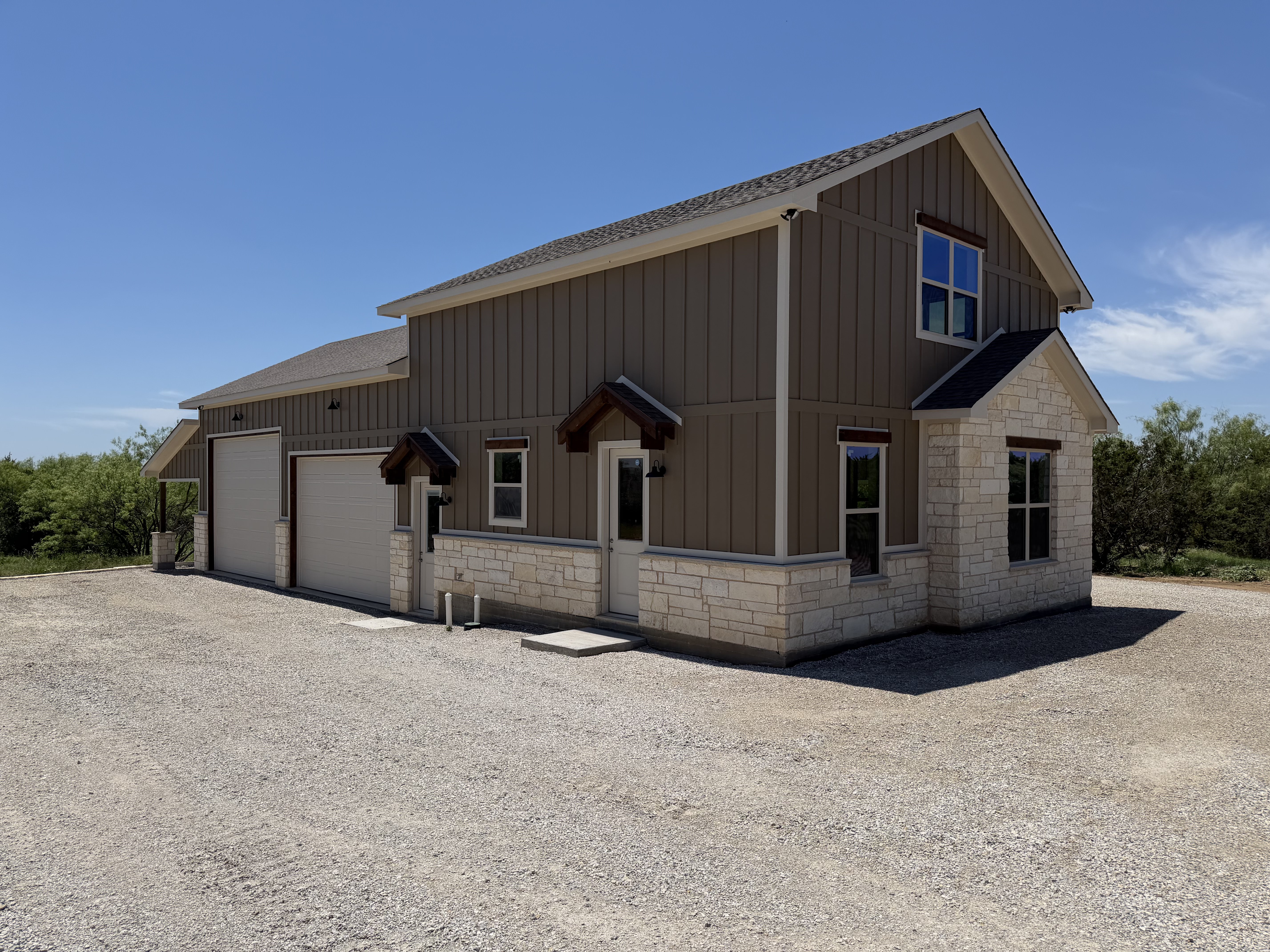
A useful Irving kitchen remodel reference point is Terry Martella’s project, which Fin Home completed and which Terry has written about publicly. Her story covers the planning sequence, material selections, and the trade-offs that most homeowners only encounter once they’re already deep into the work. We link to it below, and we’ll come back to it.
For the question of what a kitchen actually costs in Irving in 2026: most full-replacement kitchen remodels in Fin Home’s Irving portfolio settle into the $32,000 to $48,000 band. Lighter cosmetic refreshes can come in under that. Structural reconfigurations with custom cabinets and high-end appliances run above it. The middle band is the most common, and it’s the one this guide focuses on, because it’s where homeowners face the most consequential trade-offs.
To give a sense of broader scale, two recent full-project remodels Fin Home delivered in Irving landed at $36,324 and $38,862. Those were broader scopes than kitchen-only work, but they sit in the same general band where Irving kitchen pricing concentrates.

Where the Money Goes in a Mid-Range Irving Kitchen
A kitchen project that lands in the $32,000 to $48,000 band usually has the following rough split. The numbers below are typical bands from completed Irving and adjacent DFW kitchens, not quotes for any specific job.
| Line item | Typical range | Notes |
|---|---|---|
| Cabinets | $12,000 – $22,000 | Stock at the bottom, semi-custom in the middle, partial-custom at the top |
| Countertops | $3,000 – $8,000 | Entry quartz to mid-grade granite or quartzite |
| Appliances | $4,000 – $15,000+ | Standard package on the low end; pro-style or panel-ready on the high end |
| Plumbing, electrical, lighting | $2,000 – $6,000 | Sink relocations and code updates drive most variation |
| Flooring | $2,000 – $6,000 | Depends on extent and tie-in to adjacent rooms |
| Demo, debris, permits, PM | $5,000 – $10,000 | Includes the project manager’s coordination time |
| Backsplash, paint, trim | $1,500 – $4,000 | Tile selection has the widest finish-level spread |
The midpoints of those ranges add up to roughly $36,000 to $50,000, which is the heart of the Irving mid-range band.
Two things to notice. First, cabinets are the largest single line, often by a wide margin. Second, the labor and coordination line (demo, debris, permits, project management) is real money for work that produces no visible finish. Homeowners regularly question that line on a first read. It’s the difference between a kitchen that finishes on schedule and one that drifts for weeks because no one is coordinating the trades.
The Cabinet Decision Sets the Ceiling
If you want to predict where a kitchen budget will land before any selections are made, the cabinet decision tells you most of what you need to know.
Stock cabinets (factory-stocked sizes and finishes) anchor the $12,000 to $14,000 end. They install fast, lead times are short, and the cabinet line itself stays manageable. The trade-off is fewer sizes, fewer accessories, and visible filler strips where rooms aren’t laid out on stock-friendly dimensions.
Semi-custom cabinets, which dominate the mid-range Irving kitchen, typically run $16,000 to $20,000 for a standard kitchen footprint. You get soft-close drawers and doors, more box sizes, taller upper options, and the interior storage features (deep drawers for cookware, trash pullouts, spice pullouts) that most homeowners actually want. Lead times stretch to six to ten weeks.
Custom cabinets, where every box is built to fit, run $22,000 to $35,000 and up. They’re worth the spend when a kitchen has unusual dimensions, when a homeowner wants integrated panel-ready appliances to read seamlessly with the cabinet plan, or when the design includes furniture-style islands or specialty millwork. Lead times can run twelve to sixteen weeks.
The reason this decision sets the ceiling is that every adjacent decision keys off it. Custom cabinets pair naturally with stone countertops and panel-ready appliances. Stock cabinets paired with high-end appliances usually look mismatched, and the dollars spent on the appliances don’t return the value they would in the right context. When the cabinet tier moves up, the rest of the kitchen tends to follow.

What Irving Homeowners Consistently Under-Budget For
After enough Irving kitchen projects, a few line items show up as surprises on almost every first-pass budget. They’re not exotic. They’re the ones that get left off because they don’t fit cleanly into the cabinet-counters-appliances mental model.
Hood venting is the first one. If the existing range hood vents through a wall to the exterior and the new range stays in the same position, this is a small line. If the range moves, or if the existing hood was a recirculating model with no exterior vent, running new ductwork through a slab home’s ceiling out to an exterior wall can add $1,000 to $3,000. In Las Colinas townhomes and older central Irving ranch houses, the route from cooktop to exterior wall is sometimes the hardest part of the entire kitchen.
Appliance dimension changes are the second. A 36-inch range where a 30-inch range used to sit changes every cabinet flanking it. A counter-depth refrigerator that’s narrower or wider than the existing model rebuilds the surrounding cabinet plan. Appliance specs need to be locked in before cabinets are ordered. When they’re not, change orders run $800 to $3,000 per affected unit.
Electrical code updates are the third. Older Irving kitchens (1960s and 1970s housing stock especially) often need GFCI outlets added at every counter location, dedicated circuits for new appliances, and sometimes panel capacity upgrades. When a 1970s panel doesn’t have a slot for the new induction range’s circuit, that’s a separate $1,500 to $3,500 conversation with an electrician.
Flooring transitions are the fourth. The kitchen flooring decision often forces a decision about adjacent rooms. If the new floor doesn’t match the existing hardwood in the dining room, the homeowner has to choose: stop at a transition strip, refinish the adjacent floors to match, or extend the new flooring further than originally planned. Each option has a different cost and a different visual outcome.
Counter and sink template costs are the fifth. The fabrication number from a slab vendor is sometimes quoted before template and edge work is included. Templating happens after cabinets are installed, because the template has to be exact, and edge upgrades, cutouts for apron-front sinks, and faucet hole drilling can add $400 to $1,200 to the headline number.
None of these are dishonest gaps in a contractor’s estimate. They’re the lines that depend on selections the homeowner hasn’t made yet at the planning stage. A good estimate flags them as allowances or to-be-determined items rather than hiding them.
How to Read an Irving Kitchen Estimate
A useful Irving kitchen estimate has a few characteristics that homeowners should look for, and a few common gaps that they should ask about.
It separates labor from materials within each major category. A line that says “cabinets: $18,000” tells you less than “cabinets (materials, semi-custom): $14,500; cabinet installation labor: $3,500.” The split matters because if you decide to upgrade or downgrade the cabinet selection later, you know which part of the number moves.
It identifies allowances clearly. An allowance is the contractor’s placeholder for an item the homeowner hasn’t selected yet (countertops, tile, lighting fixtures, sometimes appliances). A good estimate calls allowances out by name and gives the range the allowance assumes. If the countertop allowance is $4,500 and you fall in love with a $7,200 quartzite, you know the swing in advance.
It lists what’s included in demolition, debris, and protection. That covers cabinet and countertop removal, floor protection in adjacent rooms, dust barriers, and dumpster fees. If those aren’t itemized, ask. They’re real costs that should be visible.
It identifies what the homeowner supplies versus what the contractor supplies. Appliances are commonly homeowner-supplied (the contractor coordinates installation but the homeowner buys and stores them). Plumbing fixtures sometimes are too. Lighting fixtures often are. The estimate should be clear about which line items assume contractor-supplied versus owner-supplied items.
It calls out permit and inspection costs separately. In Irving, residential remodel permits are processed through the City of Irving Inspections Department at 825 W. Irving Blvd., on the second floor of City Hall, with applications filed through the MGO online portal. Permit fees themselves are usually modest, but the time the project manager spends coordinating submissions, scheduling inspections, and validating trades is real labor. That time belongs in the estimate.
What a good estimate does not do is collapse the kitchen into a single “kitchen remodel: $42,000” line. If the number is unbroken, ask for a breakdown before signing. You’re not being difficult. You’re protecting yourself from change-order surprises that should have been visible at the start.
The Las Colinas Factor: HOA Architectural Review
For Irving homeowners outside Las Colinas, this section is optional reading. For Las Colinas homeowners, it’s a real planning consideration that affects timeline more than it affects cost, but it does affect both.
Most Las Colinas neighborhoods sit inside the Las Colinas Association’s architectural review jurisdiction. For interior-only kitchen remodels with no exterior changes (no new windows, no vent hood penetrations through the exterior wall, no changes to the building envelope), most projects don’t trigger review. For anything that touches the exterior, including a new hood vent termination, a window changeout to fit a relocated sink, or a small bump-out to gain pantry space, the architectural review process can add two to six weeks to the schedule.
What this costs in dollars depends on how the contractor handles it. If the project manager prepares and submits the review package as part of the standard scope, the cost is mostly absorbed into the project management line. If the package requires architect-drawn elevations or revised drawings, that’s a separate $500 to $2,500 line.
The reason this matters at the budgeting stage rather than the construction stage is timeline impact on total cost. A homeowner who plans for a six-week kitchen project and then discovers a four-week HOA review window in the middle ends up either accelerating selections (which usually means compromises) or paying for an extended temporary kitchen setup. Plan for the review on the front end and the schedule holds.
This is one of the genuine differences between an Irving kitchen remodel and a kitchen remodel in a city without an active master-planned HOA layer. Most Irving contractors who work in Las Colinas have seen the process. Ask any contractor you’re considering how they handle the review timeline.
Cosmetic-Only Kitchens and the Permit Exception
One nuance worth understanding before you commit to a scope: the City of Irving does not require permits for cosmetic work, including painting, carpeting, and cabinetry, nor for replacing fixtures or appliances at existing connections (water heaters are the main exception).
That carve-out matters for budgeting because it means a kitchen project scoped to stay within cosmetic boundaries (new cabinets in the existing footprint, countertops, backsplash, paint, appliance swaps at existing locations) doesn’t trigger the permit process. The labor and material costs still exist, but the permit-coordination overhead is lower.
Where the exception runs out is the moment any of the following happens: the sink moves (plumbing relocation), the range moves to a wall without existing gas or 240V service (electrical or gas work beyond replacement), a wall opens up (structural), or new circuits get added to support new appliance load (electrical). At that point you’re back inside the standard permit process.
For Irving homeowners weighing a $25,000 cosmetic refresh against a $42,000 mid-range full remodel, the permit factor itself is small. The more important question is whether your project truly stays cosmetic. A surprising number of “cosmetic refresh” projects discover a relocation need once cabinets come off the wall. A good estimate identifies that risk in advance and budgets for the possibility, rather than waiting to surprise you mid-project.
Terry Martella’s Irving kitchen story is a useful read on the planning conversation that separates a true cosmetic update from a project that’s actually solving how a kitchen works. The selection sequence Terry walks through is the same one Fin Home uses with every Irving kitchen client, and it’s the part of the process that determines whether a budget holds. For a closer look at how Fin Home prices and approaches kitchen work in this market, see the Irving kitchen remodeling page.