Cabinet work is almost always the largest single line item in a kitchen remodel. Cabinetry typically accounts for 35–45% of total project cost, which means the choice between replacing cabinets outright or refacing the existing ones has real financial weight. Get it wrong in either direction and you either overpay for a job that didn’t need to go that far, or you spend $3,000–$6,000 on refacing work that fails to address structural problems and leaves you replacing the cabinets two years later anyway.
This guide covers what each path actually costs in 2026, what you get (and give up) at each price tier, and how to make a defensible decision before any contractor sets foot in your kitchen. For broader kitchen project costs, the full kitchen remodeling cost breakdown provides the hub-level context this article feeds into.

Replace vs Reface Kitchen Cabinets at a Glance
The table below is a fast-reference summary. Every figure is a national average range for 2026 based on a standard 10×10 kitchen (roughly 20 linear feet of cabinetry). Your actual costs will vary based on region, material tier, and kitchen layout.
| Factor | Cabinet Refacing | Cabinet Replacement |
|---|---|---|
| Typical total cost | $1,500–$9,000 | $5,000–$30,000+ |
| Cost per linear foot | $75–$450 | $250–$1,500+ |
| Project timeline | 2–5 days | 2–4 weeks |
| Layout changes possible | No | Yes |
| Box condition required | Good to excellent | Any (replaced) |
| ROI at resale | Moderate (60–70%) | Higher (70–80%+) |
| Disruption level | Low | High |
| Best for | Cosmetic refresh | Structural problems or layout changes |
Refacing is the budget path when the cabinet boxes are sound. Replacement is the right call when boxes are damaged, when you want to change the layout, or when you’re planning to sell within two to three years and want the maximum return. This Old House kitchen guides document both paths in detail for homeowners who want to see real project photos before committing.
What “average cost” actually means
National averages compress enormous regional variation. A $6,500 refacing job in Chicago might cost $4,200 in Kansas City and $8,500 in the San Francisco Bay Area. Labor is the primary driver of that spread: carpenter rates tracked by the Bureau of Labor Statistics carpenter page range from $22–$35/hour in lower-cost markets to $45–$65/hour in high-cost metros. Material costs are more uniform nationally because most cabinet components ship from regional distribution centers.
How kitchen size multiplies costs
A 10×10 kitchen is the industry benchmark, but most kitchens are larger. Common real-world kitchen sizes and their approximate cabinet cost ranges:
| Kitchen Size | Linear Feet (approx.) | Refacing Range | Replacement Range |
|---|---|---|---|
| Small galley (8×10) | 16–18 LF | $1,200–$6,500 | $4,000–$22,000 |
| Standard (10×10) | 20 LF | $1,500–$9,000 | $5,000–$30,000 |
| Large (12×14) | 26–30 LF | $2,000–$13,500 | $6,500–$45,000 |
| Open-plan (16×18+) | 35–50 LF | $2,600–$22,500 | $8,750–$75,000+ |
Material tier drives the range more than anything else
Within replacement, the spread from $250 to $1,500+ per linear foot is almost entirely a material story. Stock cabinets from home improvement chains anchor the low end. Semi-custom cabinets from regional manufacturers fill the middle. Full custom cabinets built to spec by a cabinet shop occupy the upper tier. Refacing pricing is similarly tiered by veneer material, from thermofoil at the low end to real-wood veneer and solid wood doors at the high end.
What Cabinet Replacement Actually Includes
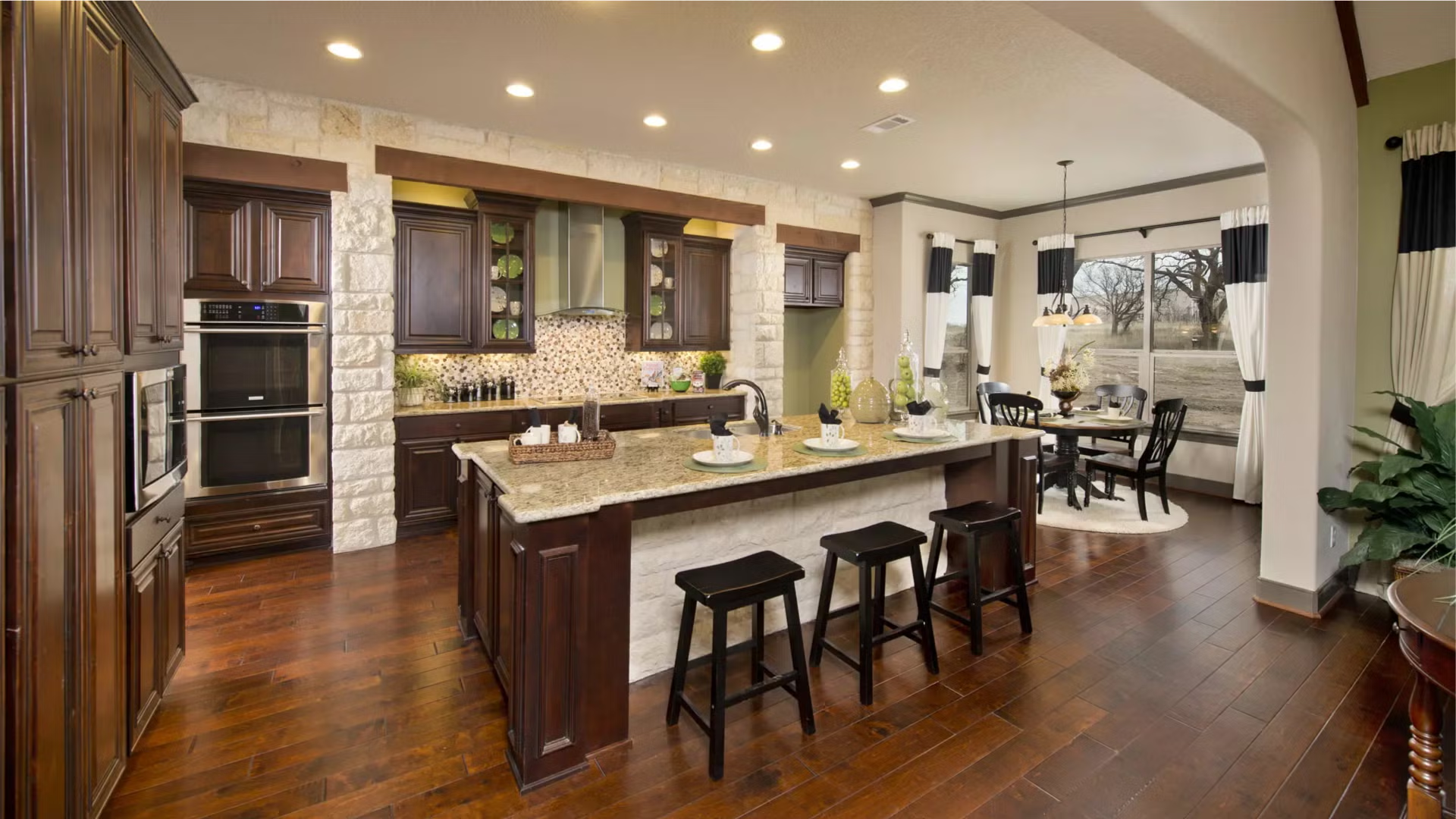
Cabinet replacement means removing every existing cabinet, down to bare walls and floor, and installing entirely new boxes, doors, drawer fronts, drawer boxes, hardware, and interior fittings. The process typically also includes new toe kicks, crown molding, and cabinet fillers where the new layout doesn’t perfectly match the old footprint.
The full scope of demolition and disposal
Demolition is fast but generates substantial debris. A standard 20-linear-foot kitchen produces 15–25 cubic yards of material: cabinet boxes, doors, drawer fronts, and hardware. Disposal is usually included in contractor quotes for replacement projects, but confirm this before signing. Some contractors haul to the dump; others leave it at the curb and bill you separately. Dumpster rental for a cabinet demo runs $350–$600 if you’re managing it yourself.
The walls behind old cabinets sometimes reveal problems: water damage from a slow dishwasher leak, outdated wiring that runs through cabinet cavities, or damaged plaster that needs patching before new cabinets go in. Experienced contractors price a contingency into their bids for this reason. Budget an additional 10–15% for surprises in kitchens over 20 years old.
Cabinet box construction and quality levels
The three cabinet tiers differ in how they’re built, not just how they look. Understanding the construction tells you what you’re actually paying for.
Stock cabinets (used in builder-grade replacements) are manufactured in fixed sizes, usually in 3-inch width increments, and ship flat-packed. They use particleboard or MDF for the box sides, which performs adequately in dry conditions but is vulnerable to water damage at joints. Prices run $60–$200 per linear foot installed.
Semi-custom cabinets are manufactured in the same factory lines as stock, but with more size options (often 1-inch increments), more finish choices, and better hardware. Plywood boxes are more common at this tier. Prices run $150–$650 per linear foot installed.
Full custom cabinets are built by a cabinet shop to your exact dimensions. You get any size, any wood species, any interior configuration. Build time is typically 6–12 weeks. Prices run $500–$1,500+ per linear foot installed. The National Kitchen and Bath Association maintains professional design standards that full custom cabinet makers typically follow, including standards for drawer box construction and door hinge durability.
What replacement does not include
Replacement quotes frequently exclude countertops, backsplash, plumbing reconnection (sink, dishwasher), and appliance installation. If you’re getting replacement quotes, verify line by line what’s in scope. A quote of $8,000 that excludes plumbing reconnection may balloon to $10,500 once a plumber touches the sink. For a complete picture of kitchen project costs, see the cost of kitchen cabinets guide which breaks down material and labor separately.

What Cabinet Refacing Actually Includes
Refacing preserves your existing cabinet boxes and replaces only the visible exterior: doors, drawer fronts, and the veneer or laminate applied to the box faces and sides. The result looks like new cabinets from any normal viewing angle, but the structural boxes behind the doors are original.
The three components of a refacing job
A standard refacing job has three components:
-
New doors and drawer fronts. These are the most visible pieces and the biggest cost driver within a refacing project. Door styles range from flat slab to shaker to raised panel. Materials range from thermofoil-wrapped MDF to solid wood.
-
Face frame veneer or laminate. The visible face frames (the strips of wood you see around the door opening) get covered with a thin veneer or rigid laminate matching the new door color and texture. This is what makes refacing look cohesive rather than like a door-swap.
-
New hardware. Hinges, pulls, and knobs are typically included in refacing packages. Cabinet hinges convert to soft-close as a standard upgrade at most refacing companies; budget $200–$500 extra for this across a full kitchen.
What refacing does not replace
Refacing leaves the interior of your cabinets unchanged. The box sides, shelves, drawer boxes, and bottom panels all remain original. If the interior surfaces are worn, stained, or damaged, they stay that way. Some refacing companies offer interior painting or contact-paper lining as an add-on for $200–$600.
Refacing also cannot change your layout. If you want to add an island, move a cabinet from one wall to another, add a pantry cabinet, or change the height of upper cabinets, refacing cannot do that. Any structural or layout change requires replacement.
“Cabinet refacing is cost-effective only when the existing boxes are structurally sound, plumb, and level. A refacing job applied to warped or water-damaged boxes is money spent that will not hold up.” — Family Handyman kitchen guidance
Refacing contractor types
You can hire a dedicated refacing company (there are national franchises that do only this), a general cabinet installer who offers refacing as one service, or a general contractor who subcontracts the work. Dedicated refacing companies often quote lower prices because they’ve systematized the process, but they’re limited to the materials and door styles they stock. A cabinet shop will give you more options but typically charges more.

Cost Comparison: Replace vs Reface (Per Linear Foot, Per Kitchen)
Costs per linear foot are the most useful comparison metric because they let you calculate estimated total cost from your own kitchen measurements.
Per-linear-foot cost by tier
| Path | Budget Tier | Mid Tier | Premium Tier |
|---|---|---|---|
| Refacing | $75–$150/LF | $150–$300/LF | $300–$450/LF |
| Replacement (stock) | $250–$400/LF | $400–$650/LF | — |
| Replacement (semi-custom) | $350–$550/LF | $550–$850/LF | $850–$1,100/LF |
| Replacement (full custom) | — | $700–$1,000/LF | $1,000–$1,500+/LF |
The overlap zone between premium refacing and budget stock replacement is where most homeowner decisions get complicated. At $300–$400 per linear foot, you’re close to the cost of stock replacement but with the limitations of refacing still in place. At that price point, replacement usually wins on value unless the boxes are genuinely excellent and the layout is exactly right.
What labor vs materials split looks like
For replacement projects, labor typically accounts for 40–55% of the total installed price. For refacing, labor is 50–65% because the precision work of fitting veneers is labor-intensive relative to the material cost. This split matters for one practical reason: when comparing quotes, a low-material quote with high labor can easily exceed a mid-tier cabinet package with efficient installation.
Regional cost multipliers
National averages need regional adjustment. These multipliers apply to the base ranges above:
| Region | Cost Multiplier |
|---|---|
| Northeast (NYC, Boston, DC) | 1.25–1.50x |
| Pacific Coast (LA, SF, Seattle) | 1.30–1.55x |
| Midwest (Chicago, Minneapolis, Detroit) | 0.95–1.10x |
| South (Atlanta, Houston, Dallas) | 0.85–1.00x |
| Mountain West (Denver, Phoenix) | 0.95–1.15x |
| Rural markets (any region) | 0.75–0.90x |
According to Houzz kitchen design inspiration, the median kitchen remodel budget for homeowners who updated cabinets in 2024–2025 was approximately $14,000 for major remodels and $6,500 for minor updates, consistent with the ranges in this guide.
Timeline Comparison: How Long Each Takes
Refacing timeline: 2 to 5 days
A professional refacing crew typically completes a standard 20-linear-foot kitchen in two to five days. Day one covers prep, cleaning, and measuring. Days two through three involve applying veneer to face frames and installing new doors. Days four through five are hardware installation and punch-list items.
The kitchen is partially usable throughout a refacing project. The sink is accessible on day one and throughout. Cooking is disrupted but not impossible. This is a significant quality-of-life advantage for households that can’t easily eat out for two to four weeks.
Replacement timeline: 2 to 4 weeks (minimum)
Cabinet replacement has a longer inherent timeline for two reasons: the factory lead time on new cabinets and the larger scope of installation work.
Lead times by cabinet type:
– Stock cabinets: typically in stock or 1–2 week lead time
– Semi-custom cabinets: 3–6 week lead time
– Full custom cabinets: 6–12 week lead time
Once cabinets arrive, installation takes 3–5 days for a standard kitchen. Add in countertop templating (which can’t happen until cabinets are installed) and countertop fabrication (another 1–2 weeks for stone), and you’re looking at 2–6 weeks of kitchen disruption from first day of demo to fully functional kitchen.
During replacement, the kitchen is completely out of service. The sink is disconnected. If you’re not on a construction-friendly property, you’ll need a temporary kitchen setup. Families consistently underestimate the cost and inconvenience of eating out or making do with a microwave for three to five weeks.
Timeline impact on total project cost
Timeline has indirect cost implications. A longer project means more days of contractor overhead, more coordination with plumbers and countertop fabricators, and higher probability of timeline slippage that pushes delivery into a higher-cost period (contractors in high-demand seasons charge more for rush work). If you’re on a tight completion deadline, refacing’s faster timeline is a genuine financial advantage, not just a convenience.

When Refacing Makes Sense (and When It Doesn’t)
Refacing is the right call in a specific set of circumstances. Outside those circumstances, it’s a waste of money.
Conditions where refacing makes financial sense
The following conditions, taken together, describe the ideal refacing candidate:
- Cabinet boxes are structurally sound. No water damage, no warping, no delamination on plywood panels, no soft spots from leaks. Boxes should be plumb and level within 1/4 inch.
- The layout works. You don’t need to move cabinets, add an island, or reconfigure the workflow. The existing footprint is functional.
- The interior is acceptable. You can live with the existing shelf material, drawer boxes, and interior finishes.
- You plan to stay 3–7 years. Refacing delivers its value over a medium-term horizon. If you’re selling in 12 months, replacement likely pencils out better on ROI.
- The cosmetic gap is real. Door styles, color, and visible surface condition are what’s making the kitchen feel dated. The underlying boxes are in good shape. Refacing addresses exactly that gap.
Where refacing fails to deliver
Refacing is the wrong choice when any of the following are true:
- Boxes have water damage, even minor visible swelling near the toe kick or under the sink cabinet
- The layout is inefficient and you’ve already identified the changes you want
- You’re planning a countertop replacement anyway and want a full renovation look
- The existing boxes are builder-grade particleboard and are more than 20 years old
- You want to change from a closed upper-cabinet configuration to open shelving or glass-front doors (this requires box modification, not just refacing)
Bob Vila project guidance recommends that homeowners do a corner-to-corner inspection of cabinet boxes before committing to refacing, specifically checking the interior bottom of the cabinet under the sink for soft spots and the toe kick area for swelling or discoloration, both of which indicate past water intrusion.
The “halfway house” problem
One pattern that costs homeowners money: refacing a kitchen and then replacing it two years later anyway because the boxes started failing. This typically happens when the boxes had marginal water damage at the time of refacing but the homeowner (or a less-than-thorough contractor) decided they were “good enough.” The refacing job runs $4,000–$7,000. The replacement two years later runs $12,000–$20,000. Total spend: $16,000–$27,000 for work that a straight replacement at the outset would have handled for $12,000–$20,000.

When Full Replacement Is Worth the Extra Cost
Replacement costs 2–5x more than refacing, but in several situations the premium is justified and the refacing alternative would be a mistake.
Structural box failure
Water damage is the most common reason replacement is mandatory. A slow dishwasher leak, a faulty garbage disposal, or an under-sink plumbing failure over months or years can compromise box bottoms and sides to the point where no amount of cosmetic work matters. Once particleboard or MDF has absorbed water and swelled, it doesn’t recover. The veneer won’t adhere cleanly, hinges won’t hold correctly, and the box will continue to deteriorate.
Real wood plywood boxes are more resilient to minor moisture exposure, but sustained water contact damages those too. If you find soft spots, visible swelling, or mold on the interior of any cabinet, build it into your replacement decision.
Layout changes you actually want
If your kitchen has the wrong workflow, the cabinets being replaced are also the opportunity to fix it. Common layout changes that require replacement:
- Adding or relocating an island
- Moving the sink to a different wall
- Converting a peninsula to open layout or vice versa
- Adding a pantry cabinet or tall cabinet where one didn’t exist
- Raising upper cabinets from standard 30-inch height to 36-inch or 42-inch to the ceiling
- Converting a corner cabinet to a pull-out Lazy Susan or blind corner solution
The kitchen island cost guide covers the cost to add or modify an island as part of a full cabinet replacement project. The cost of the island itself often runs $3,000–$10,000 on top of the base cabinet replacement, but the opportunity cost of doing refacing and living with the old layout for another decade is real.
When you’re selling within 2 years
Resale ROI consistently favors replacement over refacing, especially when buyers can identify refaced cabinets (which experienced buyers usually can). The resale discussion in this article’s ROI section covers the data in detail, but the short version: if you’re selling in 12–24 months, replacement at the mid-custom tier typically delivers a stronger sales-price premium than refacing.
Age of existing cabinets
Cabinets installed in the 1980s or early 1990s are more than 35 years old. Even if the boxes appear structurally sound today, they have limited remaining life. Spending $4,000–$7,000 on refacing a 35-year-old cabinet set that will need replacement in 5–8 years is hard to justify. Replacement on a 35-year-old kitchen delivers a fresh 20–30 year clock.
The kitchen countertop cost guide notes that countertop choices often look odd on top of significantly dated cabinetry, which means homeowners doing countertop replacements on older kitchens frequently end up doing cabinet replacement in the same project to achieve visual coherence.

Refacing Material Options and Their Cost Differences
Within refacing, material choice is the main variable that moves price. Here’s what each option delivers and what it costs.
Thermofoil and rigid thermofoil (RTF)
Thermofoil is a vinyl film heated and vacuum-pressed onto an MDF substrate. It’s the most affordable refacing option and produces a smooth, uniform surface that’s easy to clean. Typical installed cost: $75–$150 per linear foot.
Thermofoil’s weakness is heat: it can delaminate near heat sources (dishwashers, ranges, and even sunny windows in some climates). The vinyl cannot be repainted if you change your mind about color. On older thermofoil jobs, peeling at corners and door edges is a common failure point.
Rigid thermofoil (RTF) is a heavier-gauge version that wraps around shaped door profiles more reliably. It costs slightly more, $110–$180 per linear foot, and is more durable in high-moisture kitchens.
Wood veneer
Real-wood veneer is a thin slice of actual wood (typically 1/32 to 1/16 inch) adhered to an MDF or particleboard substrate. It looks and stains like solid wood, though the veneer thickness limits how many times it can be sanded before the wood layer is compromised. Typical installed cost: $150–$300 per linear foot for the doors and face frame veneer combined.
Wood veneer can be stained or painted, which gives you more flexibility for future updates than thermofoil. The quality of the veneer itself varies: shop-grade cherry or maple veneer at the low end looks similar to solid wood at arm’s length; matched-grain premium veneer used by custom cabinet shops is visually indistinguishable from solid wood.
Solid wood doors (veneer on box faces)
The premium refacing configuration uses solid wood doors and drawer fronts (not veneer-on-MDF) paired with real-wood veneer on the face frames. This is the refacing option that most closely approximates the look and feel of full replacement at the door and drawer level. Typical installed cost: $250–$450 per linear foot.
At this price point, the comparison to budget-tier replacement cabinet packages becomes direct. A 20-linear-foot kitchen at $350/LF for premium refacing runs $7,000. Budget stock replacement at the same linear footage and a $300/LF installed price runs $6,000. The $1,000 difference at the high end of refacing doesn’t buy a better structural box, it only buys a better-looking door on the same old box. That’s a meaningful tradeoff to understand before signing.
Hardware and soft-close upgrades
New hardware is standard in refacing packages, but there’s real cost variation within that category. Basic cup hinges and simple bar pulls run $150–$300 in materials for a 20-LF kitchen. Soft-close hinge upgrades add $200–$500. Undermount drawer slides (replacing side-mount slides on the original drawer boxes) add $400–$800. High-end decorative hardware (brass, unlacquered fixtures, oversize bar pulls) can add $800–$2,500 on its own.
Architectural Digest kitchen coverage regularly features hardware as the single cheapest-per-impact upgrade in a kitchen. If budget is the constraint, keeping the original hardware and upgrading just the doors and face frames can bring a refacing job in at the lower end of the range.

Hidden Costs Both Paths Carry
Both replacement and refacing have costs that don’t show up in initial quotes. Knowing these in advance prevents budget shock mid-project.
Hidden costs in cabinet replacement
- Countertop replacement. New cabinet boxes almost never match the exact height and footprint of old ones, which means existing countertops almost never fit correctly. Plan to replace countertops when replacing cabinets. Budget $2,000–$8,000+ depending on material.
- Plumbing reconnection. Every sink and dishwasher connection requires a plumber when the old cabinets come out and new ones go in. Budget $350–$900.
- Backsplash gaps. New cabinet boxes reveal old backsplash gaps or expose bare wall where old cabinets once sat. Budget $500–$3,000 for backsplash repair or replacement.
- Appliance panels. Dishwasher panels, refrigerator side panels, and range hood surrounds often need replacement to match new cabinetry. Budget $400–$1,500.
- Permit fees. Structural or electrical changes triggered by cabinet replacement may require permits, depending on your municipality. Budget $150–$600 if applicable.
- Touch-up painting. Walls, ceiling, and floor areas disturbed during demolition typically need paint. Budget $300–$800.
Hidden costs in cabinet refacing
- Under-sink cabinet base replacement. The base cabinet under the sink is the most likely candidate for water damage. Replacing just this one box (a hybrid approach) adds $400–$900 to a refacing job.
- Interior shelf replacement. Refacing doesn’t touch interior surfaces, but damaged or stained shelves are worth replacing independently. Budget $200–$600 for a full kitchen.
- Drawer box replacement. If your drawer boxes (the actual wooden box that slides in and out) are worn, broken, or use outdated slide hardware, replacing them adds $800–$2,000 for a typical kitchen. Consumer Reports appliance testing context applies broadly to product durability; the same expectation of functional durability applies to drawer hardware.
- Countertop mismatch. New doors in a different style or color can make existing countertops look dated. Budget $0 if you’re fine with a mismatch, or $2,000–$8,000 if you decide the countertops need to come along for the ride.
- Lighting. Under-cabinet lighting is frequently installed during refacing because access to the front of the cabinet face makes wiring easier. Budget $400–$1,200 for LED strip lighting professionally installed.
- Touch-up on adjacent walls. Face frame veneer application sometimes leaves adhesive residue on adjacent wall paint. Budget $100–$300 for touch-up painting.
The cost of doing it twice
The single biggest hidden cost of the entire replace-vs-reface decision is choosing refacing when replacement was the right answer, then replacing anyway two to five years later. Run the numbers honestly before committing. If the boxes have any signs of past water damage, if the layout is genuinely suboptimal, or if you’re in the house for the long term and want the project done once, the incremental cost of replacement over refacing is often recovered within the extended useful life.
ROI and Resale Value: Reface vs Replace
Return on investment is where the replace-vs-reface decision intersects directly with real estate. Both paths recover some portion of their cost at resale, but the mechanisms and percentages differ.
Refacing ROI at resale
Refacing is generally considered a 60–70% cost-recovery project at resale. A $6,000 refacing job might add $3,600–$4,200 to your home’s sale price in a competitive market. The recovery rate depends on buyer sophistication (experienced buyers notice refacing), how recently it was done (recent refacing is more compelling than work done five years ago), and how well it integrates with countertops and other kitchen surfaces.
The ROI case for refacing is strongest when:
– The work is recent (within 2 years of sale)
– The new doors and hardware are current in style
– Countertops are either new or in excellent condition
– The work eliminates what would otherwise be a buyer negotiating point
Replacement ROI at resale
Cabinet replacement delivers 70–80% cost recovery at resale on average, with full custom work sometimes recovering only 50–60% because luxury custom costs don’t translate dollar-for-dollar into sale price. Mid-tier semi-custom replacement tends to deliver the best ROI ratio because it looks premium to buyers without pricing beyond what the market can return.
The home remodel ROI guide covers all major remodel categories in detail, including kitchen work. Cabinet replacement consistently ranks among the top three ROI projects in kitchen remodeling, alongside countertops and appliance packages.
The math on “do it twice” vs “do it right”
A hypothetical: a homeowner has 20 linear feet of cabinets with boxes in marginal condition. They choose refacing at $5,500. Three years later they sell and the buyer’s inspection and walkthrough identify the aging boxes behind the refaced doors; the buyer negotiates $8,000 off the price. Net outcome: spent $5,500 on refacing, lost $8,000 in negotiating position. Versus: a $14,000 replacement job three years earlier that recovers 75% at sale ($10,500), with a net out-of-pocket of $3,500. The replacement path costs less in total when the marginal-box scenario plays out.
According to Houzz kitchen design inspiration, buyers in 2025 put kitchens in the top two rooms they inspect most carefully, and dated or visibly damaged cabinetry is the single most common negotiating point in kitchen-related price reductions. Updated, coherent cabinetry routinely eliminates that negotiating vulnerability.
Payback period vs recovery rate
ROI percentage is not the same thing as payback period. Replacement costs more up front, but if you stay in the house for 10+ years and use the kitchen daily, the “cost per year of enjoyment” math can favor replacement even when the ROI percentage is similar. Refacing’s faster timeline and lower cost make it genuinely better for short-to-medium stays. Replacement makes more financial sense for long-term residents doing the work once.
How to Decide for Your Kitchen
Decision frameworks are most useful when they’re specific. Here’s a step-by-step process for making this call.
Step 1: Inspect your boxes honestly
Before getting any quotes, spend 30 minutes doing your own box inspection. Check:
– The interior bottom of every base cabinet, especially under the sink
– The toe kick area on base cabinets for swelling or discoloration
– The bottom shelf in upper cabinets near any vent or moisture source
– The back wall panels for any bubbling or soft spots
– The face frames for squareness (a quick check with a small square)
If you find soft spots, swelling, or visible water damage anywhere, replacement is the right call. If everything is clean, firm, and square, boxes are candidates for refacing.
Step 2: Define your layout goals
Answer these questions directly:
– Are you satisfied with where everything is currently? (Cabinets, sink, appliances)
– Would you move or add anything if you could?
– Do you want an island where there isn’t one now?
– Are there awkward corners or inefficient configurations you’ve been working around?
If you answered “no” to all of the first questions and “yes” to nothing, refacing is on the table. If you have layout changes you’ve wanted for years, replacement is the only path to them.
Step 3: Set your time horizon
How long are you staying? Rough rule:
– Under 2 years: favor the option with stronger resale ROI (usually mid-tier replacement)
– 2–7 years: both paths can work, let box condition and layout goals drive the call
– 7+ years: prioritize what you’ll actually enjoy living with day-to-day
Step 4: Get parallel quotes for both
The single best decision tool is a set of quotes that prices both options for your specific kitchen. Most cabinet contractors who offer both will quote both in the same site visit. Getting parallel quotes:
- Reveals the actual price gap in your market (not a national average)
- Forces you to confront the linear-foot comparison with your specific measurements
- Surfaces any box-condition concerns the contractor identifies during their inspection
- Gives you a reference point to assess whether the premium for replacement is justified
The NKBA recommends getting at least three quotes for any cabinet project, with at least one from a cabinet shop (custom or semi-custom) and one from a contractor who works with stock products. This range gives you both a ceiling and a floor for your market.
Step 5: Apply the tiebreaker tests
If you’re still undecided after steps 1–4, apply these tiebreakers:
- If boxes are older than 25 years: replace. The remaining useful life doesn’t justify refacing investment.
- If refacing quote exceeds 60% of a replacement quote: replace. The value case for refacing disappears above that threshold.
- If you’re replacing countertops anyway: lean toward replacement. The visual disruption of refacing plus new countertops is similar to replacement, but the structural improvement is not.
- If the refacing quote includes any qualifier about “marginal” boxes: replace. Contractors who note marginal conditions in refacing quotes are protecting themselves from warranty claims, which means they already see risk.
For the full context of kitchen project budgeting and how cabinet decisions fit into a total kitchen remodel budget, the full kitchen remodeling cost breakdown covers total project ranges by scope tier and how to sequence decisions when doing more than just cabinetry.
The bottom line: refacing is the right call for sound boxes, stable layouts, and medium-term horizons. Replacement is the right call when boxes have problems, when you want layout changes, or when you’re doing the work once and want it done. Both paths have legitimate use cases. The mistake is applying either path indiscriminately without checking the specific conditions that make each one work.