Kitchen cabinets are the single largest line item in almost every kitchen remodel in the United States. According to the National Kitchen and Bath Association, cabinetry typically accounts for 25 to 35 percent of a full kitchen project budget, and in many higher-end remodels the share climbs above 40 percent. For a kitchen with roughly 25 linear feet of cabinetry, the cost of kitchen cabinets in 2026 ranges from about $6,000 for builder-grade stock boxes to more than $50,000 for fully custom shop-built cabinetry in premium hardwoods.
The national average homeowners are paying in 2026 sits between $16,000 and $22,000 for a midrange kitchen with semi-custom cabinets, finished interiors, soft-close hardware, crown molding, and professional installation. That figure tracks with cost data reported in the annual Kitchen Trends Study and lines up closely with what general contractors quote on real remodels of similar scope. The spread is wide because three variables move the number more than anything else: cabinet construction grade, the species and finish of the visible wood, and the complexity of the layout.
This guide breaks down what you actually pay for when you buy kitchen cabinets in 2026, why two quotes for the “same” cabinets can differ by 60 percent, and where the real money goes once installation, modifications, and hardware land on the invoice. The numbers below are national averages drawn from US Census construction data, NAHB cost surveys, NKBA member pricing, and contractor field reports. Regional variation is called out where it matters.

Average Cost of Kitchen Cabinets in 2026
The cost of kitchen cabinets in 2026 is most cleanly described in tiers, because pricing inside each tier is fairly tight while the gap between tiers is large. A useful rule of thumb is that each tier roughly doubles the cost of the previous one for an equivalent linear-foot count. The table below shows the national pricing landscape for a 25 linear-foot kitchen, which is close to the median US kitchen footprint.
| Cabinet Tier | Cost per Linear Foot | 25 LF Kitchen Total | Typical Buyer |
|---|---|---|---|
| Builder-grade stock (RTA) | $80 to $160 | $2,000 to $4,000 | Investors, flips, ADUs |
| Stock (big-box, pre-assembled) | $160 to $320 | $4,000 to $8,000 | Budget remodels, rentals |
| Semi-custom (mid-tier) | $320 to $600 | $8,000 to $15,000 | Most owner-occupied remodels |
| Semi-custom (premium lines) | $600 to $900 | $15,000 to $22,500 | Move-up homes, design-driven projects |
| Custom (local shop) | $900 to $1,400 | $22,500 to $35,000 | High-end remodels, custom homes |
| Fully custom (luxury) | $1,400 to $2,200+ | $35,000 to $55,000+ | Luxury builds, designer kitchens |
The numbers above are cabinetry only. They include the boxes, doors, drawers, standard hardware, and basic delivery, but they do not include installation, demolition of existing cabinets, modifications, crown molding upgrades, lighting integration, or specialty inserts. Installation typically adds another 15 to 25 percent on top of cabinet cost in most US markets, and that is covered in detail later in this guide.
What Each Cabinet Tier Actually Includes
Three variables move a quote within a tier more than anything else. Cabinet count and complexity is the most obvious, but cabinet height matters almost as much. A jump from 30-inch wall cabinets to 42-inch wall cabinets adds roughly 20 to 30 percent to the cost of wall units alone. Finish complexity is the third lever. A painted finish costs 10 to 20 percent more than a stained finish in the same line, and a glazed or distressed finish can add another 15 percent on top of that.
Anchoring Cabinet Spend Against the Full Project Budget
For homeowners thinking about cabinets as part of a larger renovation, it helps to anchor the cabinet number against the full project. Our complete guide to the cost to remodel a kitchen in 2026 walks through how cabinets, countertops, appliances, plumbing, electrical, and labor stack up across budget, midrange, and high-end remodels.
According to NKBA member surveys, more than 60 percent of homeowners exceed their original cabinet budget by 15 percent or more. The overrun almost always traces to underestimated modifications, upgrades to soft-close hardware, and the cost of taller wall cabinets run to the ceiling.
Why Cabinet Budgets Overshoot
A practical takeaway from that statistic: when you set a cabinet budget, build in a 15 to 20 percent contingency before you ever sign a contract. The low end of any tier almost never holds once you start specifying real-world details. The promotional price your dealer quotes on the first visit is rarely the number on the final invoice.
Stock vs Semi-Custom vs Custom Cabinets: Cost and Quality Comparison
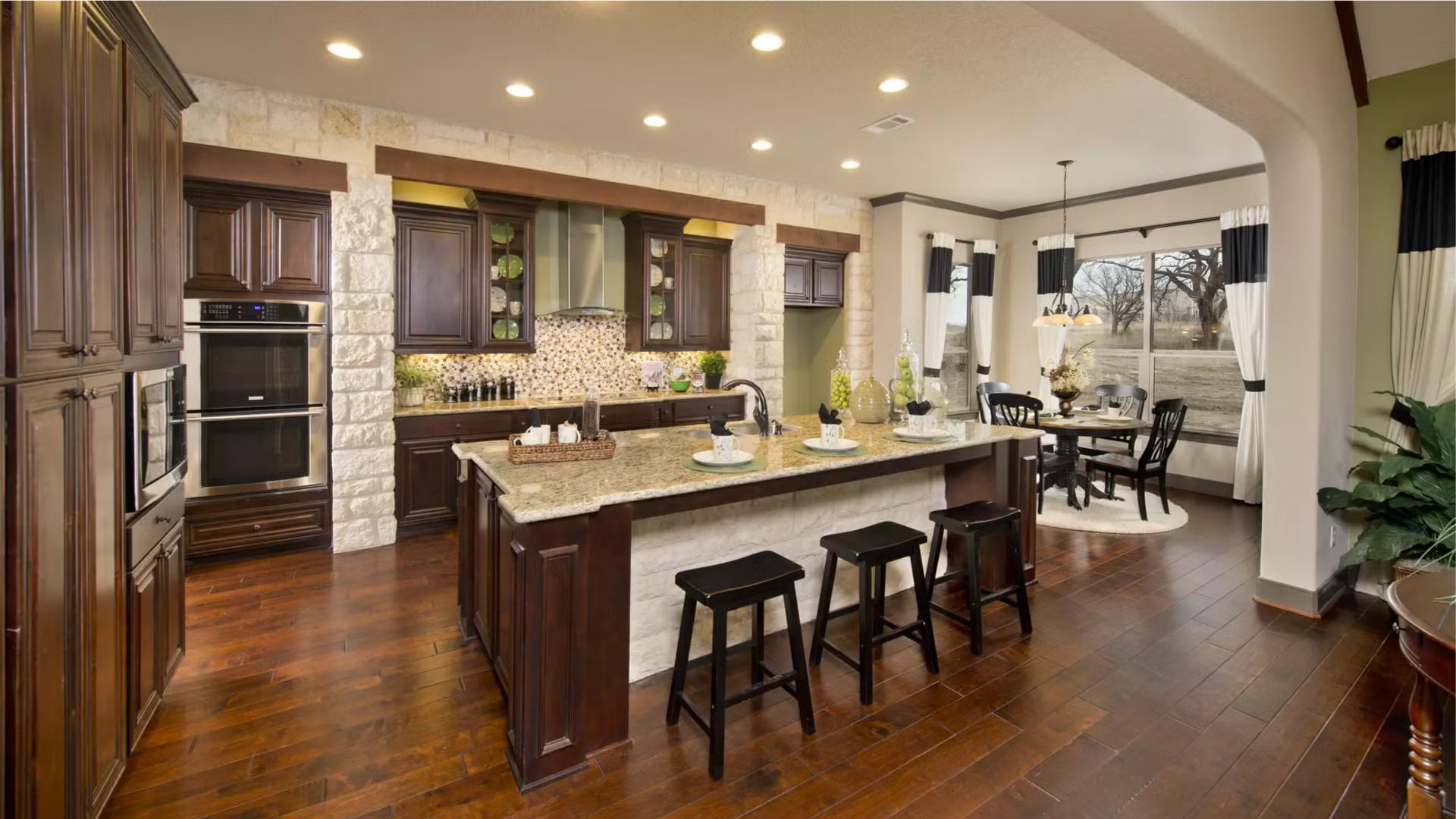
The three-tier framework (stock, semi-custom, custom) is the most useful lens for thinking about cabinet cost, because it maps directly to how the industry manufactures and prices product. Stock cabinets are mass-produced in fixed sizes, usually in 3-inch width increments. Semi-custom cabinets are built to order from a fixed catalog of sizes, styles, and finishes, with limited modification options. Custom cabinets are designed and built to your exact specifications, with no size or style constraints.
The cost gap between tiers is real, and so is the quality gap. This Old House and similar remodeling resources have documented how the jump from stock to semi-custom changes nearly every construction detail that determines how long cabinets last. The table below summarizes the practical differences in 2026 pricing.
| Feature | Stock | Semi-Custom | Custom |
|---|---|---|---|
| Lead time | In stock to 2 weeks | 6 to 12 weeks | 10 to 20 weeks |
| Size increments | 3 inch | 3 inch (with modifications) | Any dimension |
| Door styles available | 5 to 15 | 30 to 80 | Unlimited |
| Finish options | 5 to 20 | 50 to 200 | Unlimited |
| Box construction | Particleboard standard | Plywood available | Plywood standard |
| Drawer construction | Stapled, 4-sided | Dovetailed available | Dovetailed standard |
| Soft-close hardware | Often an upgrade | Usually standard | Always standard |
| Warranty | 1 to 5 years | 5 years to limited lifetime | Limited lifetime typical |
| Cost per linear foot | $80 to $320 | $320 to $900 | $900 to $2,200+ |
Why Most Homeowners Land in Semi-Custom
Most American homeowners who plan to stay in their home longer than five years land in the semi-custom tier. The reason is not snobbery about stock cabinets. It is that semi-custom lines from manufacturers like KraftMaid, Medallion, Decora, and Wood-Mode offer plywood box upgrades, dovetailed drawer boxes, full-extension soft-close glides, and 30+ door styles for a price that is typically 2 to 3 times stock, while delivering a product that lasts 20 to 30 years instead of 8 to 12.
When Custom Cabinetry Earns Its Premium
Custom cabinetry pays off when the kitchen has unusual dimensions, when the homeowner wants a specific wood species or finish that is not offered in catalog lines, or when integration with adjacent built-ins (pantry, butler’s pantry, banquette seating) demands consistent millwork. For a straightforward rectangular kitchen with standard ceiling heights, the value gap between premium semi-custom and entry-level custom is narrower than it appears.
Cabinet tier selection cascades downstream into countertop, appliance, and flooring decisions, so locking the tier early gives the rest of the project a stable budget center of gravity.
How the “Custom” Label Is Used Loosely
The label “custom” is used loosely in the industry, and that deserves a flag. A true custom cabinet shop builds boxes, doors, and drawers from raw lumber and sheet goods in their own facility. Many companies that advertise “custom” cabinets are actually high-end semi-custom dealers selling factory-built product with a wide modification catalog. The cost difference between true custom and high-end semi-custom is often 30 to 50 percent for cabinetry that looks nearly identical at install.

Cabinet Wood Types and How They Drive Cost
The species of wood used for cabinet doors, drawer fronts, and exposed end panels is one of the biggest drivers of cabinet cost. Box construction (covered in the next section) uses sheet goods regardless of species, so when you “upgrade to cherry” you are typically upgrading only the visible surfaces. Even so, the price impact is significant because doors and drawer fronts represent roughly 60 to 70 percent of the visible surface area of a kitchen.
The table below shows the relative cost impact of common cabinet wood species in 2026, indexed against maple, which is the most common semi-custom species in the United States. The NKBA tracks species popularity in its annual design trends survey and maple has held the top spot for years precisely because it takes paint and stain equally well and resists racking.
| Wood Species | Cost Index (Maple = 100) | Typical Appearance | Durability |
|---|---|---|---|
| Paint-grade (MDF or poplar) | 90 to 110 | Smooth, no visible grain | High when painted, low if chipped |
| Maple | 100 | Tight grain, light color | Excellent |
| Birch | 95 to 105 | Similar to maple, slightly softer | Good |
| Oak (red or white) | 105 to 120 | Pronounced grain | Excellent |
| Hickory | 115 to 130 | Strong grain, color variation | Very high |
| Alder | 110 to 125 | Soft, knotty character available | Moderate |
| Cherry | 130 to 160 | Reddish, darkens with age | Very high |
| Walnut | 160 to 220 | Deep brown, premium look | Excellent |
| Quarter-sawn white oak | 150 to 200 | Distinct ray flake pattern | Excellent |
| Rift-sawn white oak | 170 to 230 | Linear grain, modern look | Excellent |
| Mahogany | 180 to 250 | Rich red-brown | Excellent |
Why Painted Cabinets Often Cost More Than Stained Maple
Paint-grade cabinets are worth a closer look in 2026. Because painted finishes hide grain, manufacturers often use MDF for door panels and poplar or soft maple for door frames. The wood is cheaper, but the multi-step paint process (typically 5 to 9 steps including primer, color coats, and topcoat) is labor-intensive. The net result is that painted cabinets in white, off-white, or soft greens and blues frequently cost the same as or slightly more than stained maple, despite using cheaper wood.
Walnut and Rift-Sawn Oak: The Premium Species Surge
Walnut and rift-sawn white oak have been the two fastest-growing premium species in the past three years, driven by demand for warm modern and Scandinavian-influenced kitchens. Both species command a 60 to 130 percent premium over maple in semi-custom lines, and the premium can be steeper in custom shops because of yield losses when matching grain across large door runs.
“Wood species is the lever homeowners pull last and regret most. They specify the door style, the finish color, the hardware, and then ask what species costs the least. By then, the kitchen is designed around a look that needs walnut to read correctly.” Paraphrased from a 2025 NAHB Remodelers Council panel on kitchen design economics.
Mixed-Species Kitchens and Yield-Loss Surcharges
Two practical notes on wood selection affect cost more than most homeowners realize. First, mixing species inside a single kitchen (for example, painted perimeter cabinets with a walnut island) adds 10 to 20 percent to total cabinet cost in most semi-custom lines, because the manufacturer has to set up two production runs. Second, choosing a species with significant color variation (hickory, knotty alder, character cherry) reduces yield in the manufacturing process, which is why those species often cost more than their lumber-only price would suggest.

Cabinet Box Construction: Plywood vs Particleboard vs MDF
The cabinet box is the structural carcass that holds everything together. It is what your countertop sits on, what your hinges and drawer glides are screwed into, and what determines whether your cabinets are still solid in 25 years. Box construction is the single most underrated cost driver in kitchen cabinetry, and it is where the biggest quality gaps hide between superficially similar quotes.
The Three Box Materials Compared
There are three primary materials used for cabinet boxes in 2026: particleboard (sometimes called furniture board or industrial board), plywood, and medium-density fiberboard (MDF). Each has trade-offs in cost, weight, screw retention, moisture resistance, and longevity.
- Particleboard: The standard in stock and entry-level semi-custom cabinetry. Made from compressed wood particles bonded with resin. Lowest cost, adequate strength when dry, but loses structural integrity if exposed to water. Screw retention is poor, which becomes a real issue under sink cabinets and at hinge locations after 10 to 15 years of use.
- Plywood: The standard in mid to high-tier semi-custom and most custom cabinetry. Cross-banded layers of veneer give it superior strength-to-weight, excellent screw retention, and meaningful moisture resistance. Adds 10 to 20 percent to cabinet cost in most semi-custom lines as a box upgrade.
- MDF: Sometimes used for shelves and door panels, rarely used for the full box outside of European frameless systems. Smooth, dense, dimensionally stable. Heavy, and moisture-vulnerable unless properly sealed.
When the Plywood Box Upgrade Pays Back
Most US semi-custom manufacturers offer plywood box construction as a paid upgrade. The upcharge is typically $40 to $80 per linear foot, which on a 25-linear-foot kitchen translates to $1,000 to $2,000. For homeowners staying in their home long term, the upgrade pays for itself in cabinet longevity. Real estate appraisers and inspectors increasingly note plywood box construction in their evaluations for kitchens marketed above the regional median.
Sink Base and Dishwasher Cabinets: Where Plywood Matters Most
The two specific places where plywood matters most are the sink base cabinet and any cabinet flanking a dishwasher. These two locations see the most water exposure and the highest rate of premature cabinet failure. Some homeowners specify plywood only for these two cabinets to manage cost while protecting the most vulnerable spots, an approach that adds roughly $200 to $400 to the project.
Three Construction Details That Separate Good from Premium
Beyond box material, three construction details separate good cabinets from premium cabinets at any price tier. Look for full back panels (not stapled hardboard), 5/8-inch or 3/4-inch shelf thickness (not 1/2-inch), and dovetailed solid-wood drawer boxes (not stapled four-sided particleboard drawers). These details add roughly 5 to 10 percent to cabinet cost and noticeably extend the useful life of the cabinetry. Family Handyman has published detailed guides on inspecting cabinet construction before buying, and the checklist maps closely to these three items.
Cabinet Door Styles and Finishes
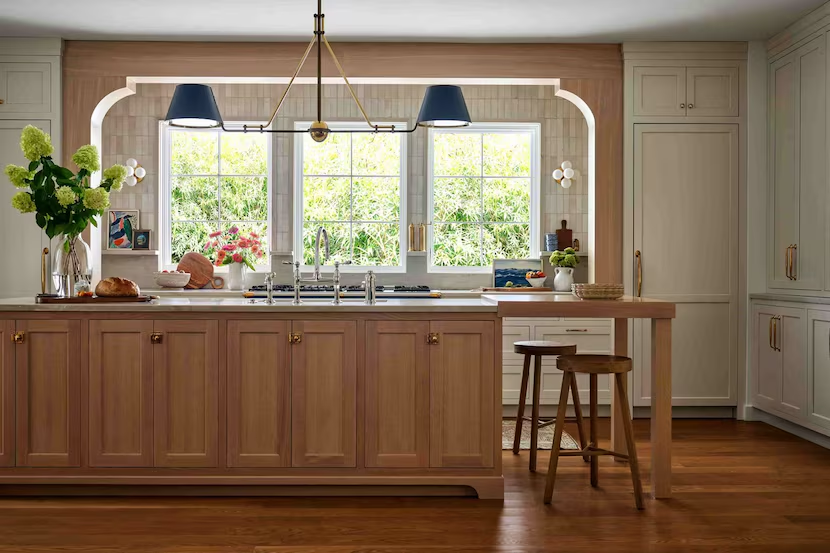
Door style is the single biggest visual choice you make in a kitchen, and it has a real cost impact even within a single cabinet line. The same maple cabinet box can carry a $40 door or a $400 door depending on style complexity, panel type, and finish.
Door styles fall into a small number of families that have remained consistent for the past two decades, though the relative popularity within each family shifts with design trends. The current breakdown by family, based on aggregate semi-custom manufacturer data and Houzz kitchen design inspiration, looks roughly like this in 2026.
- Shaker: 5-piece door with a flat center panel and square-edged frame. The dominant style in US kitchens for the past 12 years. Mid-range pricing within most lines.
- Raised panel: Traditional 5-piece door with a profiled center panel. Slightly more expensive than shaker due to the additional milling step.
- Slab (flat panel): Single flat door, often in walnut, rift oak, or high-gloss painted finish. Pricing varies widely; in MDF paint-grade it is often the cheapest option, in walnut veneer it is among the most expensive.
- Recessed panel variants (mission, beaded shaker, applied molding): Niche styles that typically run 10 to 25 percent over the base shaker in the same line.
- Glass insert doors: Add $80 to $250 per door depending on glass type (clear, seeded, reeded, leaded). Often used selectively on 2 to 4 upper cabinets rather than throughout.
- Mullion doors: True divided-light glass doors with wood mullions. Premium upcharge of $200 to $500 per door.
How Finish Choice Stacks Onto Door Cost
Finish cost is the other half of the door equation. A stain plus topcoat finish is the baseline. A solid-color paint adds 10 to 20 percent in most semi-custom lines because of additional surface prep and a higher number of finish coats. Glazed finishes (a colored wash applied over paint or stain, then wiped back) add another 10 to 15 percent. Two-tone finishes (different colors on perimeter vs island, or different colors on uppers vs lowers) add 10 to 15 percent because of the additional setup and quality control.
Hardware Budgets and the Soft-Close Upcharge
Cabinet hardware (knobs, pulls, hinges) is often quoted separately and is genuinely a meaningful cost. A 25-linear-foot kitchen typically uses 25 to 45 pieces of decorative hardware. At $4 to $12 per piece for builder-grade, $15 to $40 per piece for midrange, and $40 to $150+ per piece for designer hardware, the hardware budget alone ranges from $100 to $5,000+ on the same kitchen. Soft-close upgrades may be a paid add-on in entry-level stock lines, typically $5 to $15 per hinge and $15 to $30 per drawer.
Coordinating Finishes with Countertops and Backsplash
When countertops, backsplash, and cabinet finish are chosen together, the interactions matter. Light cabinets with light countertops require more careful design to avoid feeling washed out, and dark cabinets with dark countertops can collapse visually without good lighting. Our 2026 guide to kitchen countertop costs walks through how counter material choice interacts with cabinet finish at each budget tier.

Cost per Linear Foot vs Cost per Cabinet: Two Ways Builders Price
Cabinet pricing in the United States is quoted two different ways depending on who is doing the quoting, and the difference matters when you are comparing bids. Big-box retailers, kitchen design centers, and most semi-custom dealers quote per linear foot of cabinetry. Custom shops, some independent dealers, and many architects quote per individual cabinet, often with detailed specification lists.
How Per Linear Foot Pricing Works
Per linear foot pricing is convenient for rough budgeting. You measure the wall length your cabinets will occupy (counting upper and lower runs as the same linear foot, not separately), multiply by the per-linear-foot price for the tier and species you want, and you get a ballpark number. A 25-linear-foot kitchen at $500 per linear foot in semi-custom maple shaker prices at roughly $12,500 in cabinet cost before modifications.
Where Linear-Foot Estimates Break Down
The problem with per-linear-foot pricing is that it assumes a “standard” mix of base cabinets, wall cabinets, and tall cabinets. Real kitchens deviate from that mix constantly. A kitchen with a full-height pantry, two stacked ovens, and 42-inch upper cabinets has a very different actual cost from one with no tall units and 30-inch uppers, even if the linear footage is identical.
A useful decision rule: per linear foot is fine for early budgeting. Once you are within 60 days of ordering, demand a cabinet-by-cabinet itemized quote. The 10 to 20 percent variance between linear-foot estimates and itemized quotes is where most “the price went up” disputes start.
Comparing Itemized Quotes Across Vendors
Per-cabinet pricing is more accurate but harder to compare across vendors because cabinet sizes, included features, and modification surcharges all vary. When you collect itemized quotes from multiple vendors, ask each one to price the same cabinet specification sheet (sizes, door style, finish, drawer count, interior accessories) rather than asking each to design your kitchen independently. Vendors design to different defaults, and “the same kitchen” from three vendors can land at three different cabinet counts.
Line Items Inconsistently Included in Quotes
Three line items in cabinet pricing deserve special attention because they are inconsistently included across vendors. Crown molding is sometimes priced in and sometimes priced as an add-on, typically adding $15 to $40 per linear foot of installed molding. Toekick and shoe molding is similarly inconsistent. Finished interiors (matching the interior of glass-door cabinets or open cabinets to the exterior finish) is almost always an add-on, at roughly $50 to $150 per cabinet.
The island cabinet count and configuration is its own meaningful cost variable. A kitchen island typically uses 6 to 14 linear feet of cabinetry, with finished back panels, decorative end panels, and sometimes specialty features like microwave drawers, beverage refrigerators, and seating overhangs. Our 2026 kitchen island cost guide breaks down how island cabinet specifications differ from perimeter cabinets and where the cost premiums come from.

Installation Costs and Why They Vary
Cabinet installation is quoted as a separate line item in most US markets and represents 15 to 25 percent of total cabinet project cost. On a $15,000 cabinet order, installation typically runs $2,250 to $3,750. The variance comes from regional labor rates, kitchen complexity, and whether the installer is also handling demolition of existing cabinets.
National Labor Rates and Regional Spread
National average cabinet installation labor in 2026 sits at roughly $50 to $90 per linear foot for a straightforward replacement (existing kitchen, no layout changes), and $80 to $150 per linear foot for a renovation with layout changes, plumbing relocations, or non-standard ceiling heights. Markets with higher cost of living (San Francisco Bay Area, New York metro, Boston, Seattle) run 25 to 50 percent above national average. Markets in the Sun Belt and Midwest typically come in 10 to 20 percent below national average. The Bureau of Labor Statistics carpenter page shows the gap has narrowed since 2022 as carpentry labor demand has spread more evenly across the country.
Out-of-Square Walls and Floor-Leveling Surcharges
Out-of-square walls and out-of-level floors are the most common factors pushing installation labor up, particularly in homes built before 1980. Installers have to scribe filler strips to match wall angles, shim cabinet bases to a consistent height, and sometimes rebuild blocking inside walls to support wall cabinets. This work is rarely visible after install but can add 10 to 30 percent to labor time.
Ceiling Heights and Millwork Integration Drive Labor
Ceiling height is the second major factor. Cabinets installed to a 9-foot or 10-foot ceiling require staging, sometimes scaffolding, and additional crown molding work. Cabinets installed in a 7’6″ basement remodel can require custom cabinet height modifications that add labor. The 8-foot ceiling is the labor sweet spot.
Millwork integration is the third factor. If the cabinets are tying into a butler’s pantry, a banquette, a refrigerator panel system, or a hood surround, the installation labor compounds. Each integrated feature typically adds 4 to 12 hours of installer time and may require coordination with a separate trim carpenter.
A Sanity Check on Install Quotes
A useful sanity check on any installation quote: a competent two-person crew installs 8 to 12 linear feet of cabinetry per day in a straightforward replacement. A 25-linear-foot kitchen should take 2 to 3 days of install labor, plus a half day for crown molding and final adjustments. If a quote assumes 6 days of labor on a simple kitchen, ask why. If it assumes 1 day, ask harder. Bob Vila has published detailed guidance on vetting contractor bids for cabinet installation, and the time-estimate sanity check is one of the most reliable filters.
Hidden Costs Most Homeowners Miss with Cabinets
The published per-linear-foot price for cabinets almost never reflects the actual delivered cost. Modifications, accessories, and trim pieces add 15 to 35 percent of variance between the headline number and the invoice. The list below covers the items most homeowners forget to budget for, drawn from a review of contractor quotes across stock, semi-custom, and custom tiers.
- Filler strips and scribe pieces: $20 to $80 each, typically 3 to 8 per kitchen. Required wherever cabinets meet walls or other cabinets at non-standard widths.
- Decorative end panels: $80 to $300 per panel. Required wherever a cabinet end is visible (open end of a run, island sides, peninsula).
- Refrigerator side panels: $200 to $600 each. Required for a built-in look around standard or counter-depth refrigerators.
- Toekick and shoe molding: $8 to $20 per linear foot, often invoiced separately from cabinet pricing.
- Crown molding upgrades: Stock crown is usually included; multi-piece crown profiles add $15 to $40 per linear foot.
- Soft-close upgrades on stock cabinets: $5 to $15 per hinge, $15 to $30 per drawer.
- Drawer box upgrades: Dovetailed solid-wood drawer boxes are often a $40 to $120 per drawer upgrade in entry-level lines.
- Interior organization accessories: Roll-out trays, spice pull-outs, trash pull-outs, drawer dividers run $50 to $400 per accessory.
- Modification charges: Reducing cabinet depth, adding finished interiors, custom heights, and mullion glass each carry per-cabinet modification fees of $50 to $400.
- Delivery and freight: $200 to $800 for most semi-custom orders, sometimes free with minimum order size.
- Tear-out and disposal of existing cabinets: $300 to $1,500 depending on volume and access.
- Templating and coordination visits: Some installers charge separately for the templating visit and return trips required to address late-discovered issues.
Cumulative Impact on a 25 Linear Foot Kitchen
For a 25-linear-foot kitchen, the cumulative impact of these line items is typically $2,000 to $6,000 above the headline cabinet quote. Building this into the budget at the front end is the difference between a project that lands on budget and one that overruns by 20 percent. This is one of the most consistent findings from Architectural Digest kitchen coverage of real remodel case studies.
Inside-Cabinet Accessories: Where Homeowners Over-Spec
Inside-cabinet accessories (roll-outs, dividers, pull-outs, lazy susans) are where many homeowners over-spec late in the process. A fully accessorized 25-linear-foot kitchen can carry $3,000 to $6,000 in interior organization features. They are useful, but they are also discretionary, and many of them can be added after the fact with aftermarket products at 30 to 50 percent of the manufacturer’s price.
Industry caution worth repeating: every cabinet quote should include a written specification sheet listing every cabinet by number, size, modification, and accessory. If a vendor quotes a price without a spec sheet, the spec sheet is being filled in later, and the price is going to move.

How Cabinet Cost Fits Into a Full Kitchen Remodel Budget
Cabinets do not exist in a vacuum. They share the kitchen budget with countertops, backsplash, appliances, plumbing, electrical, flooring, lighting, and labor. Understanding where cabinets sit in that stack is critical for setting a realistic overall budget and for deciding when to spend up on cabinetry versus when to pull money toward another category.
The typical 2026 distribution of costs across a midrange US kitchen remodel looks roughly like this.
| Category | Share of Total Budget | Midrange Dollar Range (25 LF kitchen) |
|---|---|---|
| Cabinets and hardware | 25 to 35% | $14,000 to $22,000 |
| Installation labor (cabinets) | 4 to 7% | $2,500 to $4,500 |
| Countertops | 8 to 15% | $4,500 to $9,000 |
| Appliances | 12 to 20% | $7,500 to $13,000 |
| Plumbing and fixtures | 4 to 8% | $2,500 to $5,000 |
| Electrical and lighting | 4 to 8% | $2,500 to $5,000 |
| Flooring | 4 to 8% | $2,500 to $5,000 |
| Backsplash | 2 to 5% | $1,200 to $3,000 |
| Drywall, paint, trim | 3 to 6% | $1,800 to $3,800 |
| General contractor fee, permits, contingency | 10 to 18% | $6,000 to $12,000 |
Whole-Home Renovations Change the Cabinet Math
For homeowners considering cabinetry as part of a whole-home renovation rather than a single-room project, the budget dynamics shift considerably. Material orders are larger, trade coordination is more complex, and there are real economies of scale in lead time and freight. Our 2026 national guide to whole-house remodel costs walks through how kitchen cabinetry decisions ripple into adjacent spaces like pantries, mudrooms, and butler’s pantries, and where consolidating cabinet orders across rooms saves real money.
A Benchmark for Cabinet Share of Total Budget
A reasonable benchmark for cabinet share: if your cabinet quote is below 22 percent of your total kitchen budget, you are probably under-buying for the rest of the project’s quality level. If it is above 40 percent, you are probably over-buying cabinets relative to countertops, appliances, and flooring, and the kitchen will feel unbalanced. The 28 to 35 percent range is where most well-executed midrange and high-end kitchens land.
When to Spend Up on Cabinets vs Other Categories
The decision about whether to spend up on cabinets or redirect budget toward appliances or countertops depends on how you use your kitchen. Homeowners who cook daily benefit disproportionately from better cabinet interior organization, drawer quality, and hardware. Homeowners who primarily entertain see more return from countertop and appliance upgrades that are more visible to guests. That trade-off is worth making consciously rather than defaulting to whatever the showroom steers you toward first. Consumer Reports provides useful comparative testing data on appliances that helps calibrate where appliance dollars actually move the needle.
How to Save on Cabinet Costs Without Sacrificing Quality
Saving money on cabinets is genuinely possible without ending up with cabinets that fall apart in 10 years. The trick is identifying which specifications drive durability and which ones drive only appearance, then spending up on the former and economizing on the latter.
The Six-Rule Save-vs-Splurge Framework
The save-vs-splurge framework that works most reliably across price tiers comes down to six rules.
- Splurge on box construction. Plywood boxes, solid-wood dovetailed drawers, and full back panels are what determine whether your cabinets are still solid in 25 years. Save here and you replace cabinets in 12 years.
- Save on door style. Shaker doors are widely loved, broadly available, and resell well. Choosing a $40 shaker door over a $120 mullion door in the same line is a $2,000 to $4,000 savings on a typical kitchen with no real functional downside.
- Splurge on hinges and glides. Blum, Grass, and Salice hardware (the major German and Austrian brands) cost more upfront but outlast cheaper hardware by decades. Most premium semi-custom lines include them; verify before signing.
- Save on decorative hardware. Knobs and pulls can be swapped out by the homeowner with a screwdriver in an afternoon. Buy modest hardware now, upgrade later if desired.
- Splurge on the sink base and dishwasher-adjacent cabinets. Plywood and stainless steel toekick protection here is worth every dollar.
- Save on interior organizers if budget is tight. Aftermarket roll-outs, drawer organizers, and pull-outs from companies like Rev-A-Shelf, Hafele, and Richelieu install easily and cost 30 to 50 percent less than manufacturer-included versions.
Keeping the Layout Saves More Than Spec Choices
Two structural strategies save more than spec-level decisions. The first is keeping the existing layout. Cabinet costs are tied to cabinet count, but plumbing relocations, gas line moves, and electrical changes routinely add $3,000 to $10,000 to a project. Keeping the sink, range, and refrigerator in their existing locations preserves a large share of the budget for cabinet quality.
Timing the Order Around Promotional Periods
The second structural strategy is timing. Most major semi-custom cabinet manufacturers run two to four promotional periods per year, typically offering 10 to 20 percent off list price or free upgrades like plywood construction, soft-close hardware, or finished interiors. The promotions are real, but they are designed to drive volume into specific months. If your project timing is flexible, asking your dealer when the next promotion is scheduled is the simplest way to save 8 to 15 percent on cabinet cost without changing a single spec.
“The single biggest cost-saving decision a homeowner can make on cabinets is to keep the existing layout. Every plumbing wall, every gas line, every vent move costs more than a tier upgrade on the cabinets themselves.” Guidance commonly given by NARI-certified remodelers.
Freight, Lead Time, and Storage Logistics
A final cost-saving consideration that often gets ignored: the freight, lead time, and storage logistics of a cabinet order. Ordering during a high-demand period (May through September) can stretch lead times by 4 to 8 weeks and may require off-site storage if your demolition timing slips. Ordering in late fall or winter typically delivers faster and avoids the worst of freight surcharges. The ENERGY STAR appliance program runs purchasing promotions at the same time many dealers do, so coordinating appliance and cabinet orders can sometimes earn rebates on both sides of the purchase.
When to Replace vs Reface Cabinets and How to Decide
Not every cabinet project requires new cabinets. Refacing (replacing doors, drawer fronts, and visible veneer while keeping existing cabinet boxes) can deliver 70 to 80 percent of the visual impact of new cabinets at 40 to 50 percent of the cost. The decision between replacing and refacing comes down to four questions, in this order.
Are the Existing Boxes Structurally Sound?
First, are the existing cabinet boxes in good structural condition? If the boxes are particleboard with water damage, sagging shelves, or loose joints, refacing is throwing good money after bad. If the boxes are plywood or solid wood and structurally sound, refacing is genuinely viable. Most cabinet refacing companies will refuse to reface cabinets they judge structurally unsound, which is itself a useful signal. ADA accessibility guidelines are also worth consulting at this stage if the homeowner has accessibility needs, since a full replacement is often the only way to reconfigure box placement to meet clearance requirements.
Does the Existing Layout Still Work?
Second, is the existing layout working? Refacing keeps the existing cabinet footprint exactly as it is. If the kitchen suffers from layout problems (no pantry, undersized sink base, awkward island, inefficient work triangle), refacing locks those problems in for another 15 years. New cabinets give you the opportunity to redesign.
Budget Gap Between Refacing and Replacing
Third, what is the budget gap? National average cabinet refacing costs $7,000 to $15,000 for a 25-linear-foot kitchen, compared to $14,000 to $22,000+ for new semi-custom cabinets including installation. A $5,000 to $10,000 difference is meaningful, but it is not always enough to justify keeping a layout you do not love.
Hold Period and Resale Considerations
Fourth, what is the expected hold period? For homeowners who plan to sell within 5 years and want to refresh the kitchen for resale, refacing is often the right call. For homeowners staying 10 or more years, the math usually favors new cabinets, particularly if a layout change can fix functional pain points.
Our detailed 2026 comparison of replacing versus refacing kitchen cabinets walks through the decision criteria in more depth, with case-study cost breakdowns for both paths. For homeowners weighing this decision as part of a broader kitchen project, the full 2026 kitchen remodel cost guide is the place to anchor the decision against your overall budget.
A small but practical caveat about refacing pricing: some refacing companies use a high-pressure same-day-close sales model with discounts that only apply if you sign that day. Getting at least three written quotes for any cabinet project above $5,000 and refusing same-day-close pressure entirely is a reasonable standard. A legitimate vendor’s price next week is the same as their price today.
Cabinet decisions are durable. The cabinets you install in 2026 are likely the cabinets you live with through 2046 or longer, and they are the single most visually dominant element in your kitchen. Spending the time up front to understand what you are actually buying (box construction, drawer quality, hardware grade, finish process) pays back many times over in years of daily use. The cost ranges in this guide are starting points. The right cabinet for your kitchen is the one that matches your layout, your hold period, your design priorities, and the budget you can actually deliver against without compromising the rest of the project.