
Why Dallas Kitchen Remodel Costs Vary More Than Most DFW Cities
A kitchen remodel in Coppell or Flower Mound usually fits inside a tighter price band because the housing stock is more consistent. A kitchen remodel in Dallas does not. Across our tracked Dallas projects, payment data spans from a $3.5k shower repair on the low end to a $134k whole-home remodel on the high end. Even narrowing to kitchen-relevant work, scopes have ranged from a $31k cabinet-only installation up to kitchen work folded into $89k–$134k full-home remodels.
That spread is not random. It tracks the city’s housing diversity. A 1920s Lakewood Tudor and a 1990s North Dallas builder home both have kitchens that “need a remodel,” but the work behind those kitchens is not comparable. The Tudor likely needs electrical updates to support modern appliances, may have lath-and-plaster walls that complicate cabinet hanging, and could sit in a conservation district that adds review time to anything exterior-facing. The 1990s builder home usually needs cabinet replacement, countertop upgrades, and a layout rethink, but the bones rarely require correction.
That distinction shows up in every line of a Dallas kitchen estimate. A homeowner planning $40k for cabinets and counters can be in great shape in one part of the city and underwater in another.
The Four Lines That Determine What Your Kitchen Actually Costs
Most Dallas kitchen estimates break down across four categories. The relative weight of each shifts with the home and the scope, but the categories themselves are stable.
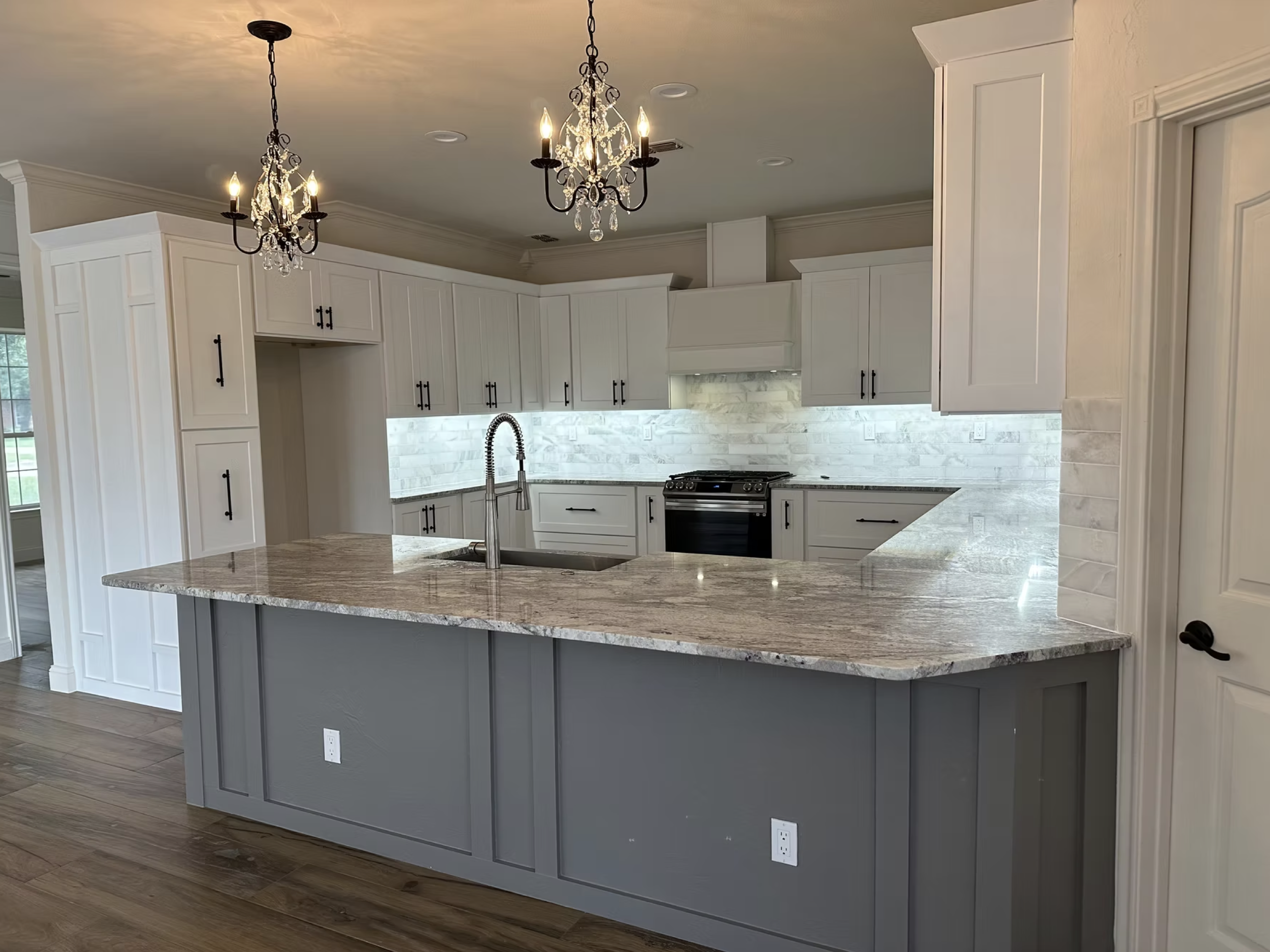
Cabinets and millwork. Usually the largest single line. In a mid-range Dallas kitchen, cabinets run roughly $12k to $25k installed; in a full-custom scope, $25k to $60k. This includes boxes, doors, drawers, hardware, soft-close mechanisms, crown and base trim, and any custom pieces (a pantry wall, a built-in coffee station, a banquette). Refacing existing boxes lands lower, typically $6k to $12k for a Dallas kitchen, but it only works when the existing cabinetry is structurally sound. In older Lakewood and East Dallas homes, cabinet boxes are often not worth saving.
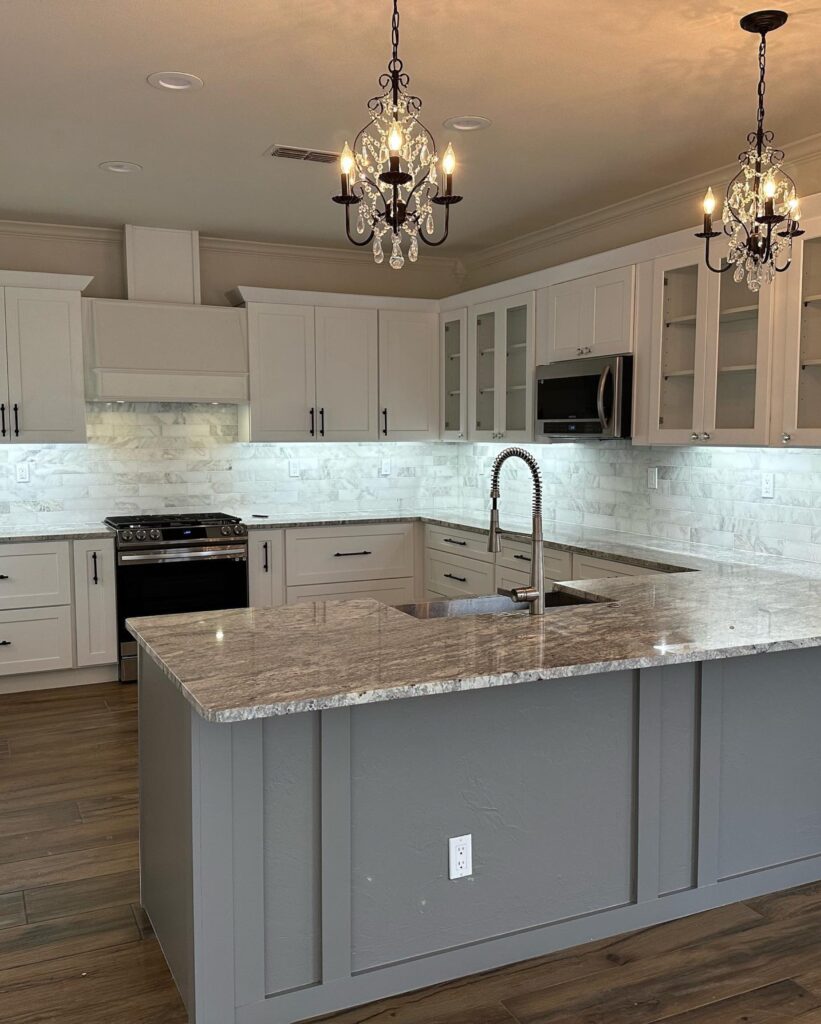
Countertops and backsplash. The second line, usually $4k to $14k for stone in a mid-range Dallas kitchen. Quartz tends to fall between $60 and $90 per square foot installed; quartzite and higher-end natural stone push $90 to $150. A waterfall island end adds $1.5k to $4k. Full-height slab backsplash behind the range, instead of tile, can add $2k to $5k. Tile backsplash itself runs $1.5k to $4k depending on material and pattern complexity.
Appliances. This is the line homeowners most often miscalculate, because the spread is enormous. A solid mid-range appliance package (range, refrigerator, dishwasher, microwave, hood) runs $8k to $14k. Step into a 36-inch professional range, counter-depth or built-in refrigerator, panel-ready dishwasher, and a properly ducted hood, and the package crosses $18k to $30k. A built-in Sub-Zero or Wolf suite can push past $40k on its own.
The work no one sees. Electrical, plumbing, ventilation routing, drywall repair, floor patching, and demo disposal. In a straightforward Dallas kitchen this might be $5k to $10k. In an older Lakewood or M Streets home with original wiring, undersized service, and a hood that needs to be converted from recirculating to ducted, it can be $12k to $25k. This is the line that turns a $32k budget into a $45k actual when nobody looked closely enough early.
A kitchen estimate that buries these four categories inside one lump-sum number is not a real estimate. Ask for them separately.
The Cabinet Decision Drives More of Your Budget Than Anything Else
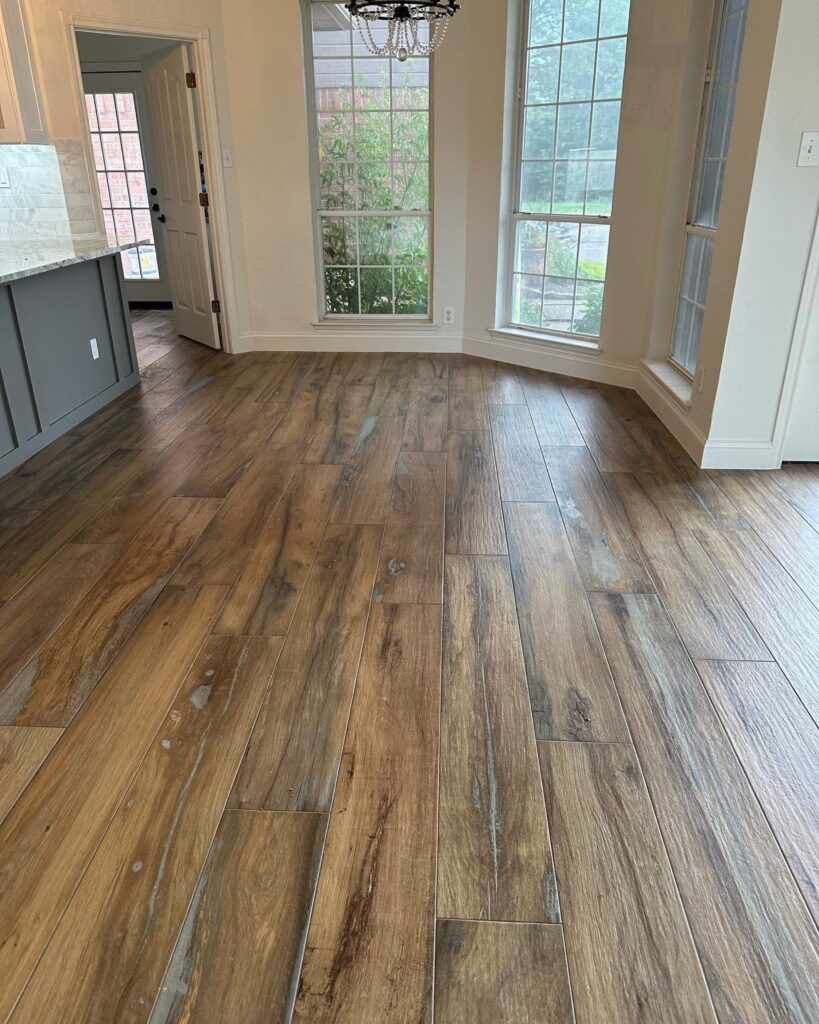
Cabinets account for 25% to 40% of most kitchen remodel budgets, and the choice between tiers is a clear dollar swing.
Stock cabinets. $4k to $10k installed for a typical Dallas kitchen. Standard sizes only, limited finishes, particleboard boxes with thermofoil or melamine fronts. Acceptable in rental properties or tight-budget scopes. They will not hold up to twenty years of family use the way better construction will.
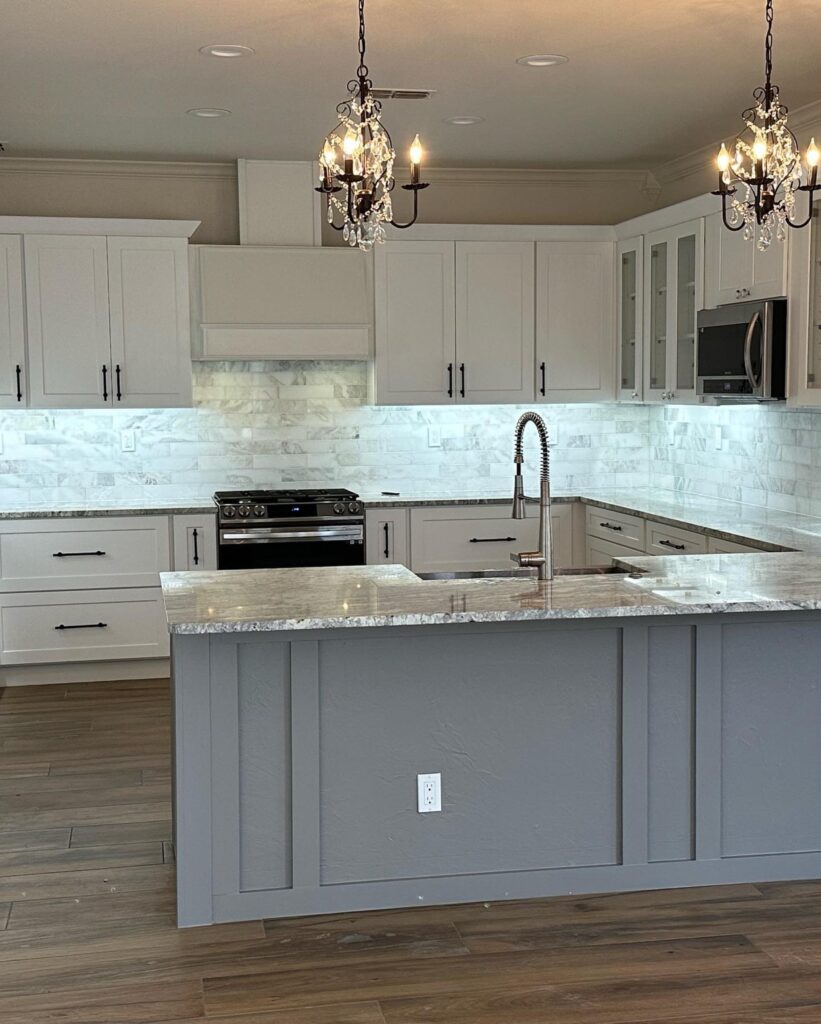
Semi-custom. $12k to $25k installed. This is where most Dallas mid-range remodels land. Plywood boxes, dovetail drawers, soft-close hardware, a wider range of door styles and finishes, and some flexibility on widths in 1-inch or 3-inch increments.
Custom and full-custom. $25k to $60k installed. Built to the room rather than fit to it. Any size, any wood species, any door profile, integrated lighting, specialty inserts. Worth it in older homes where stock dimensions never fit cleanly, in large kitchens with long uninterrupted runs, or when the homeowner wants something that does not look like every other kitchen in DFW.
The trap is buying custom finishes on semi-custom boxes, or assuming a stock package will deliver custom results. A semi-custom box with a custom paint match still costs less than full custom, and for most mid-range Dallas kitchens it is the right answer. A recent Dallas cabinet-only project came in at $31k for installation across a kitchen and adjacent storage scope. That number is roughly what semi-custom boxes plus install typically run when finishes and hardware are not pushed to the high end. If the same project had stepped up to full custom, the cabinet line alone would have crossed $50k.
What Dallas Kitchens Routinely Under-Budget For
The surprises in Dallas kitchen remodels are predictable enough to list.
Electrical updates in older homes. A 1940s Lakewood kitchen with one 20-amp circuit serving the entire room cannot run a modern induction range, dishwasher, microwave, refrigerator, and disposal without rewiring. Bringing the kitchen up to current code with dedicated circuits, GFCI protection, and adequate panel capacity often adds $3k to $8k that homeowners did not see in early estimates. In some pre-1960 homes with original service entrances, a panel upgrade may also be needed, which adds another $2k to $4k.
Hood ventilation done correctly. A range hood that vents back into the room is not the same product as one that ducts to the exterior. The price gap on the hood itself is small. The gap on installation can be $1.5k to $4k, especially when the route crosses framing, second-story spaces, or exterior masonry. In Lakewood, the M Streets, and older East Dallas, a properly ducted hood is rarely a simple straight run.
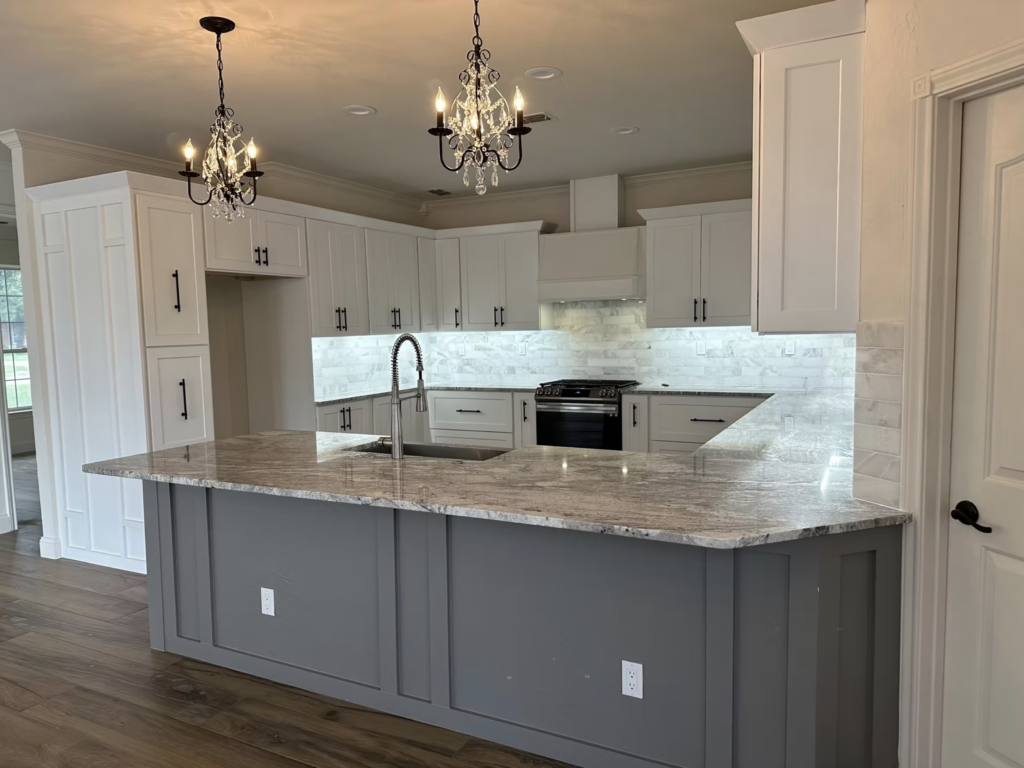
Floor transitions. When a kitchen layout changes, the new flooring footprint rarely matches the old. Either the entire room gets new flooring, or the patch-in attempt creates a visible seam that ages badly. Homeowners often budget for “kitchen flooring” and then learn that the cleanest answer is to carry the new floor into the adjoining breakfast area, dining room, or hallway. Add $2k to $6k.
Plumbing relocations. Moving a sink three feet is not a free decision. The supply lines and drain have to follow, which in a slab-on-grade Dallas home (common in North Dallas and newer infill) means cutting and patching the slab. That is $1.5k to $4k for the relocation alone, before the cabinets and countertops on top of it. Moving an island sink to a place where no plumbing existed before is more expensive still.
Historic and conservation district review. If the kitchen remodel touches any exterior element (a new window, a relocated exterior door, an exterior-vented hood), neighborhoods like Junius Heights and Munger Place may require Landmark Commission or design review. This rarely costs much in fees, but it can add 4 to 12 weeks to the timeline, which affects holding costs and contractor scheduling.
How to Read a Dallas Kitchen Estimate
The single most useful thing a homeowner can do before signing a contract is to separate fixed-bid items from allowances.
A fixed-bid item is a cost the contractor has committed to. Demo, framing changes, cabinet installation labor, drywall repair, paint, and electrical and plumbing labor are usually fixed.
An allowance is a placeholder dollar amount for something the homeowner has not yet selected. Cabinets, countertops, tile, plumbing fixtures, appliances, and lighting are commonly carried as allowances on early estimates. The estimate will say something like “$18,000 cabinet allowance” or “$45/sq ft tile allowance.”
The problem with allowances is that they look like prices inside a total. A $52,000 estimate with a $12,000 cabinet allowance is not actually a $52,000 project if the homeowner ends up selecting $22,000 cabinets. The total will be $62,000.
A few questions worth asking before signing:
Which line items are fixed bid, and which are allowances? What does the allowance amount actually buy at current pricing (a $5,000 appliance allowance in 2026 does not buy a mid-range package)? What is the change-order process if a selection exceeds an allowance? Are permit fees, dumpster, and final cleaning included? Is the hood vent ducted or recirculating in this scope? Does the electrical line include any panel work, or only kitchen circuits?
If a contractor cannot answer those clearly, the estimate is not finished yet, regardless of what the signature line says.
Three Dallas Kitchen Budgets, by Scope
Real numbers from completed Dallas projects.
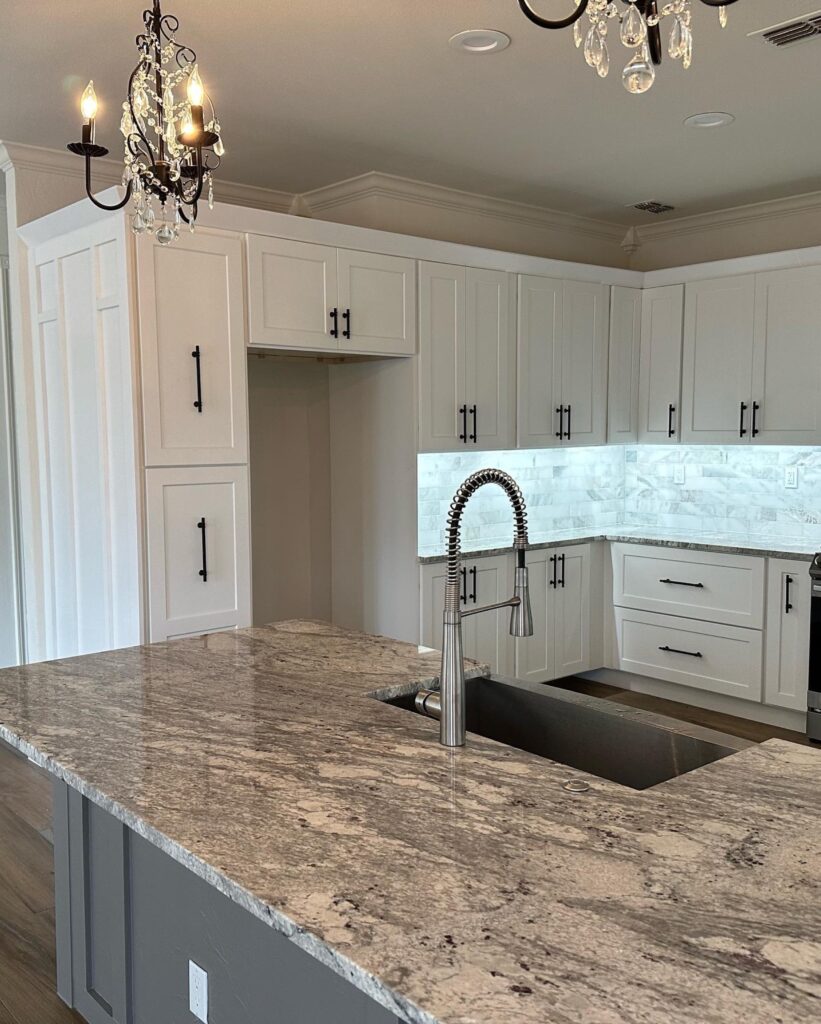
The $31k cabinet-focused scope. A recent Dallas project involved a cabinet installation across the kitchen and adjacent storage areas, totaling roughly $31k. No counter replacement, no appliance changes, no layout work. The homeowner had good existing infrastructure and wanted the cabinetry brought up to date. Fast, clean scope. This is roughly the floor for any kitchen project that involves real cabinetry rather than refacing or paint.
The $89k whole-home remodel with kitchen as the anchor. An $89k Dallas remodel covered multiple rooms, with the kitchen carrying the largest single share of the budget. Kitchen-specific costs in that scope landed in the $35k to $45k range, with the remainder going to other rooms, paint, flooring carry-through, and shared infrastructure work. This is a common pattern for Dallas homeowners doing more than just the kitchen: kitchen is the lead room, and the surrounding spaces ride along.
The $104k full home remodel including kitchen. Clay Young’s Dallas remodel was a $104k project that included his kitchen alongside the rest of the home. Clay’s testimonial details the experience in his own words. The kitchen portion of that scope was a meaningful share of the total, though not the majority, because the project carried real work across multiple rooms.
The takeaway across all three: the kitchen line item is rarely a clean standalone number when the rest of the home is being updated at the same time. The cleanest scoping happens when the homeowner decides up front whether they are doing a kitchen project, or a whole-home project where the kitchen is included. Those are different conversations, and they should be estimated differently.
The Budget Conversation to Have Before You Sign
Most Dallas kitchen budgets fall apart in one of two places: a cabinet decision made without seeing what the allowance actually buys, or an older-home discovery during demo that wasn’t accounted for upfront. Both are avoidable.
A real estimate names the cabinet tier, separates the four cost categories, walks through what the older parts of the home will require, and tells the homeowner where the allowances are before signing rather than after demo. A good Dallas kitchen project starts with that level of honesty about the scope. Anything less, and the final number is mostly a guess.
For a full breakdown of the work itself, see our Dallas kitchen remodeling page.