Cost to Remodel Your Home in Denton (2026 Guide)
A Denton remodel can be a quick cosmetic refresh, a kitchen-and-bath upgrade, or a full-house reconstruction that changes layout, systems, and finishes. The challenge for most homeowners is not deciding whether the house needs improvement. It is figuring out what level of remodeling they are actually paying for, and what that scope should cost before drawings, permits, and product selections start pushing the budget around.
That distinction matters because the phrase home remodel covers a huge spread. One family may only need paint, flooring, and fixture swaps. Another may want a reworked kitchen, two updated bathrooms, better lighting, new flooring throughout, and a more open plan. Both are remodeling projects, but one can stay in the tens of thousands while the other quickly moves into six figures.
Denton homeowners also have to think locally. The city has a mix of older neighborhoods, student-influenced rental pockets, established owner-occupied areas, and growth corridors that all create different remodeling expectations. A newer home may be a cleaner finish-driven project, while an older home may involve hidden electrical, plumbing, framing, or moisture-related issues that only show up after demolition.
This guide breaks down the cost of remodeling a home in Denton using practical planning ranges, room-by-room price expectations, labor and material drivers, permit considerations, timeline assumptions, and budget strategy. For a metro-wide benchmark, the broader Home Remodeling Cost in DFW – 2026 Full Guide provides a helpful comparison point. And when you want to compare your own home, layout, and goals to local service options, Fin Home’s Denton home remodeling page is the best place to start the conversation.
Denton home remodeling costs at a glance
The easiest way to start budgeting is to group projects by scope. Even though final estimates vary, most remodels in Denton fit into one of a few recognizable budget bands.
| Remodel scope | Typical Denton budget range | What it usually includes | Typical timeline |
|---|---|---|---|
| Cosmetic whole-home refresh | $18,000 to $50,000 | Paint, hardware, lighting swaps, partial flooring, trim touch-ups, limited fixture updates | 2 to 6 weeks |
| Kitchen-focused remodel | $45,000 to $120,000 | Cabinets, countertops, backsplash, appliances, lighting, selected plumbing or layout changes | 6 to 12 weeks |
| Bathroom-focused remodel | $20,000 to $60,000 | Tile, vanity, shower or tub work, plumbing fixtures, lighting, ventilation | 3 to 8 weeks |
| Midrange whole-home remodel | $110,000 to $190,000 | Multiple rooms, flooring, paint, kitchen or bath updates, selective electrical or plumbing work | 2 to 4 months |
| Major structural remodel | $180,000 to $325,000+ | Wall removal, layout changes, system upgrades, larger finish packages, possible addition or major reconfiguration | 3 to 6 months |
Those numbers are planning ranges, not fixed bids, but they are useful because they show how quickly scope can move the price. A national renovation benchmark summarized by Rocket Mortgage from 2025 source data placed broad home renovation costs at roughly $19,481 to $88,369, averaging about $52,228 or $15 to $60 per square foot for general renovation work. That range is helpful as a reference point, but local whole-home projects in North Texas often rise above it when kitchens, bathrooms, custom finishes, structural changes, or multiple-room packages are involved.
For example, a 2,200-square-foot house receiving a light visual refresh may stay well below the cost of a smaller home that needs a kitchen overhaul, two bathrooms, electrical updates, and floor-plan changes. Remodeling costs are driven by scope density, not just by square footage.
This is also why homeowners should avoid building their expectations around one national average. A remodel can include demolition, haul-off, framing, drywall, insulation corrections, electrical changes, plumbing relocation, cabinetry, counters, flooring, tile, paint, trim, hardware, and final punch items. Whether your project includes three of those categories or all of them determines the real number far more than a generic online calculator does.

Why Building in Denton Is Different
Denton is different from many DFW cities because its housing stock and neighborhood mix create a wider spread of remodeling conditions. Some parts of the city contain older homes that may need deeper hidden work, while newer subdivisions can support cleaner, more finish-driven renovations. That variation makes Denton budgets less predictable than a one-size-fits-all estimate might suggest.
The city’s growth pattern also matters. Denton often sits at the intersection of established in-town housing and newer development pressure, which can influence contractor availability, material lead times, and the pace at which a remodel can be scheduled. A good budget in Denton should therefore include both a money cushion and a schedule cushion.
The permit side deserves attention too. For remodels that alter structure, add square footage, or touch plumbing, electrical, or mechanical systems, the plan-review stage is part of the cost picture even if it does not show up as a glamorous line item. When the work is straightforward and the application is complete, review can move quickly; when it is more complex, the process naturally takes longer.
This is why two Denton projects that look similar on paper can feel very different in practice. One might be a mostly cosmetic interior refresh. Another might require rerouting plumbing, adjusting framing, and coordinating several inspections before the final finish work can even begin.

What a Denton remodel costs by scope
Once you know the project type, the budget becomes easier to frame.
A cosmetic refresh is the least expensive way to remodel a home and usually runs from about $18,000 to $50,000. That range can cover interior paint, a few new light fixtures, updated hardware, and modest flooring replacement in selected rooms. It is often the right choice when the home still functions well but looks tired or dated.
A partial or room-heavy remodel tends to land between $60,000 and $140,000. This is where kitchen upgrades, bathroom work, and some flooring or trim changes begin to stack together. Once cabinetry, countertops, tile, and plumbing labor enter the picture, the budget rises much faster than many homeowners expect.
A midrange whole-home remodel generally falls around $110,000 to $190,000. That type of project may include multiple room updates, new flooring throughout, kitchen and bath refreshes, paint, lighting, and selective mechanical or electrical work. The final total depends on how many rooms are touched and whether the layout stays the same.
A major structural remodel begins around $180,000 and can move above $325,000 when walls, systems, or square footage are being changed. At that level, the project is no longer just cosmetic. It is closer to a rebuild of the home’s functionality, even if the shell remains in place.

Room-by-room cost breakdown
Room-by-room thinking is useful because each part of the home carries a different cost profile. Kitchens and bathrooms are usually the most expensive rooms relative to their size because they require more trades and more finish precision.
Kitchen remodel costs in Denton
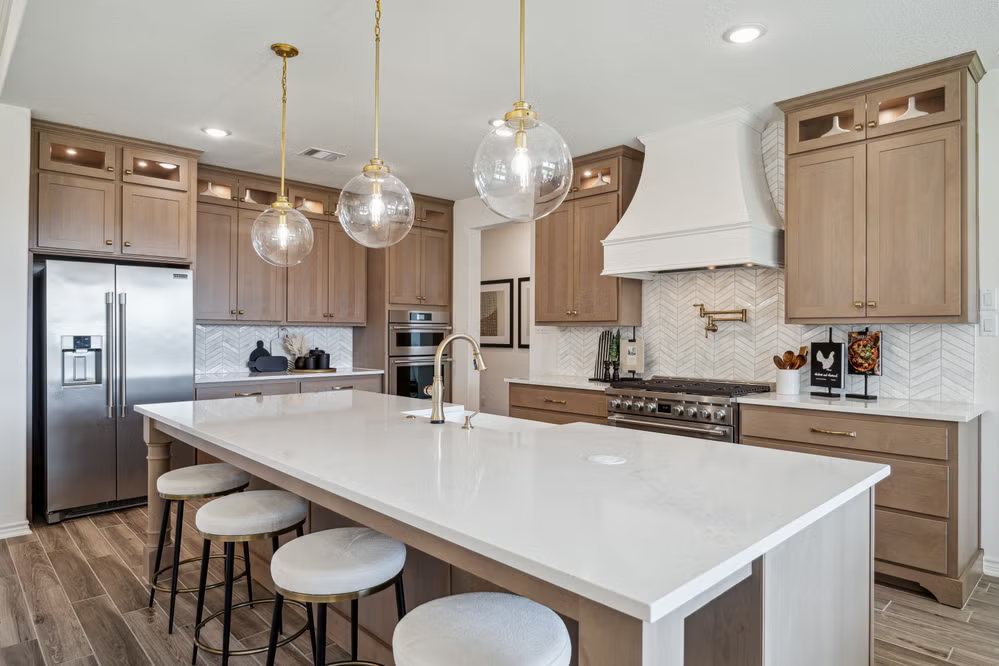
The kitchen is often the biggest single line item in a remodel because it combines cabinetry, counters, lighting, plumbing, electrical, appliances, and finish detail. A midrange Denton kitchen remodel commonly falls around $45,000 to $85,000, while a larger or more custom build-out can easily reach $100,000 or more.
A national benchmark from Rocket Mortgage’s 2025 summary places kitchen renovation at roughly $14,585 to $41,530, with broader planning ranges of $75 to $250 per square foot. Denton projects can rise above those numbers when homeowners choose custom cabinetry, premium appliances, larger islands, or layout changes that require rerouting plumbing and electrical.
Cabinetry can take roughly 25% to 35% of a kitchen budget. On a $70,000 kitchen, that means $17,500 to $24,500 may go to cabinets alone before you add countertops, installation details, or specialty storage. Appliances can add another $5,000 to $20,000+, depending on whether the package is basic replacement grade or closer to professional-grade or panel-ready.
Layout matters too. If the sink, range, refrigerator, and ventilation strategy stay roughly in place, the project is usually more efficient. If the island grows, the sink moves, or the cooking zone is relocated, labor rises because electricians, plumbers, drywall crews, and finish installers all have more work.
Bathroom remodel costs in Denton
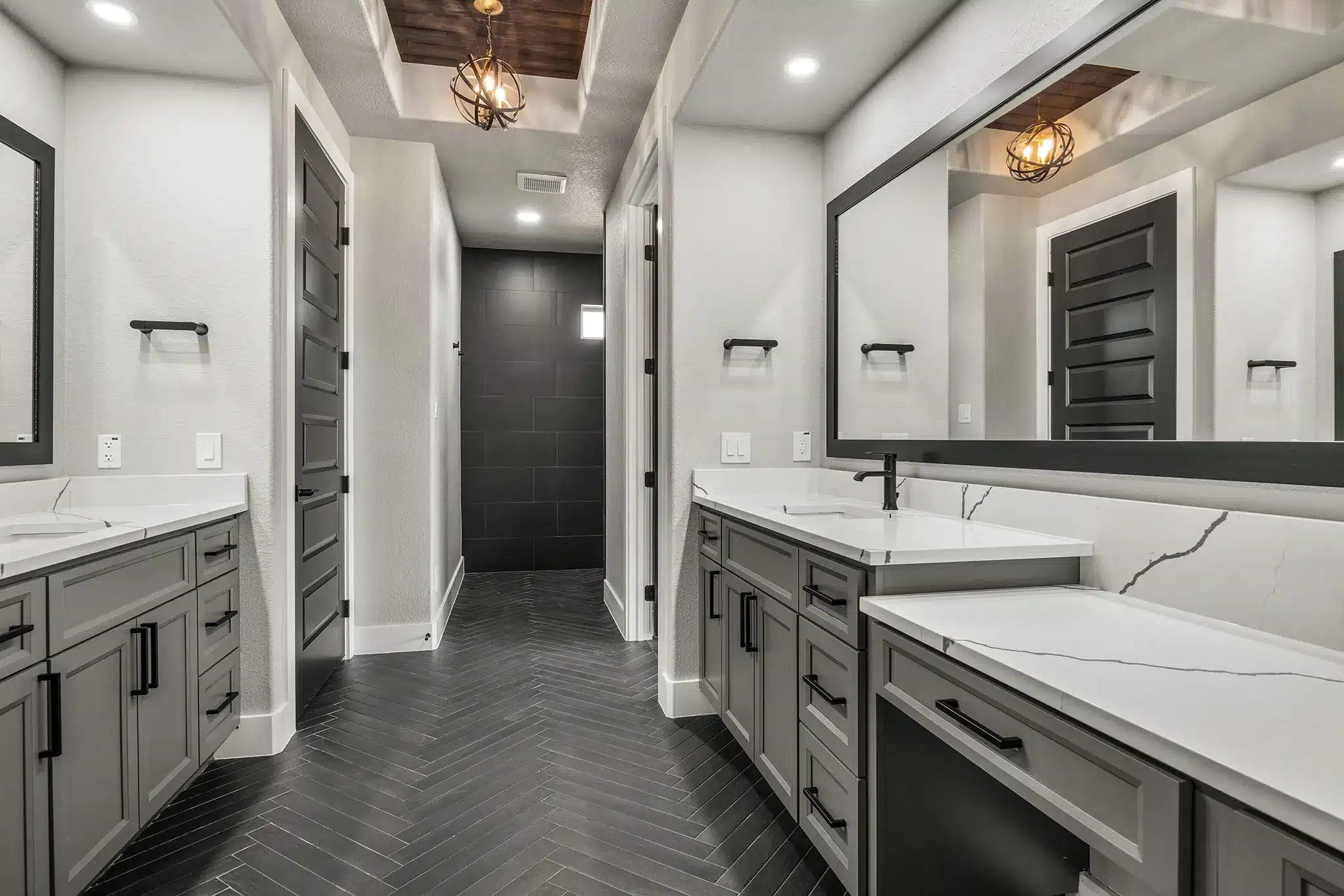
Bathrooms are smaller than kitchens, but they are often more cost-dense because the work happens in a compact area with plumbing, waterproofing, tile, lighting, and ventilation all layered together. In Denton, a hall bath often falls around $20,000 to $40,000, while a larger primary bathroom commonly lands around $30,000 to $60,000+.
Rocket Mortgage’s 2025 summary placed bathroom remodeling around $6,639 to $17,620 nationally, with luxury projects potentially moving above $80,000. Local projects in North Texas often exceed low-end national averages once better tile packages, shower glass, custom vanities, or plumbing relocation are part of the plan.
A helpful planning allowance for bathroom fixtures is about $1,500 to $8,000 per bathroom. That can include toilets, faucets, trim kits, mirrors, hardware, and portions of the vanity package. Add a frameless glass enclosure, heated flooring, larger-format tile, niche lighting, or a freestanding tub, and the number rises quickly.
Bathrooms are also where hidden conditions can show up fast. Once demolition begins, contractors may uncover water damage, weak subfloor, poor ventilation history, or outdated plumbing connections. That is one reason contingency money matters more in baths than many homeowners expect.
Living areas, bedrooms, and general interior spaces
The less trade-dense parts of the house usually carry lower costs. Bedrooms, living rooms, hallways, offices, and dining spaces may mainly involve paint, flooring, trim, doors, lighting, and window treatments. In those zones, a remodel may cost far less per square foot than the kitchen or baths because there are fewer systems to change and fewer specialty materials to install.
A bedroom refresh can land anywhere from a few thousand dollars to the low five figures if the work is cosmetic. If built-ins, custom closets, new lighting circuits, or structural changes are added, the number climbs. National figures referenced by Rocket Mortgage from Angi data placed many bedroom remodels around $12,000 to $28,000 in 2025, though local totals depend heavily on what is actually changing.
For many Denton homeowners, these lower-cost rooms are where a remodel can gain visual momentum without exhausting the budget. Updating wall texture, paint color, flooring transitions, trim, and doors often makes the house feel dramatically newer, even if the expensive wet rooms are done in a later phase.
Whole-home remodel costs in Denton
Whole-home remodeling is really a bundled set of room-by-room decisions under one construction schedule. A practical planning range for a midrange project is often around $100 to $150 per square foot, though deep structural work, premium finishes, or high design complexity can push the figure much higher.
For example, a 2,300-square-foot Denton home receiving a substantial but not fully structural remodel might land in the $230,000 to $345,000 range if several expensive rooms are being rebuilt at the same time. That does not mean every 2,300-square-foot house should cost that much. It means that once a project includes multiple wet rooms, flooring throughout, finish upgrades, and trade coordination, the total can build quickly.
That is why per-square-foot numbers are best used as broad framing tools, not as final answers. The actual budget depends on what percentage of the house is being changed, how much of the work touches hidden systems, and whether the finish level is standard, upgraded, or highly custom.

Labor, materials, and trade sequencing
In a significant remodel, labor often makes up 40% to 60% of the project budget. That surprises homeowners because material decisions feel more visible. People notice the countertop slab, the flooring, and the tile pattern. They do not see the time it takes to protect the home, demolish in the right order, reroute systems, prepare surfaces, and sequence trades so finish work is not damaged later.
Labor gets more expensive when a remodel is highly customized, heavily phased, or performed in an occupied house. An empty site is easier to protect, easier to stage, and easier to move crews through. A family living in place usually requires temporary walls, dust control, protected access, cleaning passes, and tighter daily coordination. Those constraints matter to the real cost even if they are not the most glamorous line item.
Material selection also changes labor intensity. Large-format tile needs flatter prep and tighter installation technique than many standard products. Custom cabinetry requires more precise field measurement and fitting than stock units. Premium flooring may demand more subfloor correction, more acclimation time, or more careful trim integration.
A good way to think about sequencing is in layers:
- Protection and demolition: surface protection, dust barriers, removal, haul-off, selective demolition.
- Rough work: framing, plumbing, electrical, HVAC, insulation correction, inspection-related work.
- Finish work: drywall, paint, cabinets, flooring, countertops, tile, trim, hardware, and fixtures.
If one layer slips, the next layer usually slips too. That is why schedule planning is not separate from cost planning. It is part of the same problem.
Another major issue is trade density. Kitchens and bathrooms cost more because several trades need to work in the same area, often in a specific order, and often in tight space. By contrast, repainting a bedroom or replacing flooring in a hallway may involve far fewer handoffs. The more concentrated the trade stack, the more expensive the room tends to be.
Supply lead time is part of this too. Cabinet packages, specialty tile, custom glass, engineered flooring, and stone fabrication do not all move on the same calendar. If selections are delayed, the whole schedule can become harder to sequence efficiently. That is why early product decisions often save money indirectly, even when the product cost itself does not change.

Permits, planning review, and inspections in Denton
Permit-sensitive work is one of the easiest parts of remodeling to underestimate. Cosmetic updates may not create much review burden, but once the project affects structure, mechanical systems, plumbing, electrical work, or square footage, planning and inspections become part of both the schedule and the budget.
Denton’s remodeling reality is similar to most active North Texas cities: once the scope moves beyond surface finishes, you should assume the project may need documentation and review. That matters because remodels are not judged only by whether the finished space looks good. They also have to satisfy code, structural logic, and inspection expectations when the scope goes beyond cosmetic work.
The projects most likely to feel permit-sensitive include:
- wall removal or major reconfiguration
- bathroom or kitchen plumbing relocation
- new dedicated electrical circuits
- panel upgrades
- HVAC or ventilation changes
- enclosed patio conversions
- garage conversions
- additions or square-footage changes
A practical Denton budget should therefore include time for plan review, comments, revisions if needed, and inspection coordination. Even when permit fees themselves are not the biggest part of the number, the effect on schedule can shape labor and sequencing. Waiting on approval may affect cabinetry ordering, rough-in start dates, and the handoff between demolition and finish work.
Homeowners often ask whether permits are just a contractor issue. The answer is no. They are a homeowner budget issue too, because an unclear or underdocumented scope can trigger delays that increase labor inefficiency, temporary living inconvenience, or material storage time.
This is especially relevant when a remodel starts as “mostly cosmetic” but evolves during planning. A homeowner may begin by wanting a nicer kitchen, then decide to enlarge an opening, move plumbing, improve ventilation, and add better lighting. At that point the project has crossed out of simple finish work and into a more coordinated, review-sensitive category.
The safest budgeting approach is to assume that any hidden-system work deserves schedule cushion. If the process goes faster, great. If it does not, the project is still protected.
That same mindset also helps with communication. Homeowners who review drawings, selections, and allowances early usually make fewer decisions under pressure later. A clearer front end does not just reduce stress. It often reduces change orders, which can protect both the budget and the finish quality.
In practical terms, that means the best Denton remodels are usually the ones where the homeowner has already settled the big questions before demolition begins. Which rooms are included? Which finishes are nonnegotiable? Which items can be downgraded if the budget tightens? Answering those questions early gives the project team a much cleaner path forward.

Cost drivers that push budgets up or down
Two Denton remodels of similar size can differ by tens of thousands of dollars because the cost drivers are different. The largest ones are usually the following.
1. Layout changes
Keeping the floor plan intact is often the most cost-effective choice. Moving walls, doors, appliances, or fixtures adds framing, electrical, plumbing, drywall, finish labor, and usually more decision points. Layout changes are often worthwhile, but they should be budgeted as a major move, not a small tweak.
2. Finish level
A project built with straightforward, durable selections usually stays nearer the middle of the range. As soon as you choose custom cabinetry, premium slab materials, handcrafted tile, integrated appliances, designer plumbing trim, or specialty glass, the total rises. Even a few upgraded categories can add five figures to a whole-home budget.
3. Hidden conditions
Once demolition starts, previous patchwork, moisture damage, uneven framing, outdated wiring, or plumbing defects may appear. This is one of the biggest reasons contingency matters. A 10% to 20% reserve is standard on meaningful remodels because very few larger projects unfold with zero surprises.
4. Trade density
The more trades required in one part of the house, the higher the cost. Bathrooms and kitchens are classic examples because they require waterproofing, plumbing, electrical, finish carpentry, drywall, paint, and often tile or stone installation. A living room does not usually need that kind of stack.
5. Schedule pressure
If the homeowner needs the remodel finished faster than the normal sequence allows, cost can increase. Rush ordering, compressed trade scheduling, overtime, and less flexible sequencing all affect labor. In active DFW markets, faster is often possible, but rarely free.
6. Occupied-home constraints
Remodeling while the family stays in place adds logistics. Contractors may need temporary kitchens, access planning, repeated cleanup, staging limits, and more careful daily shutdown. The work can still be worth doing in place, but the budget should reflect the reality that efficiency is lower than on an empty job.
7. Selection timing
Late selections often cause change orders or schedule drift. If tile, lighting, plumbing fixtures, countertops, and cabinet details are not resolved in time, installers may pause or return later. That can introduce extra cost even if the actual products do not become more expensive.
The best way to control these drivers is not to chase the cheapest headline number. It is to clearly define the scope, set realistic allowances, and decide early which parts of the plan are essential versus optional.
How to budget for selections, allowances, and contingency
A useful remodel budget has more than one line item. Homeowners who focus only on the contractor’s base construction number often get surprised later when design, permits, product allowances, and contingency start filling in the rest of the picture.
A healthy Denton remodeling budget usually accounts for:
- base construction scope
- design and drafting
- permit and review costs
- product allowances
- contingency reserve
- temporary living or convenience costs, if needed
On more complex remodels, design and drawings may represent roughly 8% to 15% of the total investment. That can feel expensive at first, but good drawings usually help control cost by reducing ambiguity, helping bids align, and limiting midstream changes.
Allowance planning is equally important. Kitchen appliances might need $5,000 to $20,000+ depending on the package. Countertops may need $3,000 to $10,000+ depending on material and square footage. Bathroom fixtures may need $1,500 to $8,000. Lighting can vary dramatically depending on whether the project uses builder-grade fixtures or decorative layered lighting with dimming and accent control.
Then there is contingency. A reserve of 10% to 20% is not wasted money waiting to be spent. It is the buffer that allows the project to respond to hidden conditions or smart upgrades without breaking the overall plan. On a $150,000 remodel, that means setting aside $15,000 to $30,000. On a $250,000 remodel, the reserve may be $25,000 to $50,000.
One of the most practical methods is to split choices into three groups:
- Must-have items that define the remodel’s success.
- Nice-to-have upgrades that improve quality or appearance but can be reduced if needed.
- Later-phase items that can be postponed without weakening the main project.
That framework helps homeowners avoid blowing the budget on one highly visible category while underfunding the parts of the remodel that affect everyday performance. It is common to get excited about slab material or tile pattern and forget that rough electrical, ventilation, waterproofing, or subfloor prep may matter more to long-term results.
The 2025 Houzz study highlighted how common budget and schedule stress remain for homeowners, and that reality shows up locally too. Good allowance planning does not eliminate every surprise, but it dramatically reduces the chance that the project loses momentum halfway through.

Timeline and project phases
A remodel feels easier to manage when the schedule is divided into phases rather than treated like one vague block of time. In Denton, a smaller cosmetic refresh may take 2 to 6 weeks, especially when the finish selections are straightforward and the work stays inside the existing layout.
Bathroom-focused remodels often fall in the 3- to 8-week range. Kitchen remodels commonly run 6 to 12 weeks because cabinets, counters, plumbing, electrical work, and finish details all need to line up. Whole-home projects frequently stretch into the 3- to 6-month range, particularly if multiple wet rooms or structural changes are involved.
The visible construction period is only part of the story. Homeowners should also budget time for:
- early scope definition
- measuring and design
- drawing production if needed
- permit review
- material selections
- cabinet and countertop lead times
- inspection scheduling
- punch-list completion
If selections happen late, the project often slows. Cabinet lead times are a common example. Stone fabrication is another. The same is true of custom shower glass, specialty tile, or flooring products that require ordering windows.
It also helps to think about the project in terms of decision gates. A decision gate is the point where one choice affects several later choices. Cabinet layout affects plumbing. Plumbing affects lighting and drywall. Flooring thickness affects doors and trim. These dependencies are why a remodel that seems simple at the start can become expensive if early decisions are delayed.
Another practical schedule item is punch-list work. Even a well-run remodel usually ends with a final round of touch-ups, adjustments, and small corrections. That phase may only take a few days, but it should still be planned for because it closes out the job cleanly and helps ensure the final result matches the budget and scope.
Timeline planning also becomes more important when the house stays occupied. If the kitchen will be offline, the family may need a temporary prep area. If a bathroom is being rebuilt, alternate bathing arrangements may be necessary. Those are not just lifestyle concerns. They influence how long the project feels and whether it makes sense to complete the work in one phase or split it into smaller sections.
A strong schedule also gives homeowners better leverage for decision-making. If all major selections are due before demolition, that is a sign the contractor is trying to protect the flow of the job. If many critical items are undecided after demolition begins, the schedule is more vulnerable.
That vulnerability matters because a remodel is a chain of dependencies. The kitchen cannot be finished until rough-in work is complete, inspections are passed, and the cabinet and countertop details are settled. Bathrooms have the same issue, just on a smaller footprint. A project that respects those dependencies usually ends up cleaner, faster, and easier to price.
In many cases, a realistic timeline is more valuable than an unrealistically short one. A remodel that finishes in 12 steady weeks often feels better than one that was promised at 8 weeks but drags to 16 because the sequence was too optimistic from the start.

Comparing Denton remodeling costs to nearby markets
Denton homeowners often want to know how their remodeling costs compare to nearby cities. The answer is that the fundamentals are similar across DFW, but market texture still matters. Finish expectations, neighborhood age, labor routing, and the density of higher-scope projects can shift what is considered standard.
For example, if you compare Denton to Cost to Remodel Your Home in Mesquite (2026 Guide), you may find similar broad ranges but different assumptions about housing age, layout issues, or finish expectations. If you compare Denton to Cost to Remodel Your Home in Grand Prairie (2026 Guide), the broad budgeting logic still holds, but neighborhood patterns and buyer expectations may change how much homeowners invest in kitchens, bathrooms, and whole-home upgrades.
Within Denton itself, the same comparison mindset is useful. Homes with stronger underlying layouts may justify more finish-driven investment. Homes with awkward plans or older systems may need more of the budget devoted to hidden infrastructure before the finishes even begin.
Local cross-links matter for planning too. If your scope is still evolving, it may help to understand how a companion project would price. A homeowner considering broad upgrades might also compare the city’s custom home building cost guide to understand when remodeling still makes more financial sense than starting over. If the focus narrows to one expensive room, the Denton bathroom remodeling cost guide and kitchen remodeling cost guide can help clarify the room-level side of the equation.
The point is not that one city is always more expensive than another. It is that meaningful comparisons only work when the scope, finish level, and hidden-system burden are being compared honestly.

When a local remodel is worth the investment
A remodel is worth the investment when it solves real problems in the home and does so at a cost that still makes sense for your goals. Sometimes that goal is everyday livability. The kitchen works better, the bathrooms feel cleaner and more functional, the lighting improves, and the house finally fits the family’s routines. Sometimes the goal is resale readiness. Other times it is long-term aging in place, multigenerational use, or simply wanting the home to feel less dated and more enjoyable.
It is also helpful to remember that not every dollar returns value in the same way. A better kitchen layout can make daily cooking easier, while durable flooring can reduce maintenance headaches for years. On the other hand, some highly personal finishes may delight the current homeowner without changing the home’s core function much. That is why the strongest remodel budgets usually start with practical performance and then layer style on top.
The smartest remodeling budgets are not built around maximizing spend. They are built around aligning money with the parts of the house that matter most. If the kitchen layout is failing every day, that room may deserve the highest share of the budget. If the bathrooms are serviceable but the flooring, paint, and lighting make the whole house feel old, a broader cosmetic plan may produce a better result per dollar.
It is also worth remembering that remodeling is not just a math exercise. The project affects how people live during construction and how they feel in the home afterward. A well-planned remodel can reduce daily friction, improve storage, increase comfort, update finishes, and make a familiar home feel new again without forcing a move.
For many Denton homeowners, the decision also comes down to timing. If the home already has the right location, school access, commute pattern, and lot size, remodeling can be a better value than buying a new place and starting over with closing costs, moving costs, and a higher mortgage rate. That does not mean remodeling is always cheaper in absolute dollars. It means the value equation is often stronger when the house already checks most of the boxes.
A second practical question is whether the remodel will be visible to future buyers or mostly enjoyed by the current household. Highly visible improvements like kitchens, bathrooms, flooring continuity, and lighting often have the strongest day-to-day impact and the clearest resale effect. Less visible changes, such as better insulation, improved framing, or upgraded electrical capacity, may not photograph as well but can be just as important for comfort and function.
A third question is whether the home is becoming easier to live in or merely more expensive to finish. That distinction matters. A project that improves circulation, storage, durability, and maintenance burden is usually easier to justify than a project that only adds decorative upgrades. The best budgets usually balance both: a durable backbone and a finish package that feels current without being excessive.
If you are in the early planning stage, start by defining the must-have outcomes, then compare them against realistic scope-based price bands. From there, narrow the finish level, build in contingency, and verify whether any structural or permit-sensitive work changes the schedule. When those pieces are clear, the budget stops feeling abstract and starts becoming actionable.
For Denton homeowners, that is the real goal: not just asking what remodeling costs in theory, but understanding what your house is likely to cost based on the work it truly needs. A good remodel does more than spend money. It creates a home that works better on ordinary weekdays, not just on the day the project is finished.
If you want a local team to help you turn these planning ranges into an actual scope, Fin Home’s Denton home remodeling page is a good starting point for the next step.