
After 19 Flower Mound projects since 2020, the kitchen pricing pattern is consistent. A meaningful Flower Mound kitchen remodel starts around $28,000, but the final number is rarely decided by the kitchen alone. It’s decided by which trades the kitchen pulls in once demo begins — and by four specific cost levers that swing the budget by tens of thousands of dollars before a single tile is selected.
This guide breaks down where the money actually goes. Cabinet by cabinet, slab by slab, appliance by appliance. The goal is for a Flower Mound homeowner to read a kitchen estimate and know what’s driving the bottom number.
The Cabinet Decision Is the Biggest Single Cost Lever
Cabinetry runs 35–45% of a typical Flower Mound kitchen project. It’s the largest line on the estimate, and it’s where the broadest dollar swing happens — usually a $6,000 to $25,000 spread between the cheapest credible option and the most expensive one for the same kitchen.
Stock cabinetry sits at the bottom of that range. Pre-built in standard sizes, two-week lead times, fine when the existing layout is solid and the homeowner wants to keep cosmetic changes simple. In Flower Mound, this works best in newer Lakeside DFW and Canyon Falls homes where the kitchen footprint already matches modern use.
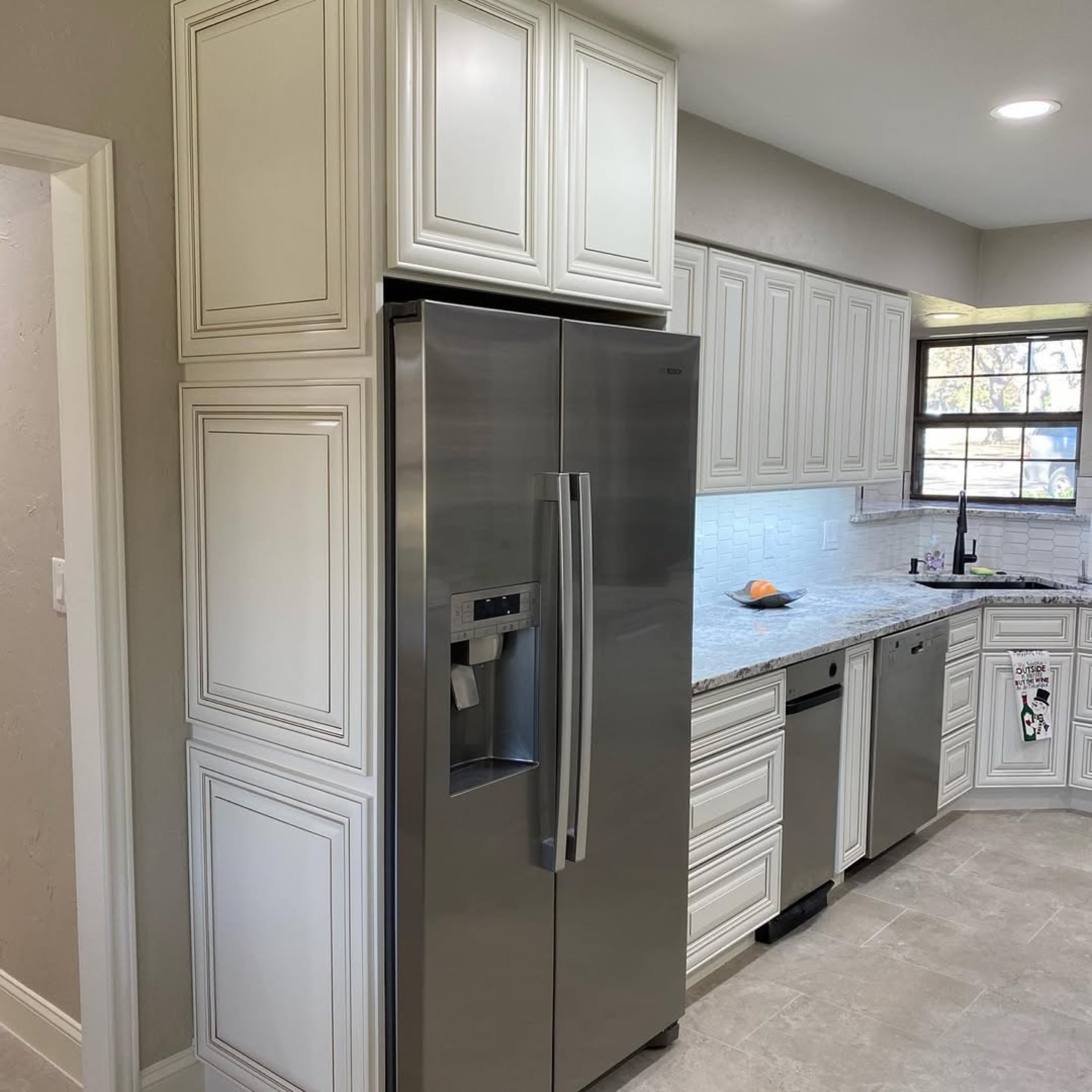
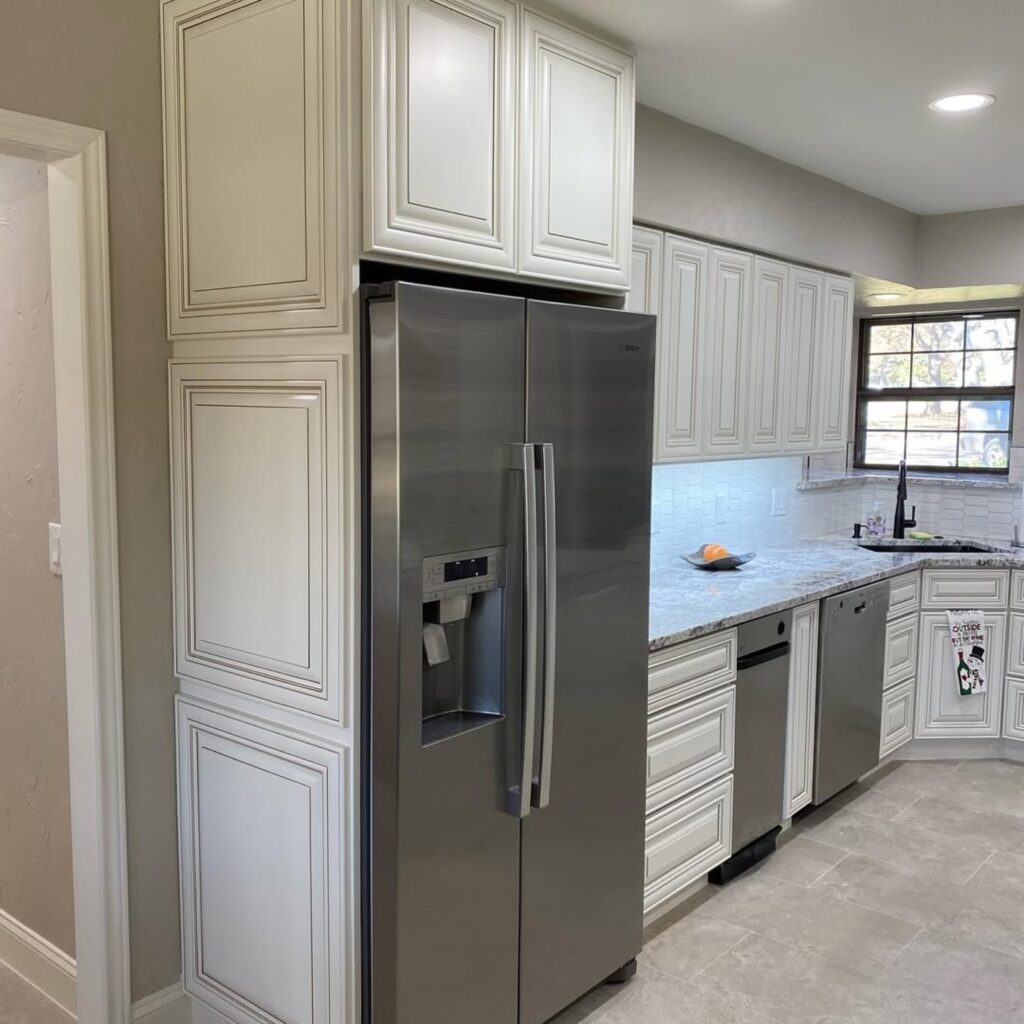
Semi-custom cabinetry is where most Flower Mound mid-range projects land. Same modular boxes, but with modifications: extended depth, custom door styles, soft-close drawers, taller uppers, pull-out organizers. The cost premium over stock is typically $4,000–$10,000 for an average kitchen, and the payoff is storage that fits how the family actually cooks. In Bridlewood and Wellington homes from the 1990s, this is where most remodels need to land because the original layout had short uppers, dead corners, and built-in desks that wasted wall space.
Full custom cabinetry is built to the room. Every box is sized to the available wall, ceiling, and appliance specs. No fillers, no factory-standard limitations, no compromises on tall pantry walls or oversized islands. The premium over semi-custom is usually $10,000–$25,000 for a kitchen of comparable size. This is the cabinet tier on larger Cross Timbers and Tour 18 projects where the kitchen has to match the scale and finish quality of the rest of the house.
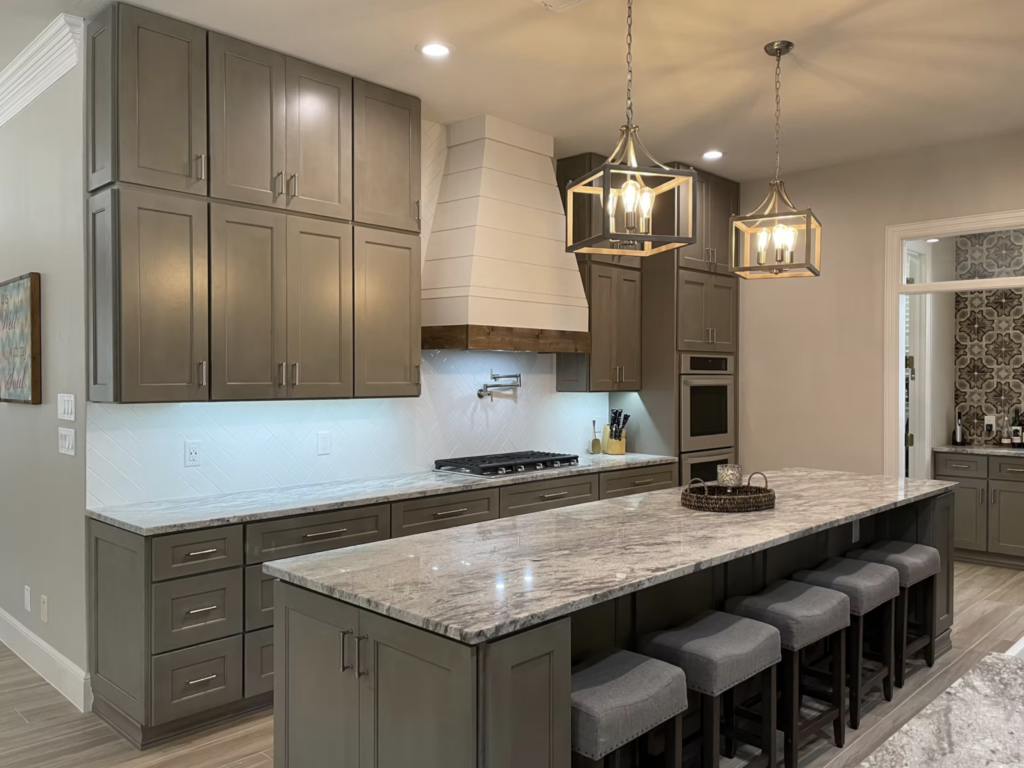
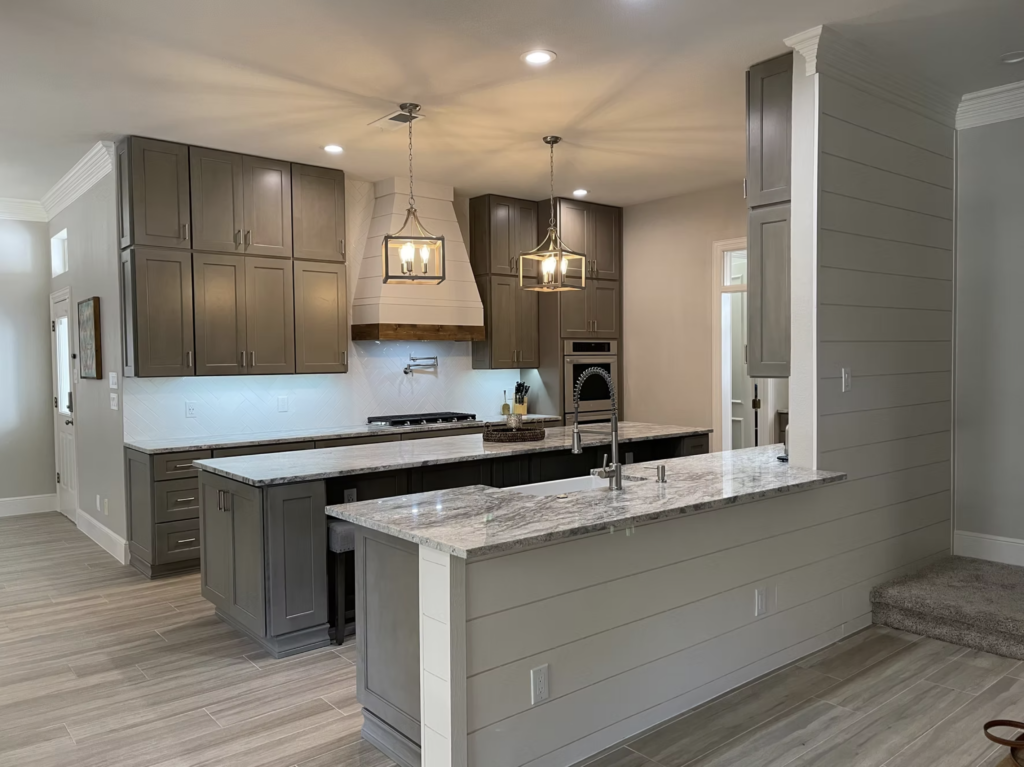
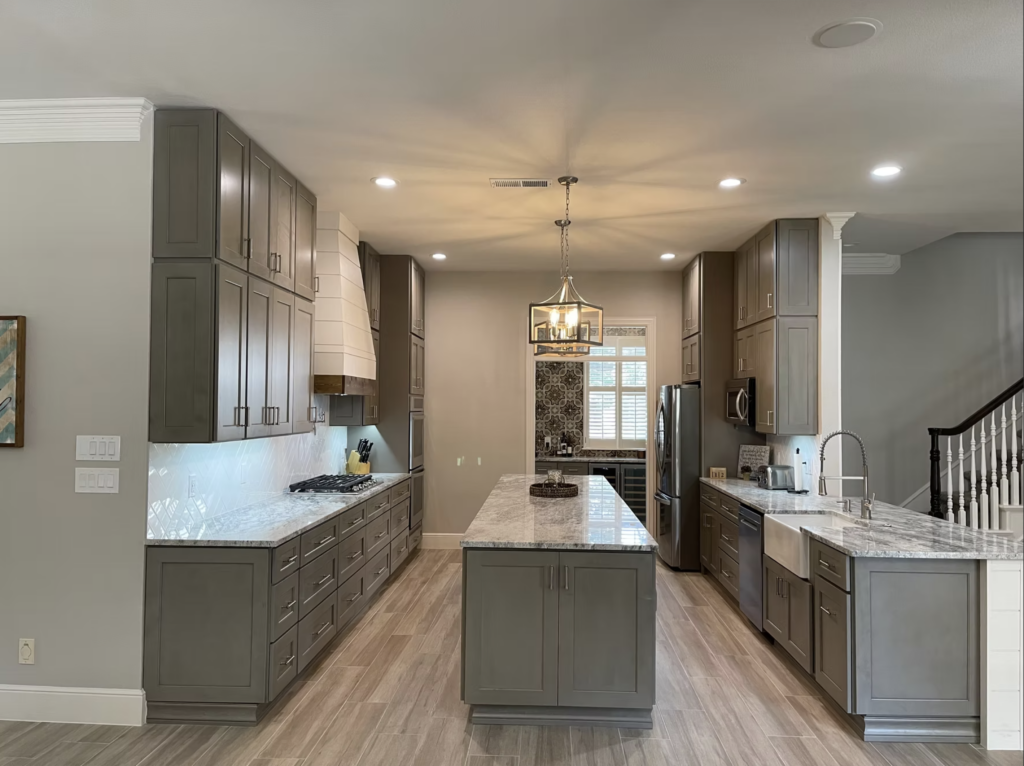
On a recent $145k Flower Mound home remodel where the kitchen was the centerpiece, the cabinet allowance landed in the $32,000–$38,000 range — semi-custom with several custom modifications. Reframing that same kitchen in stock cabinets would have dropped the line to around $24,000, but the family would have ended up with the same dead corner cabinets they started with. Pushing to full custom would have added another $12,000–$18,000 for storage they would have used, but only marginally more than the semi-custom configuration delivered.
Countertop Costs: The Material Is Only Half the Story
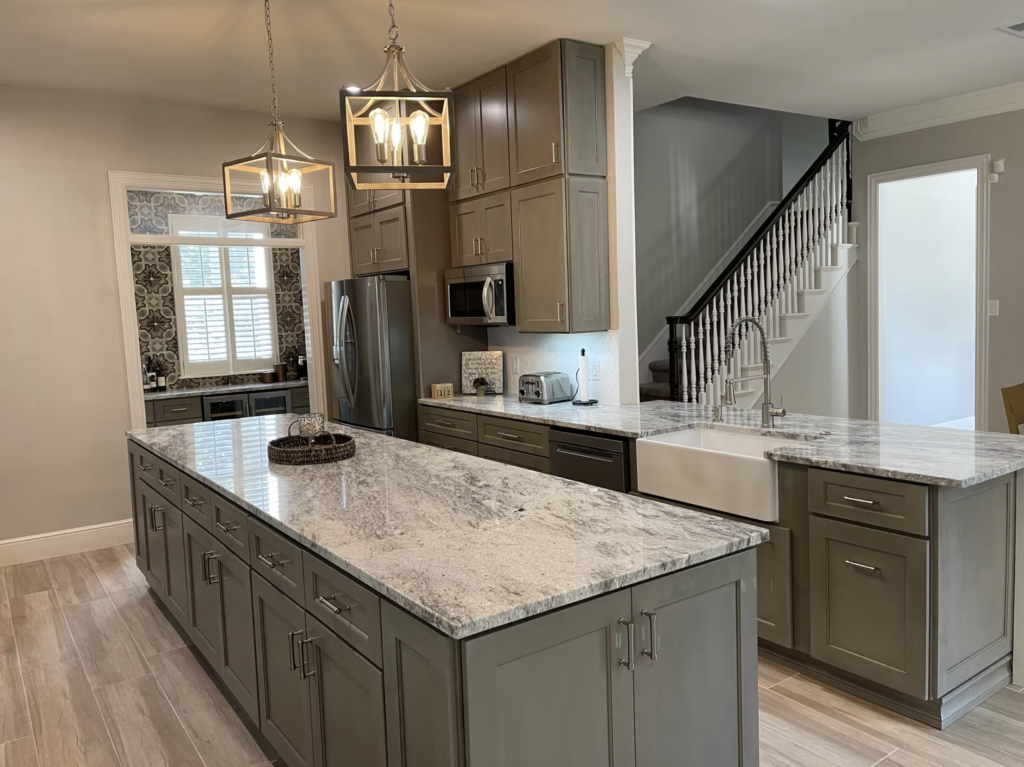
The visible swing on countertops is material, from laminate at the bottom to exotic natural stone at the top. The full range for a typical Flower Mound kitchen runs $3,500–$15,000+ for surface and installation. But the part that surprises homeowners is rarely the slab itself. It’s everything around it.
Quartz runs $60–$110 per square foot installed for mainstream brands, more for designer lines. Predictable, no sealing required, handles Flower Mound’s pattern of heavy daily kitchen use. Most semi-custom kitchen projects use quartz unless the homeowner has a strong preference for natural material.
Granite and quartzite vary widely. Standard granite is comparable to quartz in price, but premium granite slabs and most quartzites run $90–$160 per square foot installed. The slab itself is one cost; selecting from a yard, paying for the specific slab rather than a stock pull, and getting the veining matched on a waterfall island add 15–25% on top.
Marble is rare in Flower Mound kitchens for a reason — it stains. When homeowners want the look, they usually end up specifying a quartz that mimics marble veining, which keeps the visual and eliminates the maintenance.
Two hidden costs surprise homeowners on the countertop line. Full-height slab backsplashes — running stone up the wall behind the range — double the slab quantity for that wall and typically add $1,500–$4,000. Waterfall ends on an island add another slab plus the labor to miter the seam, usually $1,200–$3,000. Both are aesthetic upgrades, neither is required, but both are increasingly common in the $75k+ Flower Mound full-renovation tier.
Appliances: The $8k–$20k Swing in Detail
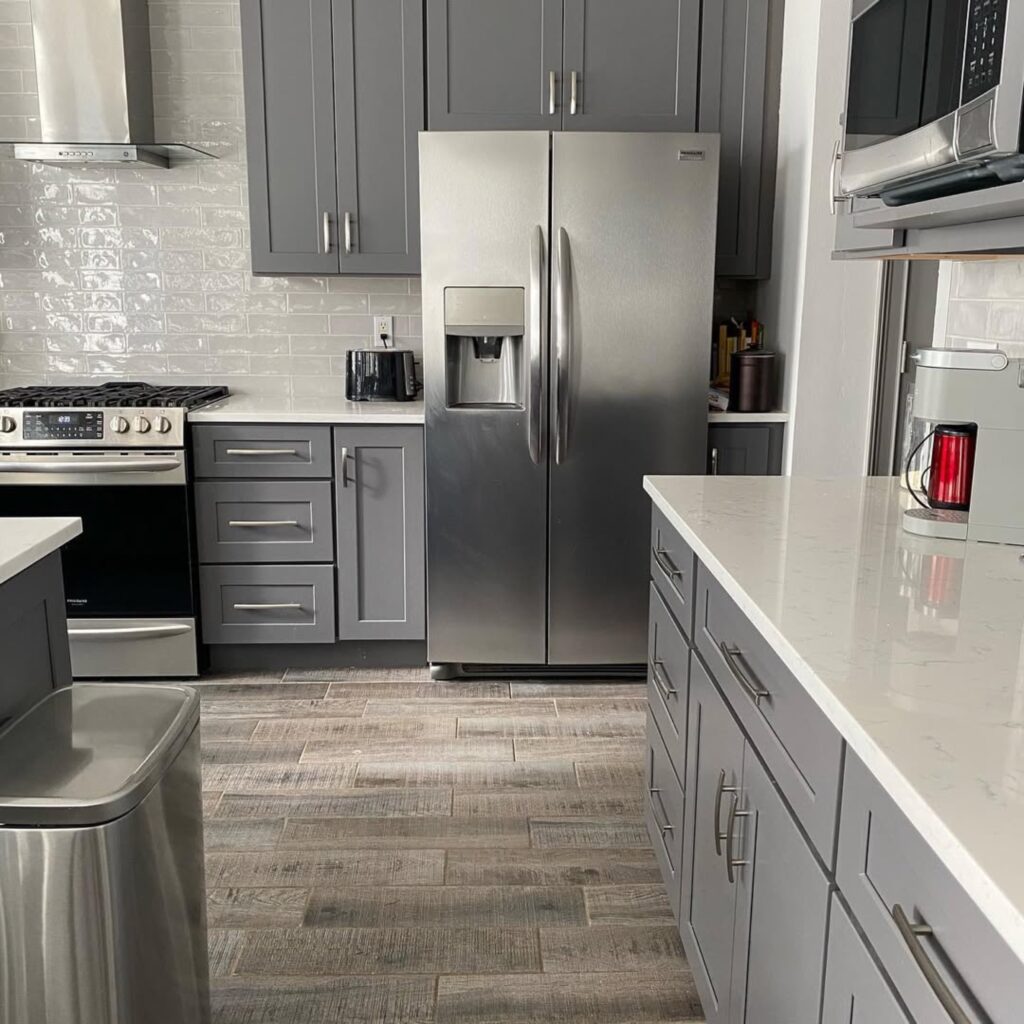
A mid-tier appliance package in Flower Mound — GE Profile, KitchenAid, Bosch — runs $6,000–$10,000 for a full kitchen: refrigerator, range or cooktop/wall oven, dishwasher, microwave, vent hood. This is the package behind most $45k–$70k mid-range kitchens.
A high-end package — Café, JennAir, Thermador entry — runs $12,000–$20,000. The jump buys quieter dishwashers, more precise oven controls, larger refrigerator capacity, and a more integrated look with panel-ready fronts.
A luxury package — Sub-Zero, Wolf, Miele — starts around $25,000 and can pass $50,000 in larger Cross Timbers or Tour 18 kitchens with full integration. This is the appliance tier that anchors the upper end of Flower Mound full-renovation pricing.
The hidden cost isn’t the appliance itself. It’s what surrounds it. A 36-inch Sub-Zero refrigerator requires a deeper cabinet box, a custom panel, dedicated electrical, and often modifications to upper cabinets to handle the height. The appliance alone might be $12,000; the cabinetry and electrical to host it correctly might be another $4,000–$6,000. The same logic applies to drawer microwaves (cabinet modification plus a new electrical run), wall ovens (cabinet rebuild plus a 240V circuit), and built-in beverage centers (plumbing line plus a dedicated circuit).
Layout Changes: Three Decisions That Move the Number
This is where Flower Mound remodels sprint past their initial budget. Three layout decisions move the number most.
Removing a wall between the kitchen and an adjacent room is common in Bridlewood and Wellington homes where the kitchen was originally separated from the living room by a half-wall or partition. Non-load-bearing wall, clean opening (demo, drywall repair, flooring patch, paint): $2,500–$5,000. Load-bearing wall: add a structural beam, engineering review, and temporary support during framing — another $5,000–$15,000, sometimes more if the beam route crosses second-floor framing or HVAC.
Moving the sink or island changes the plumbing under the slab. In Flower Mound’s slab-on-grade homes, that means saw-cutting concrete, rerouting drain and supply lines, and patching the slab before flooring goes back in. Budget $3,500–$7,500. Moving the dishwasher with the sink usually rides on the same plumbing work; moving it independently adds $800–$1,500.
Rebuilding the island sounds like a finish-level change but touches three trades: cabinet (new build), electrical (new circuit and outlets), and possibly plumbing. A new island in an existing footprint with electrical only runs $4,000–$8,000. Add a prep sink and the number jumps to $6,500–$11,000. Add a cooktop and the appliance, ventilation routing, and gas line push it well past $12,000.
How a Flower Mound Kitchen Budget Actually Breaks Down
To make this concrete, here’s a representative breakdown of the kitchen portion of a Flower Mound home remodel in the $135k–$150k total range — the cluster where most of our recent Flower Mound mid-to-upper projects have landed. The kitchen itself in this scope typically runs $85,000–$100,000 of the total.
| Line Item | Range |
|---|---|
| Cabinetry (semi-custom with island rebuild) | $32,000–$38,000 |
| Countertops (quartz, full-height backsplash) | $9,500–$11,000 |
| Appliances (high-end package, homeowner-supplied) | $11,000–$14,000 |
| Electrical (panel update, new circuits, lighting) | $6,500–$8,500 |
| Plumbing (sink relocation, new fixtures) | $3,500–$5,000 |
| Flooring (continuous engineered hardwood) | $7,000–$9,500 |
| Demo, drywall, paint, finish carpentry | $8,000–$11,000 |
| Permits, project management, contingency | $4,000–$6,000 |
The same kitchen built around custom cabinetry, a luxury appliance suite, and a load-bearing wall removal pushes past $130,000 on its own. The same kitchen at the essential-refresh tier — stock cabinets, mid-range quartz, no layout change, no appliance upgrade — comes in around $32,000–$38,000.
What Homeowners Underestimate
Reviewing the last several years of Flower Mound kitchen scopes, three line items routinely come in higher than first-time remodelers expect.
Electrical updates. Flower Mound homes from the 1990s and early 2000s typically have 100-amp or 150-amp panels and limited dedicated kitchen circuits. A modern kitchen with a 36-inch range, microwave drawer, dishwasher, refrigerator, disposal, and six counter outlets often requires panel work or a sub-panel. Add $1,500–$4,500 on top of the kitchen-specific electrical scope.
Ventilation. A recirculating hood works in some kitchens, but Flower Mound homeowners with gas ranges or oversized cooktops usually want a properly ducted exhaust. Running ductwork from the range to an exterior wall — especially through second-floor framing or masonry — adds $1,200–$3,500.
Lead times. Custom and full-custom cabinetry typically runs 8–14 weeks from order to delivery in 2026. Designer appliances can add another 6–12 weeks. The total project timeline in Flower Mound is rarely the 6–12 weeks the construction phase suggests; it’s that plus the lead time on the long-pole items, which has to be planned around before demo starts.
Reading a Kitchen Estimate
A good Flower Mound kitchen estimate clearly separates fixed pricing from allowances. Fixed pricing covers labor, cabinet construction once a tier is chosen, demolition, drywall, paint, electrical and plumbing rough-in, and permits. Allowances cover items still being selected: countertop slab, tile backsplash, plumbing fixtures, lighting fixtures, and sometimes flooring.
If an estimate lists “countertops: $8,000” without specifying material and square footage, that’s an allowance — and the final cost can swing $3,000–$6,000 in either direction once a slab is chosen. The estimate should also list what’s excluded: appliance purchases (almost always homeowner-supplied), HOA submission fees, structural engineering if walls are coming down, and any city inspection re-fees if rework is required.
A line-by-line written estimate that distinguishes “fixed at this scope” from “allowance pending selection” is the document worth comparing across contractors. A single total dollar figure isn’t.
When Phasing the Kitchen Makes Sense — and When It Doesn’t
Some Flower Mound homeowners ask whether they can phase a kitchen: cabinets and counters now, appliances later, or layout changes now, finishes later. Honestly, phasing rarely saves money within a kitchen specifically.
The labor cost of mobilizing demo, electrical, plumbing, and cabinet trades twice exceeds the savings from spreading the spend across two budgets. The exception is when the kitchen is part of a larger whole-home plan. It sometimes makes sense to remodel the kitchen and primary bath in one mobilization, then come back for secondary baths and other living areas later. That phasing works at the room-by-room level, not within the kitchen itself.
For homeowners building toward a longer remodel, the better strategy is usually to settle the kitchen layout once and pick finishes that can be upgraded over time without rebuilding: change pulls and pendants in year three, replace a microwave in year five, refinish or repaint cabinet boxes in year eight. None of that requires reopening the room.
What Done-Right Looks Like in Flower Mound
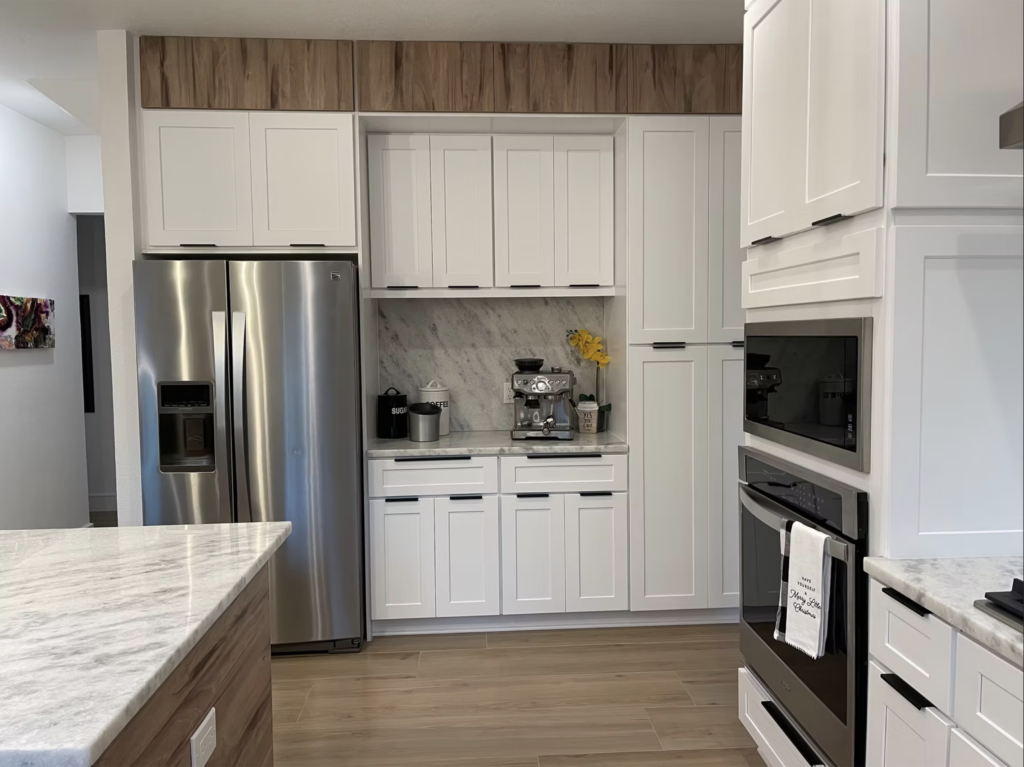
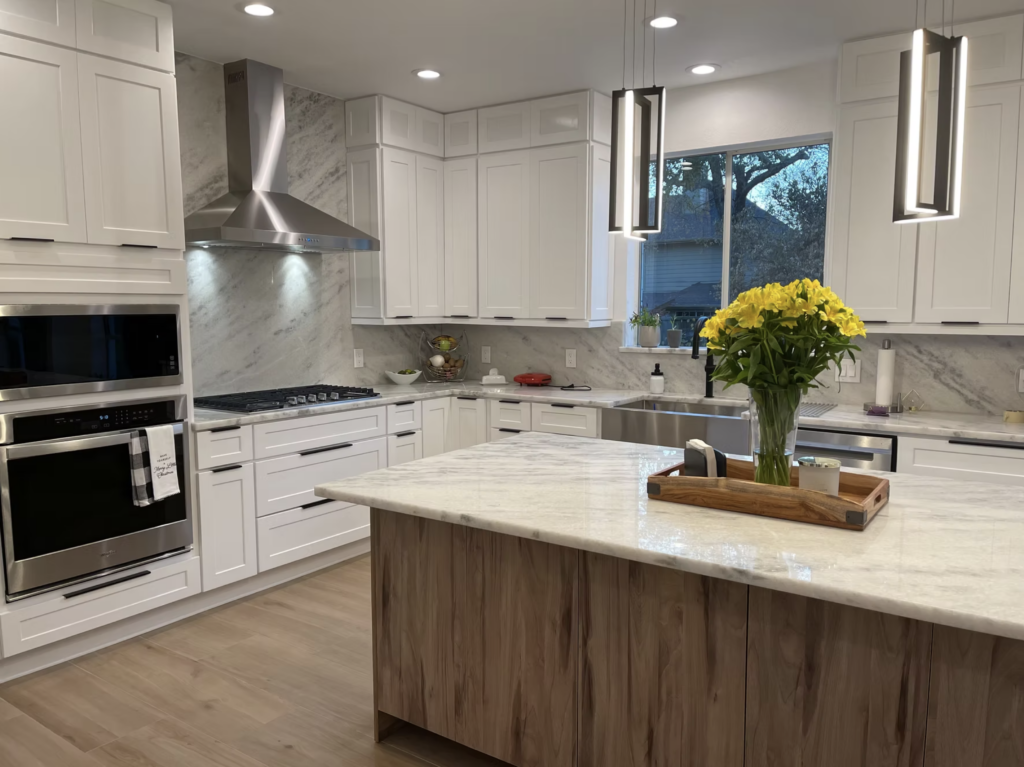
Margie Lackey’s Double Oak remodel story is a useful reference for what the process looks like when the planning is done early. The kitchen wasn’t isolated from the rest of the remodel scope, the cabinet decisions were locked in before demolition, and the appliance specs were finalized before cabinet drawings went to the shop. None of that is dramatic, but it’s the difference between a 10-week kitchen and a 16-week kitchen.
The summary view of pricing tiers, process, and neighborhood patterns is on the Flower Mound kitchen remodeling page. For comparison numbers across DFW, the DFW Kitchen Remodeling Cost Guide puts Flower Mound pricing next to Coppell, Plano, and Irving.
A Flower Mound kitchen remodel can be a $35,000 refresh, an $80,000 full mid-range, or a $150,000+ centerpiece of a whole-home renovation. The right number isn’t the lowest one. It’s the one that matches how the kitchen will actually be used for the next 15 years.