
A bathroom remodel in Plano isn’t a single cost calculation. It’s two, and they rarely land within $15,000 of each other.
A primary bath in a 1990s Willow Bend home was designed around a large deck-mounted tub, an oversized vanity, and a smaller framed shower that doesn’t get used the way it was sold. Updating it usually means rebuilding the wet area, not refinishing it. A hall bath in a 1980s Hunters Glen home was designed for daily traffic, and its remodel turns on whether the existing tub stays or becomes a tiled shower.
Both are bathroom remodels. Both happen on the same street sometimes. The cost difference between them frequently exceeds $15,000 even when the rooms are the same square footage. Understanding why is the difference between a budget that holds and one that doesn’t.
This guide covers the cost mechanics specific to Plano bathrooms: where the money actually goes inside a typical mid-range project, the cost lines that swing hardest, what tends to get under-budgeted, and how to read a written estimate from a Plano contractor without missing the parts that matter most.
Where the Money Goes in a Plano Primary Bath
Most Plano primary bath remodels fall in the $26,000 to $40,000 range. That number is composed of seven or eight line items, and each one has a defensible range you can pressure-test against any written estimate.
For a primary bath built in the 1990s or early 2000s with the typical Plano footprint (around 90 to 130 square feet), the breakdown usually looks like this:
| Line Item | Typical Plano Range |
|---|---|
| Vanity cabinetry (semi-custom, double sink) | $3,500 to $8,500 |
| Vanity countertop (quartz or granite) | $1,500 to $4,500 |
| Shower rebuild (tile, valves, niches, glass) | $7,000 to $14,000 |
| Tub decision (keep, replace, remove, or upgrade to freestanding) | $0 to $8,000 |
| Floor tile and labor | $1,800 to $4,500 |
| Lighting, mirror, and electrical updates | $1,200 to $3,500 |
| Plumbing rough-in changes (if valves or drains move) | $1,500 to $5,000 |
| Demo, dump fees, permits, project management | $2,500 to $5,500 |
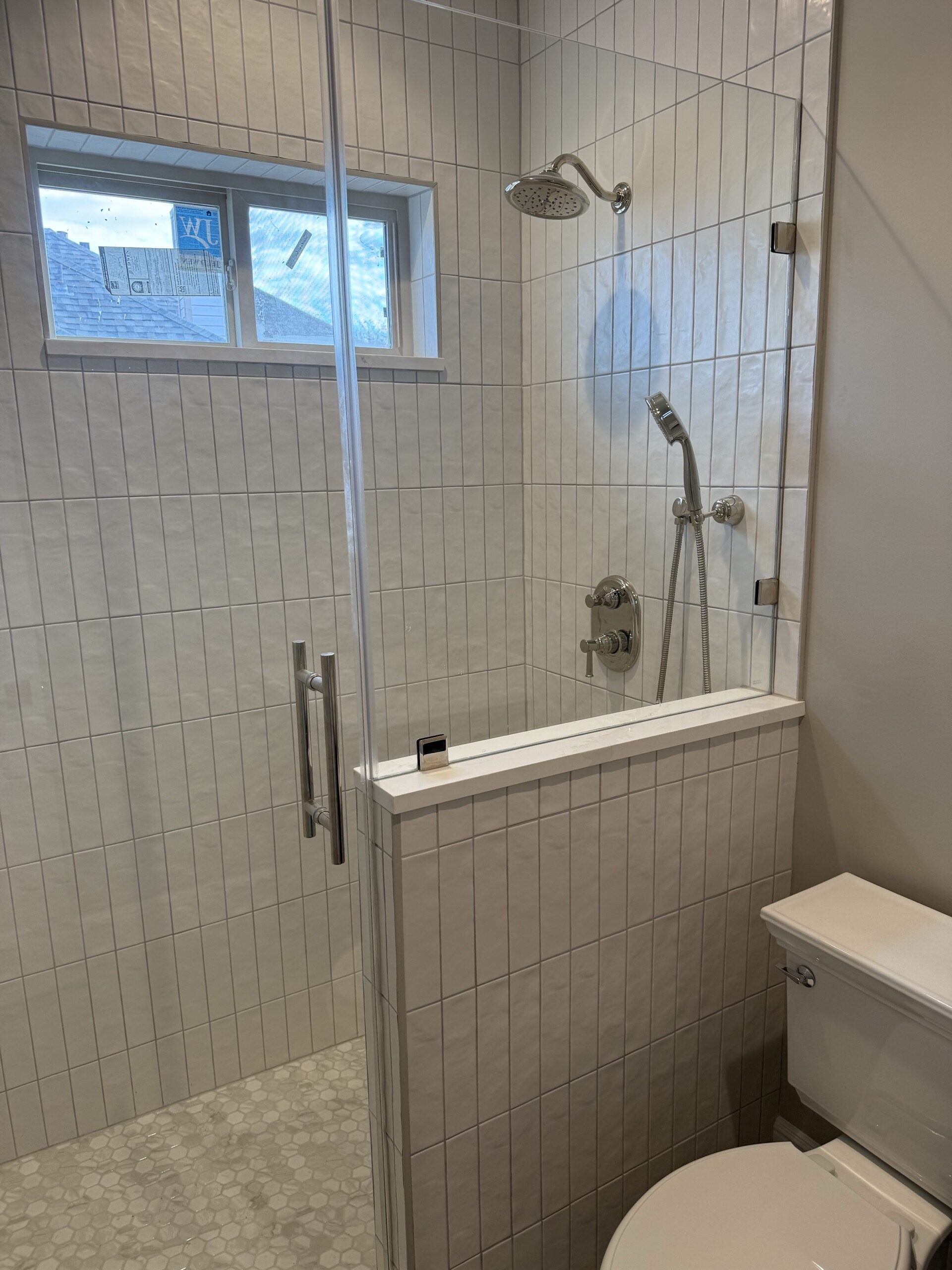
The shower line is where most Plano primary baths gain or lose ground. A 36×60 tile shower with a standard pre-made pan, framed glass, and one niche prices very differently from a 42×72 curbless shower with a Schluter or Wedi waterproofing system, two niches, a tile bench, and frameless glass. That second build can be a $4,000 to $7,000 swing on the shower line alone, and the homeowner often doesn’t see the cost driver because the surface choice (which tile) gets the attention while the substrate choice (which waterproofing system) doesn’t.
The tub line is the second hinge point. Keeping an existing deck-mounted tub costs effectively nothing, but most Plano primary bath remodels don’t keep them. The tub either gets removed entirely to gain shower footprint, replaced with a freestanding tub that requires plumbing relocation, or downsized. Each option has a different downstream effect on tile quantity, drain location, and floor framing.
Why Plano Secondary Baths Price Differently
A hall bath or kid’s bath in Plano usually sits in the $15,000 to $22,000 range when the layout stays intact, and climbs into the mid-$20s when the tub becomes a tiled shower. The cost driver isn’t luxury. It’s durability and the condition of the existing wet area.
In older central Plano neighborhoods, secondary bath remodels frequently uncover problems that the visible surfaces hid: drywall that’s soft behind the tub apron, subfloor that flexes around the toilet flange, a tub drain that’s been slow for years because the trap was never sized correctly, or galvanized supply lines that haven’t been touched since the home was built. None of those show up in a clean walkthrough. All of them show up in the estimate when a contractor scopes the job honestly, because anyone who’s opened a 1980s Plano hall bath knows what’s behind the wall.
The room also has to perform. A secondary bath used by kids and guests sees more daily traffic than most primary baths. Tile choice, grout color, vanity construction, and fan capacity all matter more here than they do in a room one or two people use. A $1,200 vanity that fails in three years is more expensive than a $2,800 vanity that lasts fifteen, but only one of those numbers shows up in the first estimate.
In two-story Plano homes, upstairs hall baths add another cost layer. If there’s any history of leakage through the floor below, the remodel scope usually expands to include framing inspection, joist repair where needed, and waterproofing assemblies that account for the additional load. That work isn’t visible in the finished room, but it’s the difference between a remodel that holds and one that telegraphs the same problems through the ceiling below within five years.
Tub-to-Shower Conversion: The Most Common Plano Upgrade
The single most requested change in Plano bathroom remodels is removing a deck-mounted tub or a tub-shower combo and replacing it with a larger walk-in shower. It’s worth understanding what that conversion actually costs, because it’s the upgrade most often under-quoted by contractors who haven’t done a lot of them.
A full tub-to-shower conversion in Plano typically runs $8,000 to $18,000, with the spread driven by four decisions.
The waterproofing system. A traditional mortar bed with a sheet membrane is the lowest-cost approach. A bonded waterproofing system like Schluter Kerdi or Wedi adds $1,500 to $3,000 but eliminates most of the moisture risk that older Plano tile showers had. In a primary bath, the upgrade is almost always worth it. In a secondary bath, it depends on how long the homeowner plans to stay.
The threshold. A standard 4-inch curb is the default. A low-threshold or curbless shower requires more careful drain slope work, sometimes a recessed pan, and almost always a linear drain instead of a center drain. That’s a $2,000 to $4,000 add, but it changes the look of the room and adds accessibility for long-term ownership.
The glass. Framed shower glass runs roughly $600 to $1,200 installed. Semi-frameless runs $1,200 to $2,000. Frameless tempered glass at 3/8-inch thickness runs $1,800 to $3,500 depending on the opening size and whether the panel needs a notch or angle. Frameless looks better and lasts longer, but the cost difference is real.
The valve and drain location. If the existing tub valve and drain stay where they were, the plumbing work is minimal. If the shower is repositioned or enlarged, the valve usually moves and the drain almost always does, which means opening the slab or floor, running new lines, and re-inspecting. That work adds $1,500 to $4,000 depending on access.
The pattern across most Plano tub-to-shower conversions is that the cost question isn’t whether to do it. It’s how to specify it so the line items reflect the actual decisions instead of a placeholder allowance that grows mid-project.

When Bath Work Is Part of a Larger Plano Remodel
A meaningful share of Plano bathroom work doesn’t happen as a standalone project. Plano remodels tend to run larger than the typical DFW pattern. Recent project values in the city include a $73k Plano renovation, a $118k Plano home remodel, and a $220k Plano home addition, and at those budget tiers bathroom updates often get folded into multi-room scopes rather than commissioned on their own. You can see the broader pattern on our Plano home remodel page.
When a bath is part of a larger remodel, the per-bath cost is usually lower. The general contractor’s mobilization cost is spread across more square footage. Tile, drywall, and plumbing crews are already on site, which reduces scheduling overhead. And the permit timeline runs once for the whole project instead of separately for each room.
But the bath line item still has to be defensible on its own. A primary bath buried inside a larger remodel estimate as “primary bath: $35,000 allowance” isn’t a quote. It’s a placeholder. The same components apply: cabinetry, counters, shower, tub decision, tile, lighting, plumbing, and finish hardware all need to be specified or clearly bracketed. Otherwise the bath becomes the line that absorbs scope creep from the rest of the project.
This matters most when the homeowner is comparing two estimates of different shapes. A standalone bath quote at $32,000 and an “included” bath inside a $120k remodel that allocates $28,000 to the bath aren’t directly comparable until both estimates show the same line items. They often don’t.
What Plano Homeowners Under-Budget For
After enough Plano bathroom projects, the list of things that surprise homeowners gets predictable. None of these are exotic. They’re easy to miss when looking at a clean estimate.
Waterproofing systems. The tile is the part the homeowner picks. The waterproofing is the part that determines whether the tile lasts twenty years or fails at the curb in six. Older Plano showers used hot-mopped pans, which can still work but are no longer standard. Most current builds use a bonded sheet system, and the cost difference between the cheapest acceptable system and a Schluter or Wedi build is $1,500 to $3,000. That’s a real decision, not a line item to skip past.
Shower glass timing. Glass is field-measured after the tile work is complete and the silicone is fully cured. The bathroom usually sits unusable for an additional 7 to 14 days after the tile crew finishes. Most homeowners build their schedule expectations around “tile is done,” which is two weeks early.
Lighting. Builder-grade Plano bath lighting is almost universally undersized. A primary bath with one ceiling fixture and a single mirror light is normal for a 1990s home and inadequate for a modern remodel. Adding sconces, recessed cans, and switched task lighting usually adds $800 to $2,500 in electrical work plus the fixtures themselves.
Ventilation. Older Plano bath fans were specified at 50 CFM or less, which doesn’t clear humidity from a primary bath. Upgrading to a properly sized fan (80 to 110 CFM for most primary baths) is straightforward when the duct run is reusable. When the duct has to be re-routed or the roof penetration relocated, the line jumps from $300 to closer to $1,200.
The cost of being without a bathroom. If the remodel is in the only full bath in the house, the family needs somewhere to use a bathroom during the work. Four to six weeks of partial displacement, restaurant trips, and occasional hotel nights is a real cost that almost never makes it into the construction budget but should be in the household budget.
How to Read a Plano Bathroom Estimate
A useful estimate for a Plano bathroom remodel separates four categories clearly. If your written quote merges them, it’s worth asking for a revision before signing.
Fixed labor costs versus allowances. Labor for demo, framing, drywall, tile install, and plumbing is fixed and quotable up front. Material allowances for vanity, countertop, tile, fixtures, mirrors, and lighting are placeholders until the homeowner makes selections. A good estimate shows both clearly and notes which numbers will firm up after selections are made.
Tile labor versus tile material. These should be two separate lines. Tile material is bought by the square foot. Tile labor is priced by complexity (basic offset, herringbone, large-format, mosaic accents). Bundling them into one number hides the actual cost driver, which is usually the labor on complex tile, not the material itself.
Rough plumbing versus finish plumbing. Rough plumbing is the work in the walls (supply lines, drains, valve bodies). Finish plumbing is the visible fixtures (faucets, showerheads, trim kits, toilet, tub filler). These come from different suppliers, get installed at different times, and have different lead times. An estimate that lists one “plumbing” line is hiding sequence-driven cost.
Glass quoted as TBD. Shower glass is field-measured after tile is set, so a written estimate should reflect that with a clear allowance and a note that final glass pricing is confirmed before fabrication. Estimates that promise a fixed glass number before the tile is in are guessing.
Separately, permits, project management, and disposal should each have their own line. Permits in Plano are processed through Plano Building Inspections at 1520 K Avenue, Suite 140. Most bathroom remodels that touch electrical, plumbing, or mechanical systems require a permit, which covers nearly every project beyond paint and a vanity swap. You can confirm requirements through the city’s residential permits page.
When the estimate separates these categories cleanly, the homeowner can pressure-test each line and have a real conversation about scope before the work starts. When the categories are bundled, the conversation about scope happens during construction, which is the wrong time for it. The cheapest way to control a Plano bathroom budget is to specify it before demo, not to negotiate it after.
For broader pricing context across our service tiers, see our Plano bathroom remodeling page.