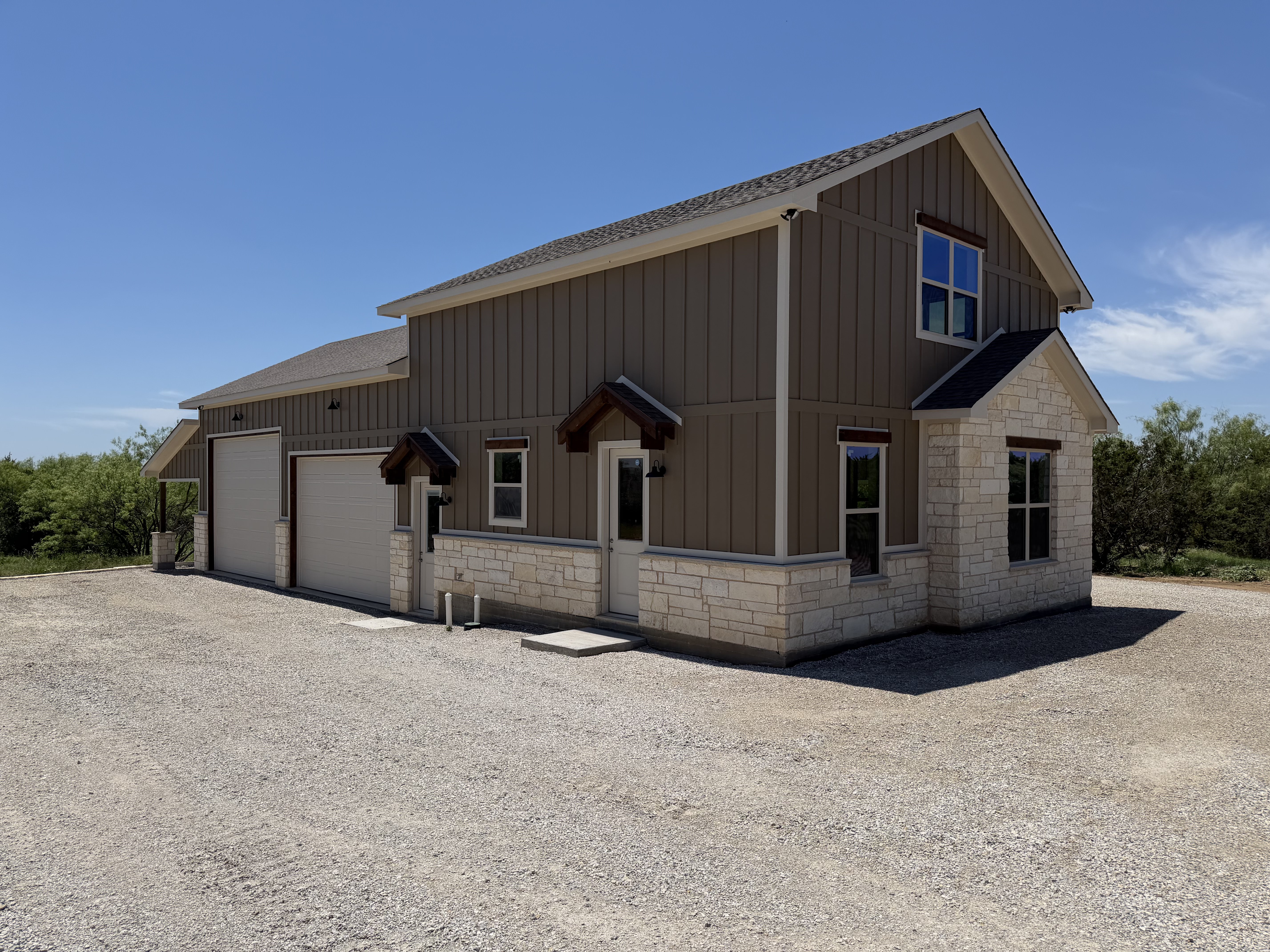
Three Coppell projects from Fin Home’s recent work tell most of the cost story before you read another word. A remodel on Tennyson Place closed at roughly $31,000. A Coppell home addition currently in progress is past $50,000. A whole-home project for a different Coppell homeowner cleared $940,000. Those numbers are not a typical, a low, and a high. They are three different remodels in three different houses, all in the same city, all from the same contractor. Coppell pricing only looks confusing if you start with averages instead of scope.
A mid-range Coppell home remodel of the kind most homeowners are actually planning runs $55,000 to $85,000, which is the range Fin Home publishes on its Coppell home remodeler page. That tier covers two to three connected living areas, full finish replacement across the core of the house, a kitchen or bathroom included in scope, and the permit work that comes with any plumbing, electrical, or HVAC changes. Past that, the cost curve bends steeply, and the reasons it bends are the same in every project: cabinets, walls, and finish reach. This guide explains where the money actually goes when a Coppell remodel is priced honestly, what gets under-budgeted, and how to read a written estimate so the final number is not the surprise.

Where the Money Goes in a Typical Coppell Mid-Range Remodel
For a $65,000 to $80,000 Coppell scope that touches a kitchen plus two adjoining living areas with flooring, paint, lighting, and trim carried through, the cost generally distributes across six categories.
Cabinetry and countertops are the biggest line, usually $18k–$30k combined for semi-custom cabinet boxes, quartz or quartzite surfaces, and a tile backsplash. Flooring and trim across the core living areas runs $8k–$15k depending on material (engineered wood vs. luxury vinyl plank vs. tile transitions). Electrical and plumbing rough-in, including new recessed lighting layouts, dedicated circuits for kitchen appliances, and fixture swaps in connected rooms, lands $6k–$12k. Drywall, paint, and texture for the touched areas comes in around $4k–$8k. Permit fees, inspections, and project management together add another $3k–$6k. Demolition and disposal, often overlooked, runs $2k–$4k.
That leaves a working contingency line that most homeowners forget to ask about. On a Coppell remodel of this size, 8% to 12% of the contract value should be carried as a written allowance for unforeseen conditions: a soft spot under the kitchen floor, a non-code-compliant outlet behind a cabinet, an HVAC supply that needs to be rerouted around a new ceiling soffit. A contingency line on paper does not mean money gets spent. It means the budget does not break the first time the floor comes up.

The Two Cost Decisions That Move the Total More Than Anything Else
Two scope decisions move a Coppell remodel total more than every other decision combined, and they get made in the first three weeks of planning.
The first is the cabinet tier. Stock cabinets (built-to-stock sizes, particleboard boxes, basic hardware) for an average Coppell kitchen run $6k–$12k installed. Semi-custom cabinets (better box construction, more door styles, soft-close hardware, some modified sizes) run $14k–$25k for the same kitchen. Fully custom cabinetry, built to the exact dimensions of the room with hardwood boxes and inset doors, runs $30k–$60k+ for a similar footprint. That is a roughly $50k swing on a single line item, and it is the single biggest reason two Coppell kitchens that look similar from the doorway can be priced $35k apart.
The second is structural work. Removing a wall between a Coppell kitchen and the adjacent family room sounds straightforward until the wall is opened. If it is non-load-bearing, the removal and the patching of floor, ceiling, and adjacent cabinets typically adds $3k–$8k to the project. If it is load-bearing, the project picks up a structural engineer’s stamp ($800–$2,500), a beam (often LVL or steel, $1,500–$5,000 for materials), framing labor ($2k–$5k), and ceiling and floor repair on both sides ($2k–$5k). The total swing for opening a load-bearing wall versus leaving it in place is usually $8k–$20k, and the decision rarely shows up cleanly on the first estimate because it depends on inspection findings.
These two decisions are also why a $75,000 budget can deliver a finished, cohesive Coppell remodel or fall $20,000 short of one, depending on the choices made before the contract is signed.

What Coppell Homeowners Under-Budget For
Three categories get under-budgeted on almost every Coppell remodel that goes over scope.
The first is lighting. Homeowners price the fixtures (chandeliers, pendants, can lights, vanity sconces) and forget the labor and electrical changes needed to install them where they belong. A retrofitted lighting layout in an older Coppell home (drilling new locations, running new switch legs, adding dimmers, possibly upgrading the panel) routinely adds $3k–$8k beyond the fixtures themselves. The fixtures are the visible cost. The electrical work to make them land in the right ceilings is the invisible one.
The second is appliances. A new range, dishwasher, fridge, microwave, and vent hood at builder-grade pricing comes in around $4k–$6k. At a mid-range package (counter-depth fridge, induction or gas range with a real hood, a quieter dishwasher), the number doubles to $8k–$12k. At the upper end (panel-ready fridge, professional-grade range, built-in coffee), the package can clear $25k for the appliances alone. If the kitchen scope is being designed with custom cabinetry, the cabinetry assumes appliance dimensions that often push the appliance budget upward by default.
The third is what trade contractors call “finish creep.” Once the floors are down and the cabinets are in, the existing baseboards, doors, hardware, switch plates, and HVAC vents that were going to stay suddenly look wrong against the new work. Replacing them mid-project costs more than including them in the original scope. A $1,800 baseboard scope at the start becomes a $3,500 scope when it gets added in week six.

How to Read a Contractor Estimate Line by Line
A written remodel estimate in Coppell should make four things visible: what is included in each line, what is carried as an allowance, what is excluded entirely, and what triggers a change order. Most disputes between homeowners and contractors trace back to the second and third categories.
Allowances are a placeholder dollar figure for items the homeowner has not yet selected. A $4,500 plumbing fixture allowance means the estimate assumes that amount for the kitchen faucet, two bathroom faucets, a toilet, and a shower system. If the homeowner selects fixtures totaling $6,200 during the design phase, the contract goes up by $1,700, not by surprise but by the original terms of the agreement. Allowances are not lowball pricing. They are honest placeholders for decisions that have not been made yet. A homeowner who reads an estimate and does not see allowance lines for cabinets, countertops, flooring, plumbing fixtures, lighting, and appliances is probably reading an estimate that will grow during construction.
Exclusions matter just as much. A clear Coppell estimate names what is not included: appliance haul-away, window treatments, HVAC duct modifications outside the scoped rooms, foundation repair, exterior paint touch-up after window replacement. The exclusion line is the contractor saying these are real costs that may come up, but they are not part of this contract. A homeowner who notices excluded items early can decide whether to add them to scope, handle them separately, or accept that they will come up later.
Change orders are the mechanism for adjusting scope after work has started. A good Coppell contractor writes a change order for any scope addition over a defined threshold (often $250 or $500), gets the homeowner’s written approval, and adjusts the schedule accordingly. A project without written change orders is not less expensive. It is just less documented.

The Old Coppell Historic District Adds Real Steps (and Real Cost)
Old Coppell, the original town site clustered around the intersection of Bethel Road and South Coppell Road, has been a designated historic district since the mid-2000s. Properties inside the overlay are subject to design guidelines that affect any visible exterior change: front elevation modifications, window and door replacement, roof material changes, additions visible from the street, and exterior color decisions. The guidelines do not prevent remodels. They add review steps and material constraints that have real cost implications.
For an interior-only remodel of an Old Coppell home, the historic overlay typically adds nothing to scope or budget. The walls, kitchens, baths, and flooring inside the house are not the city’s concern. For a remodel that includes exterior work, the overlay adds two to six weeks of design and review time, requires materials that match or complement the period character of the original structure, and sometimes adds $5k–$15k to the project for higher-grade exterior materials (real wood windows instead of vinyl, dimensional shingles instead of three-tab, traditional siding profiles instead of modern). The cost is rarely catastrophic. The schedule impact is more meaningful, and it should be priced into the project’s start date rather than discovered after demolition.
Outside Old Coppell, the broader HOA review process for visible exterior changes (door replacements, paint, roof, additions) applies in most established subdivisions. Coppell’s residential permits are processed at Coppell Building Inspections, 255 E. Parkway Blvd., and inspections are scheduled online through the CSS portal or by email. Submission timing rarely surprises a homeowner who is informed up front. It almost always surprises one who is not.

The High End of What Fin Home Does in Coppell
Fin Home’s Coppell book includes a whole-home project that closed at over $940,000 in contract value. That number is not a typical remodel and should not be used as a benchmark for one. A homeowner planning a $75k kitchen-and-living-area scope is not in the same project class as a homeowner gut-renovating a 5,000+ square foot home with custom cabinetry, structural reconfiguration, premium finishes throughout, and a full mechanical replacement.
The reason the number matters at all is that it shows what the firm can scale to. The same project manager, subcontractor base, and quality-control process that runs a $31,000 Tennyson Place remodel is the one running the $940,000 whole-home project. For most Coppell homeowners that means very little. For the smaller subset planning a top-of-market project, it means a local DFW general contractor can deliver a six-figure-plus scope without subbing the project out to a national luxury builder.
Most Coppell homeowners will never see this tier. The mid-range $55k–$85k bracket remains where the bulk of Fin Home’s Coppell home remodel work sits, and that range is the realistic planning band for a typical project. The $940k figure is mentioned here so that a homeowner planning at the upper end knows the capability exists, not so anyone planning a typical remodel is shopping against the wrong number.

Phased Remodels vs. All-at-Once: The Math
A phased remodel splits one large project into two or three smaller projects done over 18 to 36 months. The argument for phasing is cash flow: a $120k whole-house scope becomes a $45k kitchen this year, a $35k primary bath next year, and a $40k flooring-and-paint refresh the year after. The argument against phasing is that the same work in pieces almost always costs more in total.
The cost premium on phased work in Coppell typically runs 15% to 25%. The drivers are predictable. Mobilization charges (the cost of bringing a crew, materials, and dumpsters to the site) get paid three times instead of once. Demolition that could have been done once is done in two or three passes. Trade contractors charge minimum visit fees on small scopes that they waive on large ones. Material orders below truckload pricing carry per-item premiums. And the design work, which can be done once for a unified plan, gets revisited each phase as the kitchen choices are reconciled with bath choices made a year later.
For a homeowner who cannot finance the full scope at once, phasing is a reasonable trade-off. For a homeowner who can finance the full scope and is phasing only because it feels lower-risk, the math usually favors doing it once. A coordinated estimate from a single contractor for the full scope, with a phased construction schedule and a clear written sequence, often costs less than three sequential contracts. The 5% to 15% the homeowner sometimes saves by writing one contract instead of three pays for the contingency line described earlier.
A nearby example: Daniel Czyz, a Fin Home client in Grapevine, describes the value of running one coordinated scope rather than chasing finish work room by room. Grapevine is not Coppell, but the geographic adjacency and similar housing stock make the comparison useful for any Coppell homeowner weighing the trade.

Putting the Numbers Together
The honest framing for a Coppell home remodel in 2026 is that the typical project sits in the $55k–$85k range, the lower bound starts around $30,000 for a single-room or finish-only scope, and the upper end of what Fin Home executes in the city has cleared $940,000 for a whole-home build-out. The number a homeowner ends up paying depends less on the city and more on three specific choices: cabinet tier, structural scope, and whether the remodel touches the exterior of an Old Coppell historic property. Those three decisions, made in planning, determine roughly 70% of the final cost. The rest is finish selection, allowance discipline, and contingency planning. A Coppell remodel goes over budget when those decisions get pushed into construction. It comes in on budget when they get made on paper, in writing, before demo starts.