
Why a Dallas Remodel Budget Can Range From $60k to Over $200k for the Same Square Footage
Three of the most useful budget reference points in our recent Dallas project history fall in a single band: a $134k whole-home remodel, a $104k renovation that’s now public on Fin Home’s site through Clay’s story, and an $89k mid-scope project that ran tight to plan. None of these were unusual in their finishes. All three would read as “comparable” on a real estate listing. The difference between them came down to four variables that don’t show up in a price-per-square-foot calculation: the age of the existing systems, whether the layout was being changed, what got demolished versus replaced, and whether the house sat in a district that adds review time.
Dallas is the city in our DFW footprint where these variables spread the cost the most. A 1930s Lakewood bungalow and a 1990s ranch in Far North Dallas can both be 2,200 square feet. They will not cost the same to remodel. Sometimes the older home costs more. Sometimes the newer home does, because the layout change is larger.
This guide walks through the cost ranges we actually see in Dallas, the line items homeowners tend to underestimate, and the trade-off between phasing the work versus doing it in one pass. For the summary view of pricing tiers and the neighborhoods we work in most often, the Dallas home remodeler page covers that ground. This guide goes deeper on the cost structure underneath those tiers.
Three Real Dallas Projects, Same Mid-Range Band
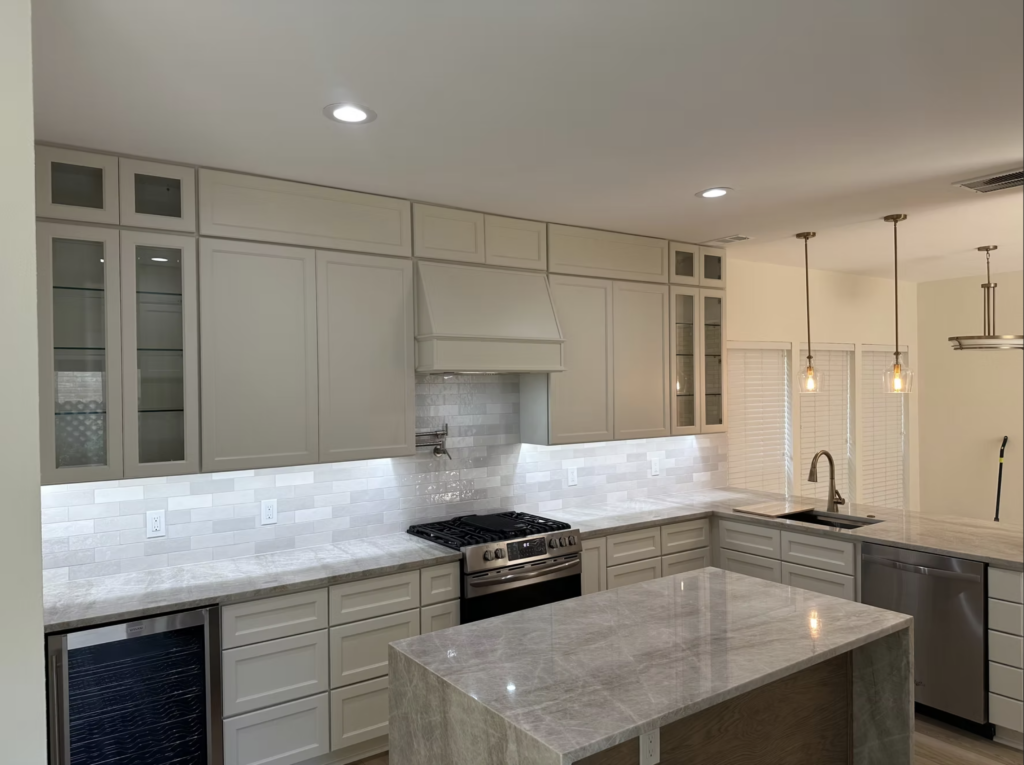
To make the cost discussion concrete, here are three Dallas remodels that landed within roughly $45k of each other on paper but had very different scopes underneath:
| Project | Final cost | What drove the budget |
|---|---|---|
| An East Dallas whole-home remodel | $134k | Multiple connected rooms, layout adjustments, full-finish replacement across the main level |
| Clay Young’s Dallas remodel | $104k | Coordinated room-by-room updates with full finish replacement (see Clay’s full story) |
| A mid-scope Dallas renovation | $89k | Disciplined scope: finish-tier work across main rooms with one focused reconfiguration |
The lesson from these three is that “mid-range Dallas remodel” is a band, not a number. The $89k project finished close to plan because the scope was disciplined. The $104k project carried more weight on cabinetry and finishes. The $134k project crossed into territory where the layout itself was changing, which means framing, electrical, and HVAC followed the new plan rather than the old one.
When a homeowner asks what a typical Dallas remodel costs, the honest answer is that the typical number depends on which of these three patterns the project most resembles. A homeowner planning their first remodel will often anchor on the lowest of the three and then drift toward the highest as scope decisions get made in real time. The estimate they sign and the check they write at the end are two different documents if those decisions aren’t made in the planning phase.
Where Era of Construction Changes the Cost Math
Dallas housing stock spans almost a century of construction, and the cost of remodeling a home shifts significantly depending on the decade the house was built.
Pre-1960s homes (Lakewood, M Streets, Junius Heights, Munger Place)
These are the homes that look the best on a real estate listing and surprise homeowners the most after demo. Pier-and-beam foundations, original galvanized or cast-iron plumbing, knob-and-tube remnants behind newer walls, plaster instead of drywall in some rooms, and previous additions that didn’t follow current code all become budget items the moment the walls open. The pattern we see most often: a homeowner budgets for a kitchen and main-floor refresh, demo exposes a plumbing run that needs replacement, and the project picks up $8k to $15k in plumbing before any cabinets arrive.
Several pockets of East Dallas sit inside city-recognized historic or conservation districts, which add review requirements for exterior changes. We verify which overlay applies before any exterior scope is locked in. Inside those overlays, window replacement, siding, roofline changes, and additions require additional review that can add 4 to 12 weeks to the schedule before construction starts. That’s a real cost driver, both in carrying costs (insurance, financing, temporary housing if the project is unoccupied) and in lost momentum.
1960s through 1980s homes (Lake Highlands, Casa Linda, parts of Preston Hollow)
These homes have practical square footage but were built for a different way of living. Closed kitchens, sunken living rooms, paneled studies, and bathrooms cut into small footprints are the recurring problems. Mechanical systems from this era are usually approaching the end of their service life, which means an HVAC system that worked fine before demo may not be the right system for a renovated open layout. We see HVAC upgrades land in the $10k to $25k range on these projects, often as a mid-project decision rather than an original scope item.
1990s and newer (Far North Dallas, North Dallas custom pockets)
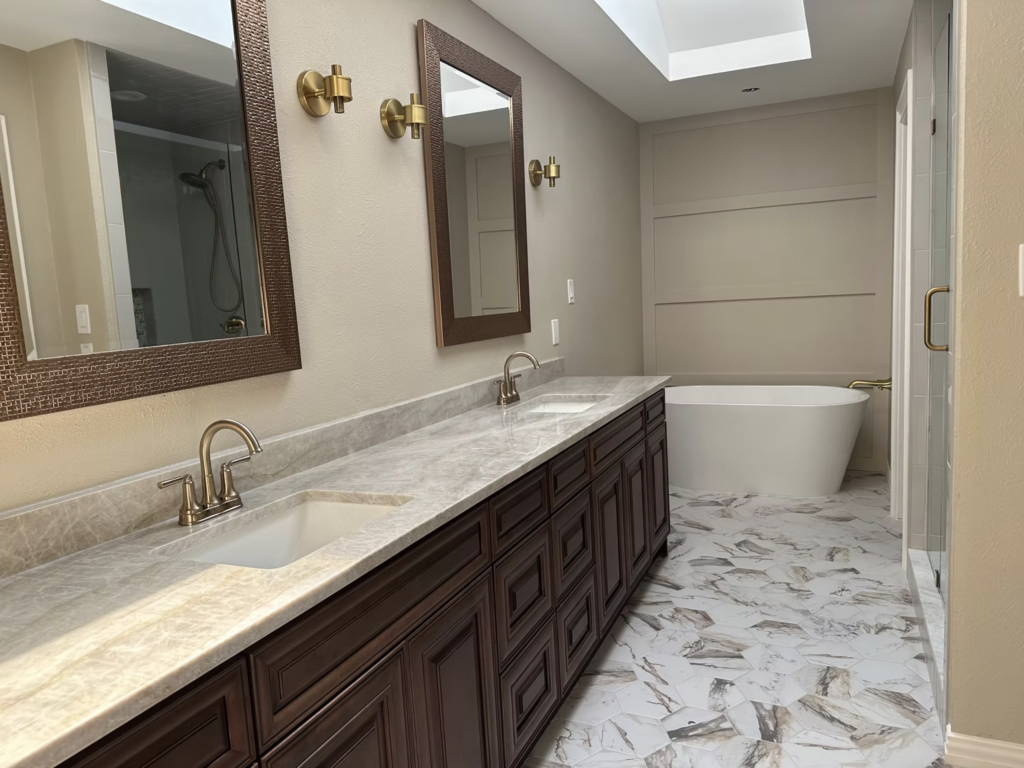
Cost drivers here shift toward layout ambition and finish tier. Mechanical systems are usually sound. The remodel is rarely about fixing the house. It’s about replacing builder-grade finishes with custom selections and reworking floor plans for current use. Custom cabinetry alone can swing the budget by $15k to $40k versus semi-custom, and that’s just on one line item.
Phased Versus All-at-Once: The Real Cost Difference
Homeowners considering a whole-home remodel often ask whether it would be cheaper to do the work in two or three phases. The honest answer is that phasing usually costs more in total but is sometimes the right financial choice anyway.
Phasing costs more because of three structural items. Each phase carries its own mobilization (crews, equipment, dust containment, port-a-johns, permit applications), which is roughly $3k to $8k per mobilization on a Dallas project. Each phase has its own permit cycle through Dallas Permitting & Inspections, which means duplicated drawings and inspection runs for related work. And material prices move. A cabinet line quoted in spring 2026 will not be priced the same in spring 2027, and we have seen 6% to 12% material increases between project phases on Dallas jobs over the past several years.
Where phasing makes sense: when financing the whole project at once would force a homeowner into worse credit terms, when the family genuinely cannot be displaced for the duration of a full remodel, or when one zone of the house (typically the primary suite) needs to stay operational while everything else gets touched. In those cases, the right approach isn’t to split the budget evenly across phases. It’s to put all the disruptive work in phase one (anything involving plumbing rough-ins, HVAC, electrical panel changes, structural framing) and leave only finish-tier work for phase two. That keeps the mobilization premium contained to one phase instead of two.
All-at-once costs less in total but front-loads the disruption. For occupied Dallas remodels above $90k, we typically recommend a 6-to-12-week window where the family relocates to a short-term rental for the most disruptive stretch of the project. That cost (usually $4k to $12k depending on the rental) should be in the original budget. It almost never is in the homeowner’s first draft.
What Dallas Homeowners Under-Budget For
The line items that surprise homeowners most often on Dallas remodels are not the ones in the headlines. Cabinets, countertops, and appliances are visible in showrooms and get planned for. The items below are the ones we see omitted from initial budgets and added back during the project.
Structural engineering and load-bearing wall removal. If the remodel touches any wall that supports floor or roof structure, the project needs an engineer’s stamp on the new beam design. Engineering fees run $1,500 to $4,000. The beam itself, plus framing modifications and column locations, adds $5,000 to $20,000 depending on the span. None of this is usually in a homeowner’s initial mental budget.
Electrical panel and service upgrades. Many pre-1990s Dallas homes have 100-amp panels that were adequate for the original load but cannot support a renovated kitchen with a new range, double oven, induction cooktop, or expanded lighting circuits. A service upgrade to 200 amps runs $3,500 to $7,500 in most Dallas situations, and the trigger is often discovered mid-project.
Flooring continuity. Replacing the kitchen floor exposes a transition problem with the adjacent hallway, which exposes a transition problem with the living room, which means the homeowner either accepts a visible seam where there wasn’t one before or extends the flooring scope. The honest version of this conversation needs to happen during planning, not after the kitchen subfloor is exposed. Continuous hardwood across 1,200 to 1,800 square feet of connected living space adds $12,000 to $30,000 depending on material.
Temporary kitchens and bathroom rotation. On an occupied Dallas remodel, the family needs at least one functional bathroom and some version of a working kitchen throughout the project. Setting up a temporary kitchen in a garage or dining room with a microwave, mini-fridge, induction burner, and folding table is not free, and the cost of eating out more often during construction is real. Plan on $400 to $900 a month in elevated food and household costs during an active whole-home project.
Project contingency. A Dallas remodel on a pre-1980s home should carry a 10% to 15% contingency for items discovered after demo. A remodel on a newer home can run 5% to 8%. If a bid has no contingency line and the contractor says they will figure it out as the project goes, the contingency exists. It just isn’t disclosed. That’s where change orders come from.
Post-construction items. Window treatments, professional cleaning, furniture refinement to match the new finish level, and small punch-list items the homeowner finishes themselves. These usually add 3% to 8% to the total project cost and almost never appear in the original budget.
What This Means for a 2026 Dallas Remodel
A Dallas home remodel in 2026 is best planned around the actual house rather than a per-square-foot benchmark. The three projects referenced above ($89k, $104k, $134k) sit in the band where most of our Dallas mid-range work lands. Smaller cosmetic refreshes start around $25k to $38k. Whole-home renovations with layout changes, exterior work, or significant mechanical updates regularly land between $150k and $250k or higher depending on house size and finish tier.
The homeowners who finish on budget tend to share three habits. They decide the scope before they sign the contract, not during demo. They build a contingency into the budget rather than into a separate emotional bucket. And they prioritize structural and mechanical work in the planning phase so that finishes go on top of a settled house, not a half-resolved one. Clay’s experience working through his Dallas remodel covers part of this from the homeowner side, and his Fin Home story is worth reading if you’re trying to picture what the process feels like from start to finish.